In medical billing, claim denials are a routine challenge—but understanding why a claim was denied is the key to fixing it efficiently. One such denial is Code 236, which indicates that a procedure or procedure/modifier combination is incompatible with another service billed on the same day.
This denial is commonly linked to National Correct Coding Initiative (NCCI) edits or payer-specific rules, including workers’ compensation fee schedules. If not handled correctly, it can lead to revenue loss or unnecessary delays.
In this article, we’ll break down what Denial Code 236 means, why it happens, and how to resolve it effectively—even if you’re new to medical billing.
What is Denial Code 236?
Denial Code 236 means:
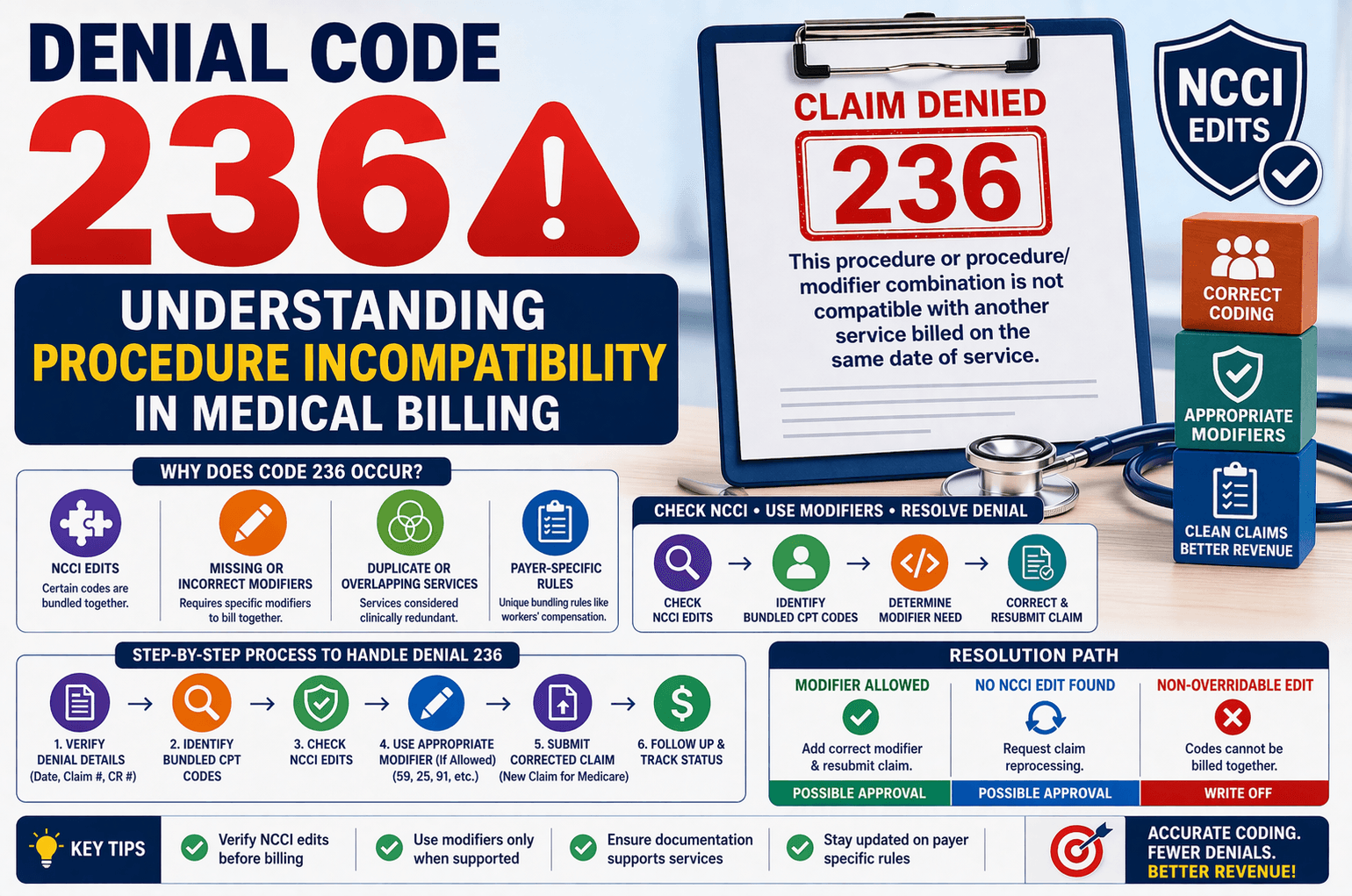
“This procedure or procedure/modifier combination is not compatible with another procedure or procedure/modifier combination billed on the same date of service.”
In simple terms:
The insurance payer believes that two procedures billed together should not be reported together—or they require a specific modifier to justify billing both.
Why Does Denial Code 236 Occur?
This denial is primarily driven by coding rules designed to prevent duplicate or unnecessary billing.
Common Causes
NCCI Edits
Certain CPT codes are bundled together because one is considered part of the other.
Missing or Incorrect Modifiers
Some procedures can be billed together—but only with appropriate modifiers (e.g., modifier 59, 25, etc.).
Duplicate or Overlapping Services
Two services may be seen as clinically redundant.
Payer-Specific Rules
Workers’ compensation or commercial payers may have unique bundling rules.
Step-by-Step Process to Handle Denial 236
When you encounter this denial, follow a structured approach to resolve it.
- Verify Denial Details
Start by gathering essential information:
Denial date
Claim number
Call reference number
Affected CPT codes - Identify the Bundled CPT Codes
Ask:
Which CPT code is being denied?
Which CPT code is it bundled with?
This helps determine whether the denial is valid. - Check NCCI Edits
Use coding tools such as:
Encoder software
Find-A-Code
NCCI edit tables
These tools help you identify:
Whether an NCCI edit exists
If the edit is modifier-allowed or non-modifier-allowed - Determine If a Modifier Can Be Used
If the edit allows a modifier, apply the correct one.
Common Modifiers Used:
Modifier 59 – Distinct procedural service
Modifier 25 – Significant, separately identifiable E/M service
Modifier 91 – Repeat lab test
Always confirm with documentation before applying any modifier.
- Send to Coding Team
If unsure, escalate to the coding team with:
CPT codes involved
Denial reason
Supporting documentation
They will confirm whether:
A modifier is needed
The coding is correct
The charge should be written off - Take Correct Action Based on Findings
Scenario A: Modifier Required
Update the claim with the correct modifier
Submit a corrected claim
For Medicare: submit as a new claim, not corrected
Scenario B: No NCCI Edit Exists
Contact the insurance payer
Request claim reprocessing
If denied again, file an appeal
Scenario C: Non-Overridable Edit
The services cannot be billed together
Write off the denied amount
- Know Filing Limits
Always confirm:
Time limit for corrected claims
Appeal deadlines
Submission method (fax or mailing address)
Missing deadlines can result in permanent revenue loss.
Practical Example
Scenario:
A provider bills:
CPT 11042 (wound debridement)
CPT 97597 (wound care management)
Outcome:
Insurance denies one code under Denial 236.
Resolution:
Check NCCI edits → these codes may be bundled
If modifier allowed → append modifier 59
Resubmit claim
Key Tips to Prevent Denial Code 236
Always verify NCCI edits before claim submission
Use appropriate modifiers only when justified
Ensure documentation supports separate services
Stay updated on payer-specific billing rules
Train billing staff on coding guidelines
Use coding tools proactively
FAQs
- Can all NCCI edits be overridden with a modifier?
No. Some edits are non-modifier-allowed, meaning they cannot be billed together under any circumstance. - What is the most commonly used modifier for Denial 236?
Modifier 59 is the most frequently used, but it must be supported by documentation. - Should I always resubmit a corrected claim?
Only if a modifier correction is needed. Otherwise, request reprocessing or file an appeal. - Does Medicare accept corrected claims?
No. Medicare requires submission of a new claim instead of a corrected one. - What if the coding is already correct?
Contact the payer and request reprocessing. If they still deny, proceed with an appeal.
Conclusion:
Denial Code 236 may seem complex at first, but it becomes manageable once you understand the role of NCCI edits and modifiers. The key is to carefully review CPT combinations, validate coding accuracy, and apply the correct resolution path.
By following a structured workflow—verifying edits, consulting coding teams, and using appropriate modifiers—you can significantly reduce denials and improve reimbursement outcomes.
Mastering this denial not only boosts revenue cycle efficiency but also strengthens your overall medical billing expertise.