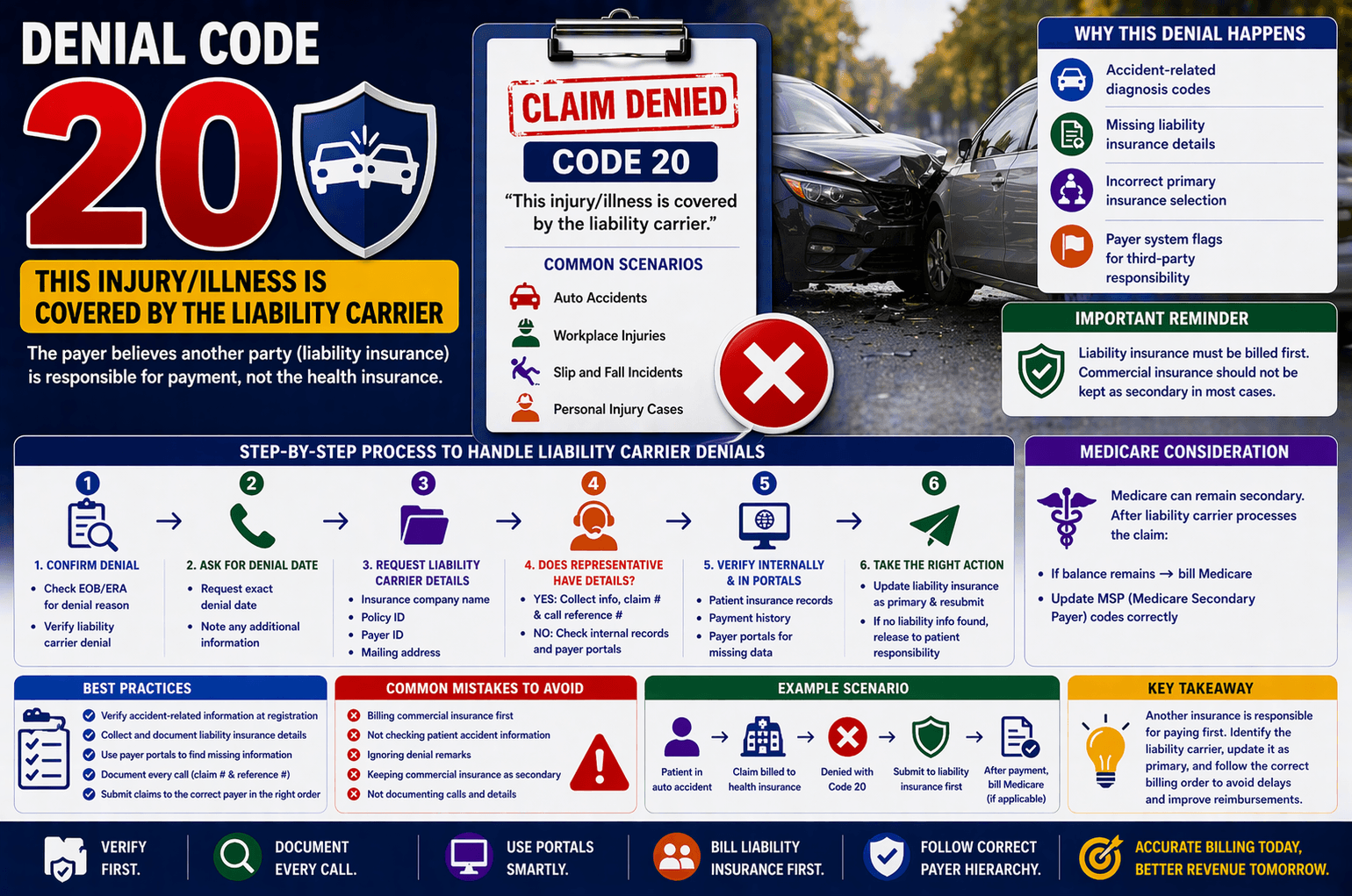
In medical billing, claim denials are common—but each denial comes with a reason that needs careful handling. One such denial is: “This injury/illness is covered by the liability carrier.”
If you’re new to healthcare revenue cycle management (RCM), this message might seem confusing. However, it simply means that another party—usually an insurance linked to an accident or injury—is responsible for paying the claim, not the standard health insurance.
This guide breaks down everything you need to know about liability carrier denials, how to handle them step-by-step, and how to prevent revenue delays.
What Does “Covered by Liability Carrier” Mean?
A liability carrier is an insurance provider responsible for covering medical expenses resulting from accidents or third-party injuries.
Common scenarios include:
Auto accidents
Workplace injuries
Slip and fall incidents
Personal injury cases
When a claim is denied for this reason, it means:
The payer believes another insurance (liability insurance) should be billed first.
Why Do These Denials Occur?
Understanding the root cause helps resolve the issue faster.
Key reasons:
Accident-related diagnosis codes on the claim
Missing liability insurance details
Incorrect primary insurance selection
Payer system flags indicating third-party responsibility
Example:
If a patient visits the hospital after a car accident, their auto insurance (liability carrier) should be billed before their regular health insurance.
Step-by-Step Process to Handle Liability Carrier Denials
Handling these denials requires a structured approach. Here’s how experienced billing professionals resolve them.
- Confirm the Denial
Start by verifying the denial reason:
Check the Explanation of Benefits (EOB) or Electronic Remittance Advice (ERA)
Look for statements indicating liability involvement - Ask for the Denial Date
Contact the payer and request:
Exact denial date
Any additional notes related to the denial
This helps maintain proper documentation and follow-up timelines. - Request Liability Carrier Details
You need complete information about the responsible insurance.
Ask for:
Insurance company name
Policy ID
Payer ID
Mailing address
Without these, you cannot proceed with resubmission. - Check if the Representative Has the Details
At this stage, there are two possible scenarios:
✔ If the Representative HAS Details:
Collect all liability insurance information
Ask for:
Claim number
Call reference number (for documentation)
❌ If the Representative DOES NOT Have Details:
Take the following actions:
Check your internal system:
Patient insurance records
Payment history
Look for:
Any liability insurance listed as primary
Use payer portals (if accessible) to find missing data
What to Do After Gathering Information
Once you have clarity, the next step depends on whether liability details are available.
Scenario 1: Liability Insurance Found
Update the liability carrier as primary insurance
Resubmit the claim to the liability payer
Ensure:
Commercial insurance is not kept as secondary
Keep proper documentation of submission
Scenario 2: No Liability Information Available
If all efforts fail:
Release the claim to the patient responsibility
Inform the patient (if required)
Document attempts made to retrieve liability details
Special Case: Medicare as Secondary Insurance
Medicare follows specific coordination of benefits rules.
Important guidelines:
Medicare can remain secondary
After billing the liability carrier:
If balance remains → bill Medicare
Update:
MSP (Medicare Secondary Payer) codes correctly
Key Tips to Handle Liability Denials Efficiently
To streamline your workflow and reduce errors, follow these best practices:
Always verify accident-related information
Check patient intake forms carefully
Document every call
Record claim number and reference ID
Use payer portals effectively
They often provide missing insurance details
Never assume primary insurance
Confirm before resubmission
Avoid keeping commercial insurance as secondary
This is a common mistake that leads to repeated denials
Practical Example
Let’s simplify with a real-world scenario:
Situation:
A patient visits after a workplace injury.
What happens:
Claim submitted to commercial insurance → Denied
Reason: Covered by liability carrier (Workers’ Compensation)
Resolution:
Contact payer → Confirm denial
Get Workers’ Compensation details
Update insurance as primary
Resubmit claim
Frequently Asked Questions (FAQs)
- What is a liability carrier in medical billing?
A liability carrier is an insurance company responsible for paying medical expenses related to accidents or injuries caused by a third party. - Can I bill secondary insurance without billing the liability carrier?
No. The liability carrier must always be billed first before any secondary insurance. - What if no liability insurance information is available?
If all efforts fail to locate it, the claim can be transferred to patient responsibility. - Why shouldn’t commercial insurance be kept as secondary?
Because liability insurance takes priority. Keeping commercial insurance as secondary can lead to repeated denials. - When should Medicare be billed?
After the liability carrier processes the claim and leaves a balance, Medicare can be billed as secondary—provided MSP codes are updated correctly.
Conclusion:
Liability carrier denials may seem complicated at first, but with a structured approach, they are manageable. The key is understanding that another insurance is responsible and taking the right steps to identify and bill that payer.
By:
Verifying denial details
Gathering complete liability information
Updating insurance correctly
Following proper resubmission protocols
—you can reduce claim delays and improve reimbursement efficiency.
Mastering this process is essential for anyone working in medical billing, as it directly impacts revenue flow and claim accuracy.