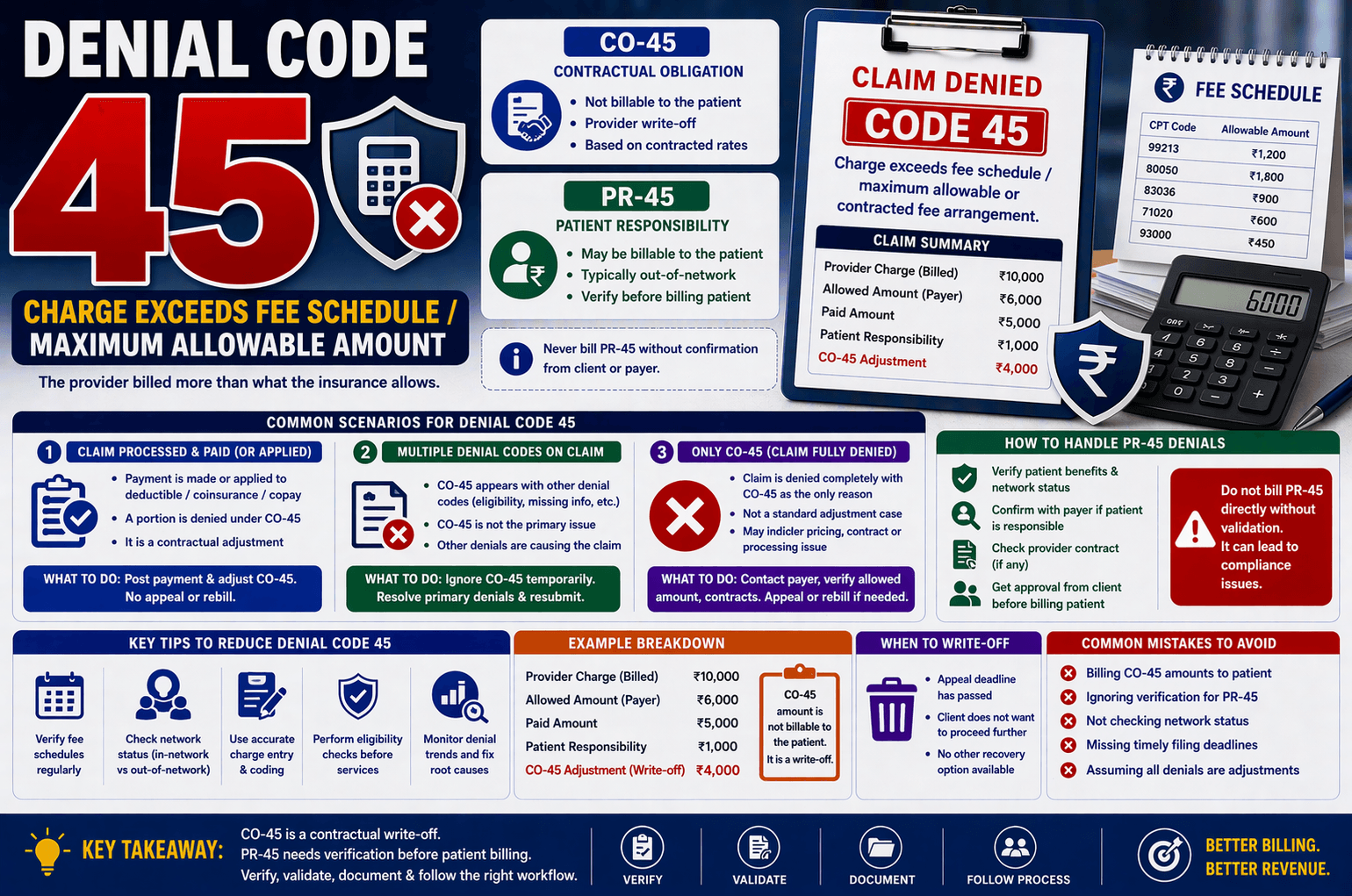
In medical billing and revenue cycle management (RCM), denial codes are a common challenge. One of the most frequently encountered denial codes is Denial Code 45, which indicates that the charged amount exceeds the allowable fee schedule set by the payer.
For beginners, this can be confusing—why would a claim be partially denied even when services were correctly billed? The answer lies in how insurance companies determine payable amounts.
This article breaks down Denial Code 45 (CO-45 and PR-45) in simple terms, explains common scenarios, and provides step-by-step guidance on how to handle it efficiently.
What is Denial Code 45?
Denial Code 45 means:
“Charge exceeds fee schedule / maximum allowable or contracted/legislated fee arrangement.”
In simple words:
The provider billed more than what the insurance company allows for a specific procedure (CPT code). The payer will only reimburse up to their allowed amount, and the rest is typically adjusted.
Understanding CO-45 vs PR-45
- CO-45 (Contractual Obligation)
The denied amount is not billable to the patient
It is considered a provider write-off
Based on contracted rates with the payer
Example:
Provider charges ₹5,000 for a procedure, but insurance allows only ₹3,500 → ₹1,500 becomes CO-45 adjustment.
- PR-45 (Patient Responsibility)
The denied amount may fall under patient responsibility
Usually occurs when the provider is out-of-network
Requires verification before billing the patient
Important: Never bill PR-45 directly without confirmation from the client or payer.
What is a Fee Schedule?
A fee schedule is a list created by insurance companies that defines how much they will pay for each service or CPT code.
It varies by payer
It depends on contracts, location, and provider network status
Providers agree to these rates when they sign contracts
Common Scenarios for Denial Code 45
Scenario 1: Claim Processed and Paid (or Applied to Patient Responsibility)
What Happens:
The claim is processed successfully
Payment is made or applied to deductible/coinsurance/copay
A portion is denied under CO-45
What It Means:
The denied amount is a contractual adjustment
No further action is required in most cases
What You Should Do:
Post the payment correctly
Adjust the CO-45 amount (if authorized)
Do not appeal or rebill
This is the most straightforward scenario.
Scenario 2: Multiple Denial Codes on the Same Claim
What Happens:
The claim includes CO-45 along with other denial codes (e.g., missing information, eligibility issues)
What It Means:
CO-45 is not the primary issue
Other denials are causing the claim to fail
What You Should Do:
Ignore CO-45 temporarily
Focus on resolving the primary denial codes
Correct and resubmit the claim
Fixing the root cause will automatically resolve CO-45 in most cases.
Scenario 3: Only CO-45 Denial (Claim Fully Denied)
What Happens:
The claim is denied completely
CO-45 is the only denial reason
What It Means:
This is not a standard adjustment scenario
Something may be wrong with pricing, contract, or processing
What You Should Do:
Contact the insurance company
Ask:
Why was the claim denied instead of partially paid?
What is the allowed amount?
Verify:
Contract details
Fee schedule
Take action:
Appeal if processed incorrectly
Rebill if necessary
Do not assume it is an adjustment without verification.
How to Handle PR-45 Denials
PR-45 requires extra caution.
Why PR-45 Happens:
Out-of-network provider
Patient agreement issues
Plan limitations
Steps to Handle PR-45:
Verify patient benefits and network status
Confirm with payer if patient is truly responsible
Check provider contract (if any)
Get approval from client before billing patient
Never directly bill PR-45 without validation—it can lead to compliance issues.
Key Tips to Reduce Denial Code 45
Preventing denials is always better than fixing them. Here are some practical tips:
- Verify Fee Schedules Regularly
Keep updated payer contracts
Maintain a reference sheet for common CPT codes - Check Network Status
Confirm if the provider is in-network or out-of-network
This impacts reimbursement significantly - Use Accurate Charge Entry
Avoid overbilling
Ensure correct CPT and modifiers - Perform Eligibility Checks
Verify patient benefits before services
Understand coverage limitations - Monitor Denial Trends
Track recurring CO-45 or PR-45 cases
Identify patterns and fix root causes
Real-Life Example
Let’s simplify with a quick example:
CPT Code billed: ₹10,000
Insurance allowed: ₹6,000
Paid amount: ₹5,000
Patient responsibility: ₹1,000
CO-45 adjustment: ₹4,000
The ₹4,000 cannot be billed and must be written off.
FAQs
- Can CO-45 be appealed?
No, CO-45 is usually a contractual adjustment and cannot be appealed unless processed incorrectly. - Is CO-45 billable to the patient?
No. CO-45 amounts are not billable to the patient. - What is the difference between CO-45 and PR-45?
CO-45 → Provider responsibility (write-off)
PR-45 → Potential patient responsibility (needs verification) - Why does PR-45 occur frequently?
It often occurs when providers are out-of-network or when benefit coverage is limited. - What should I do if CO-45 is the only denial?
Always contact the payer to confirm the reason before taking action.
Conclusion:
Denial Code 45 is one of the most common yet manageable denials in medical billing. Understanding the difference between CO-45 and PR-45 is crucial for accurate claim processing and compliance.
In most cases, CO-45 is simply a contractual write-off, requiring no further action. However, situations where it appears as a full denial or under PR-45 demand deeper investigation.
By following structured workflows, verifying payer contracts, and focusing on root causes, you can handle Denial Code 45 efficiently and reduce its occurrence over time.
Mastering these basics not only improves your claim success rate but also strengthens your expertise in revenue cycle management.