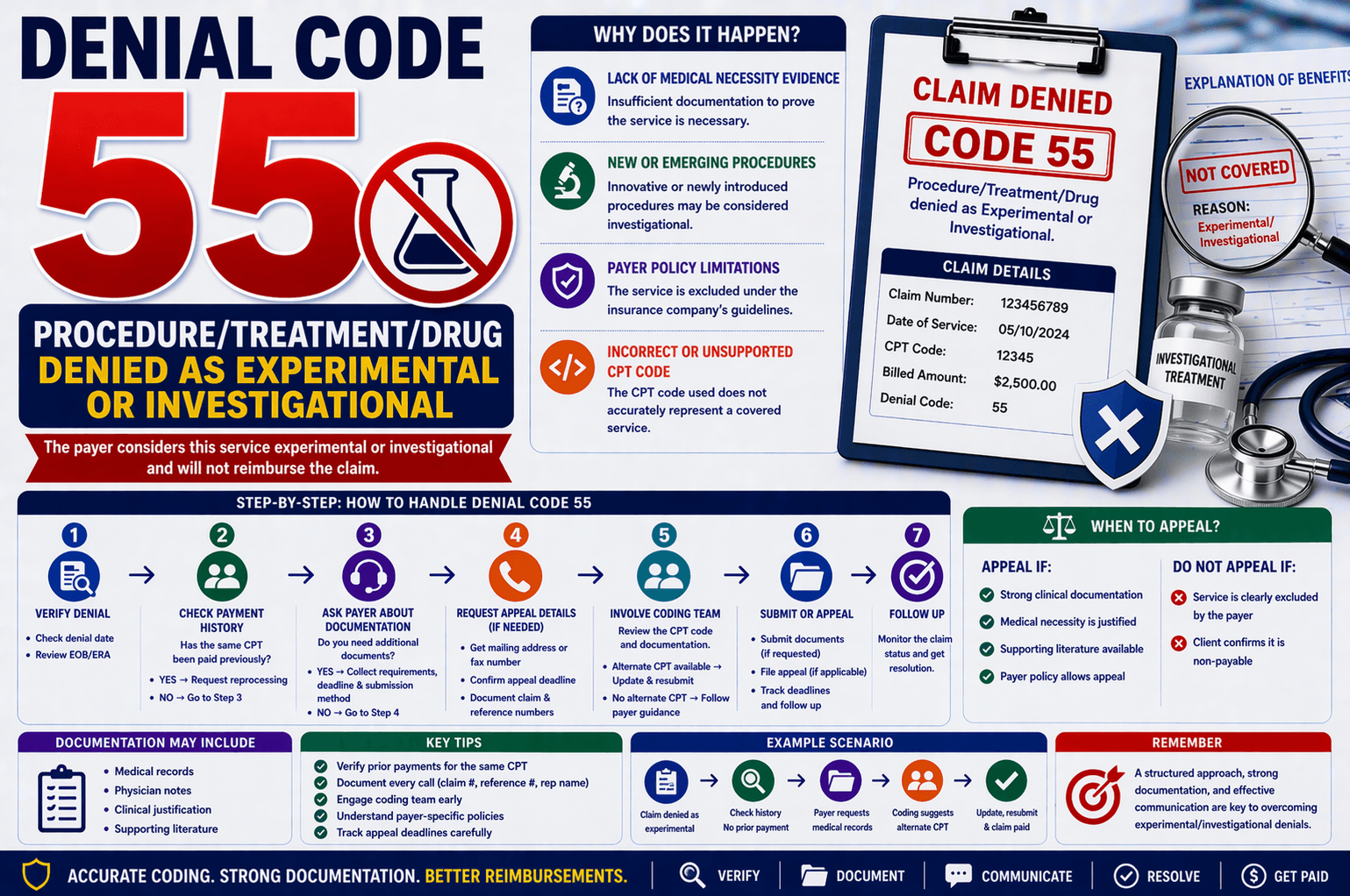
In medical billing, claim denials are a routine challenge—but some are more complex than others. One such denial is when a procedure, treatment, or drug is labeled as experimental or investigational by the payer. This type of denial can significantly delay reimbursement and often requires deeper analysis, coordination, and strategic follow-up.
If you’re new to revenue cycle management (RCM) or medical billing, this guide will walk you through what this denial means, why it happens, and how to handle it effectively step by step.
What Does “Experimental/Investigational” Mean?
When an insurance payer classifies a service as experimental or investigational, it means:
The procedure or treatment is not widely accepted as standard medical practice.
There may be insufficient clinical evidence supporting its effectiveness.
It may not be included in the payer’s coverage policy guidelines.
As a result, the insurance company refuses to reimburse the claim.
Common Reasons for This Denial
Understanding the root cause helps in resolving the issue efficiently. Here are the most common reasons:
- Lack of Medical Necessity Evidence
The payer may believe that the treatment is not medically necessary based on the documentation provided. - New or Emerging Procedures
Innovative treatments or newly introduced CPT codes are often flagged as investigational. - Payer Policy Limitations
Each insurance company has its own coverage rules. A procedure covered by one payer may be denied by another. - Incorrect or Unsupported CPT Code
Sometimes, the CPT code used may not accurately represent a covered service.
Step-by-Step Process to Handle This Denial
Here’s a structured workflow you can follow when dealing with this denial:
Step 1: Verify the Denial Details
Check the denial date
Review the Explanation of Benefits (EOB) or Electronic Remittance Advice (ERA)
Step 2: Check Payment History
Ask:
Has the same CPT code been paid previously by the same insurance?
If YES:
Request reprocessing:
“Can you please reprocess the claim as payment was received for the same CPT previously?”
Ask for:
Turnaround Time (TAT)
Claim number
Call reference number
If NO:
Move to the next step.
Step 3: Ask About Required Documentation
Contact the payer and ask:
Do you need additional documentation to process the claim?
If YES:
Identify required documents (e.g., medical records, clinical notes)
Ask:
Time limit for submission
Submission method (fax/email/mail)
Collect:
Claim number
Call reference number
If NO:
Request appeal details:
Mailing address or fax number
Appeal submission deadline
Document:
Claim number
Call reference number
Role of the Coding Team
This denial often requires collaboration with the coding department.
Why Coding Review is Important
The originally billed CPT may not be appropriate
There might be a covered alternative CPT code
Possible Outcomes
- Alternate CPT Code Available
Update the claim with the new code
Resubmit the claim - No Alternate CPT Code
Follow payer guidance:
Submit documentation if required
File an appeal if applicable
When to Appeal the Denial
Appeals can be effective—but only in the right situations.
File an Appeal If:
You have strong clinical documentation
The treatment has supporting medical literature
The provider can justify medical necessity
Avoid Appeals If:
The payer clearly excludes the service
The client confirms it is non-payable
Importance of Client Communication
Always keep the client (provider or facility) informed.
Why It Matters:
Clients may already know payer behavior for certain CPTs
They may prefer to:
Write off the charge
Avoid unnecessary administrative work
Best Practice:
Share denial trends with clients
Get confirmation before proceeding with appeals
Key Tips for Handling Experimental Denials
Always verify prior payments for the same CPT
Document every call (claim #, reference #, rep name)
Engage coding team early
Understand payer-specific policies
Track appeal deadlines carefully
Avoid unnecessary resubmissions without correction
Example Scenario
Let’s simplify with a real-world example:
A claim is denied for CPT XYZ as investigational
You check history and find no prior payment
You call the payer:
They request medical records
You gather documents and submit within the deadline
Meanwhile, coding suggests an alternate CPT
You update and resubmit → Claim gets paid
This shows how combining payer communication + coding support can resolve complex denials.
FAQs
- What is the difference between experimental and non-covered services?
Experimental services lack sufficient evidence, while non-covered services are explicitly excluded under the policy. - Can experimental procedures ever get reimbursed?
Yes, if supported by strong documentation and medical necessity, some payers may reconsider upon appeal. - How long do I have to appeal such denials?
It varies by payer, but typically ranges from 30 to 180 days. Always confirm with the insurance representative. - Should I always resubmit the claim?
No. Only resubmit if corrections are made (e.g., CPT change). Otherwise, consider appeal or documentation submission. - What documents are usually required?
Common documents include:
Medical records
Physician notes
Clinical justification
Supporting literature (in some cases)
Conclusion:
Denials related to experimental or investigational procedures can be complex, but they are manageable with a structured approach. The key lies in:
Thorough verification
Effective communication with payers
Strong coordination with the coding team
Strategic decision-making (resubmit vs. appeal vs. write-off)
By following a systematic workflow and understanding payer expectations, you can significantly improve your success rate in resolving these denials.
Mastering this denial type not only boosts reimbursement outcomes but also strengthens your overall expertise in medical billing and revenue cycle management.