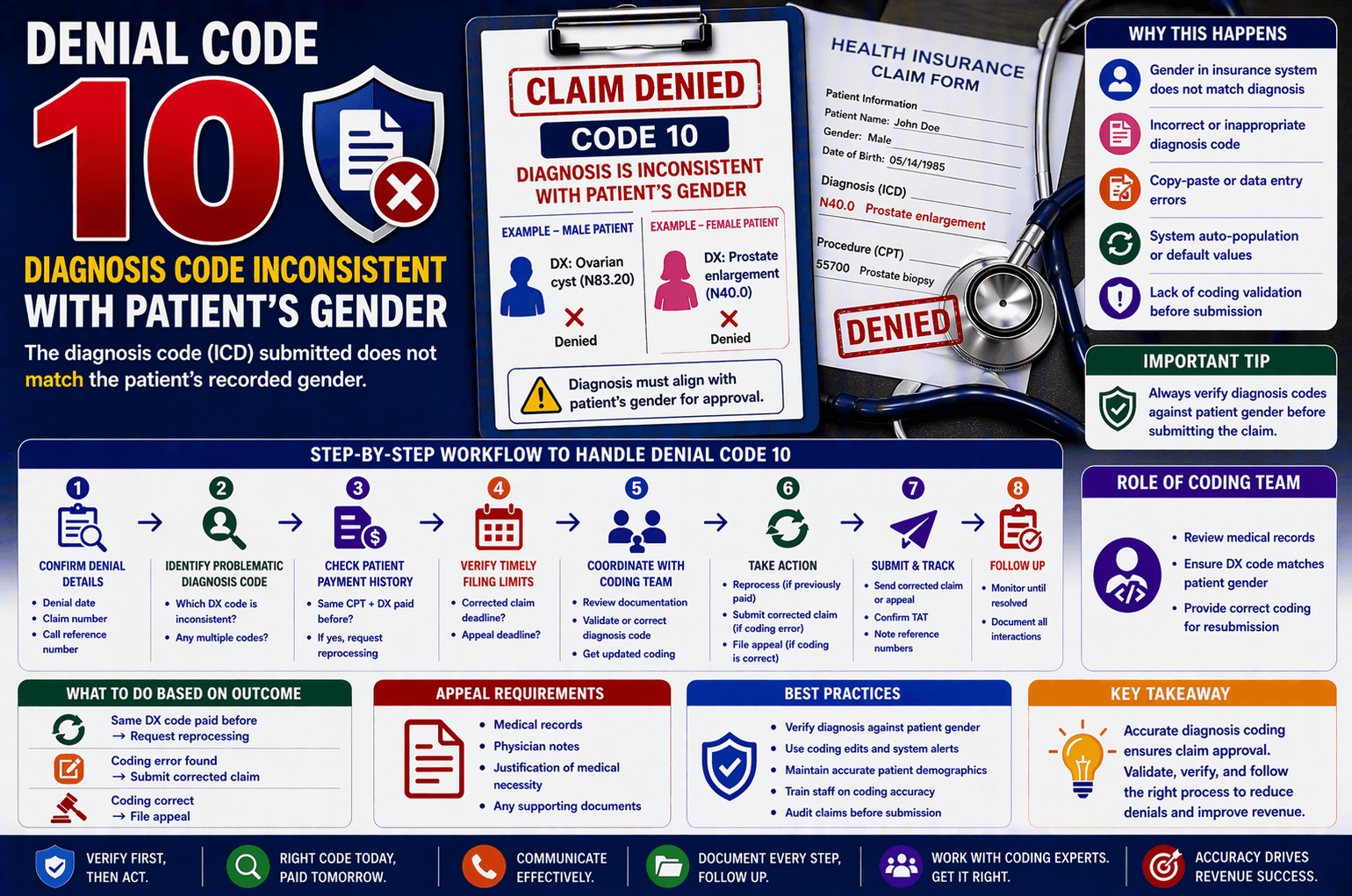
In medical billing, claim denials are a common challenge—but some can be especially confusing. One such denial is “Diagnosis is inconsistent with the patient’s gender.” This issue arises when the diagnosis code (DX code) submitted does not align with the patient’s recorded gender in the insurance system.
For beginners and even experienced billers, understanding how to handle this denial efficiently is critical to minimizing revenue loss and ensuring smooth claim processing. This guide breaks down the scenario step-by-step, explains the root causes, and provides actionable solutions.
What Does This Denial Mean?
This denial occurs when an insurance payer flags a mismatch between:
The diagnosis code (ICD code) submitted in the claim
The patient’s gender on record
Example:
A claim includes a diagnosis code for prostate conditions but the patient is listed as female.
A diagnosis related to ovarian disorders is submitted for a male patient.
Such mismatches trigger automatic denials because they are medically implausible under standard coding rules.
Step-by-Step Denial Handling Workflow
When you encounter this denial, follow a structured approach to resolve it effectively.
- Confirm the Denial Details
Start by gathering key information:
Denial date
Claim number
Call reference number (if contacting payer)
This ensures proper tracking and documentation. - Identify the Problematic Diagnosis Code
Ask or verify:
Which diagnosis code(s) caused the denial
Whether multiple codes are involved
This step is crucial because sometimes only one of several codes is incorrect. - Check Patient Payment History
Now, analyze prior claims:
Has the same diagnosis code been used before?
Was it paid successfully with the same CPT code?
If YES:
Request the payer to reprocess the claim
Mention prior payment as proof
If NO:
Proceed to correction or appeal - Ask About Timely Filing Limits
Before taking action, confirm:
Time limit to submit a corrected claim
Time limit to file an appeal
Missing these deadlines can result in permanent revenue loss. - Decide the Next Action Path
Scenario A: Reprocessing Request
If the same code was previously paid:
Ask the payer to reprocess
Confirm:
Turnaround time (TAT)
Reference number for the request
Scenario B: Corrected Claim Submission
If the diagnosis code is incorrect:
Ask:
Fax number or mailing address for submission
Timely filing deadline
Then proceed to correction (after coding review).
Scenario C: Appeal Submission
If coding confirms the diagnosis is correct:
Prepare and send an appeal
Include:
Medical justification
Supporting documentation
Role of the Coding Team
This denial is primarily a coding issue, so involving the coding team is essential.
When to Assign to Coding Team:
Diagnosis appears incorrect
Gender mismatch is obvious
Multiple conflicting codes exist
Coding Team Responsibilities:
Review patient documentation
Validate or correct the diagnosis code
Provide updated coding details
Important Notes to Remember
- Always Verify Before Resubmitting
Never blindly correct a claim without confirming with the coding team. Incorrect resubmissions can lead to repeated denials. - Timely Filing Is Critical
If the deadline is not crossed → Submit corrected claim or appeal
If the deadline is crossed → Typically write off (unless client instructs otherwise) - Client-Specific Instructions Matter
Sometimes clients may request:
Submission even after deadline
Appeal regardless of denial validity
Always follow client guidelines. - Track Every Interaction
Maintain records of:
Claim number
Call reference number
Dates of communication
This helps in follow-ups and audits.
Common Causes of Gender-Based Denials
Understanding the root causes helps prevent future issues:
Incorrect patient demographic entry
Wrong diagnosis code selection
Copy-paste errors in billing software
Lack of coding validation checks
System auto-population mistakes
Tips to Avoid This Denial
Here are practical ways to reduce occurrences:
✔ Double-Check Diagnosis Codes
Ensure the ICD code logically matches the patient’s gender.
✔ Use Coding Edits or Software Alerts
Modern billing systems can flag gender mismatches before submission.
✔ Verify Patient Demographics
Confirm gender information is correctly entered and matches insurance records.
✔ Train Billing Staff Regularly
Continuous training reduces human errors.
✔ Perform Pre-Submission Audits
A quick audit can catch mismatches early.
Example Scenario
Let’s simplify with a real-world case:
Situation:
A claim is denied because a male patient was assigned a diagnosis code for ovarian cyst.
Steps Taken:
Verified denial date and claim number
Identified incorrect diagnosis code
Sent claim to coding team
Coding team corrected the diagnosis
Submitted corrected claim within filing limit
Outcome:
Claim approved after resubmission.
FAQs
- What should I do first when I see this denial?
Start by identifying the incorrect diagnosis code and confirming denial details like date and claim number. - Can I correct the diagnosis code myself?
No. Always involve the coding team to ensure accuracy and compliance. - What if the diagnosis code is actually correct?
If coding confirms correctness, submit an appeal with proper documentation. - What happens if the timely filing limit is exceeded?
Typically, the claim is written off unless the client instructs otherwise. - Can this denial be prevented?
Yes. Proper coding validation, staff training, and system checks can significantly reduce such denials.
Conclusion:
The “Diagnosis inconsistent with patient’s gender” denial may seem straightforward, but resolving it requires a careful, step-by-step approach involving both billing and coding teams. By verifying denial details, reviewing coding accuracy, checking prior payment history, and adhering to timely filing limits, you can resolve these denials efficiently.
More importantly, implementing preventive measures—such as coding audits and demographic verification—can reduce the frequency of such errors altogether.
Mastering this denial process not only improves claim success rates but also enhances your overall billing accuracy and operational efficiency.