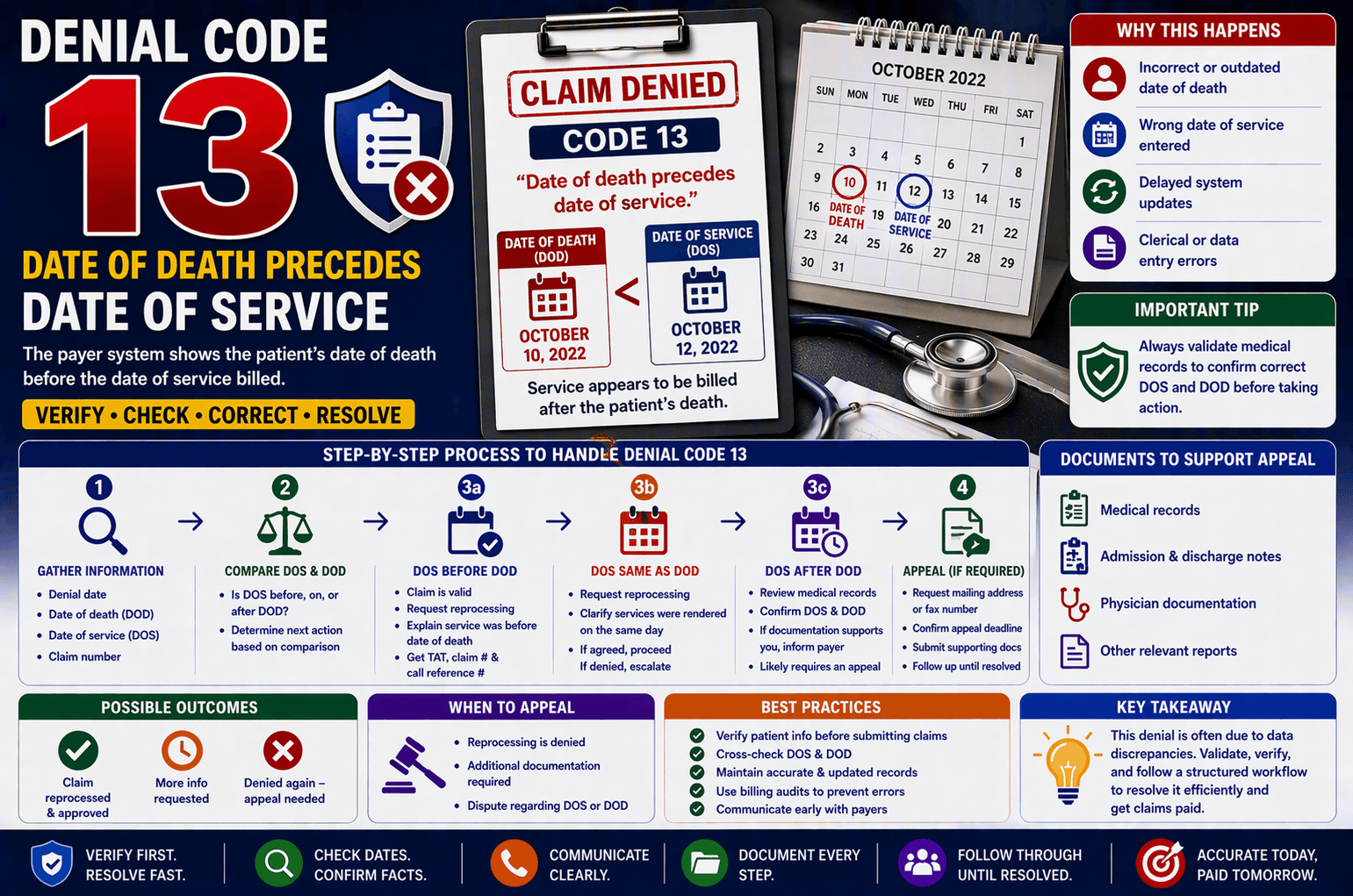
Healthcare billing can be complex, and claim denials are a common challenge. One particularly confusing denial is when the date of death (DOD) precedes the date of service (DOS). At first glance, this seems illogical—how can a service be provided after a patient’s death?
In this guide, you’ll learn what this denial means, why it happens, and how to resolve it effectively using a structured approach.
What Does This Denial Mean?
This denial occurs when an insurance payer’s system shows that:
The patient’s recorded date of death is earlier than the date of service billed, or
The system incorrectly assumes services were rendered after the patient passed away
Example:
Date of Death: October 10, 2022
Date of Service: October 12, 2022
The claim gets denied because services appear to be billed after the patient’s death.
Why Does This Denial Occur?
Despite sounding serious, this denial is often caused by simple data issues rather than actual fraud or billing errors.
Common Reasons:
Incorrect Date of Death Entry
The payer’s system may have an outdated or wrong DOD.
Wrong Date of Service
The provider may have entered the wrong DOS.
Delayed System Updates
Death information may not have been updated correctly across systems.
Clerical Errors
Manual entry mistakes during billing or claim submission.
Step-by-Step Process to Handle This Denial
When you encounter this denial, follow a structured workflow to resolve it efficiently.
Step 1: Gather Key Information
Start by collecting essential details:
Denial date
Date of death (DOD)
Date of service (DOS)
Claim number
Step 2: Compare DOS and DOD
Check the relationship between the dates:
- DOS is Before DOD
This means the claim is valid.
Action:
Request reprocessing of the claim
Explain that the service occurred before the patient’s death
Suggested approach:
Ask the payer to reprocess the claim
Confirm the turnaround time (TAT)
Record claim number and call reference number - DOS is On the Same Day as DOD
This is often acceptable, depending on timing.
Action:
Request reprocessing
Clarify that services were rendered on the same day
Possible outcomes:
If the representative agrees → proceed with reprocessing
If denied → request further clarification or escalation - DOS is After DOD
This requires deeper investigation.
Action Steps:
Verify medical records
Confirm whether the DOS is correct
Check if the DOD is incorrectly recorded
If records support your claim:
Inform the payer that documentation proves services were rendered correctly
Request guidance on next steps
Most likely outcome:
The payer will ask for an appeal submission
How to File an Appeal
If reprocessing isn’t possible, an appeal becomes necessary.
Key Steps:
Request the appeal mailing address or fax number
Confirm the appeal filing deadline
Prepare supporting documents:
Medical records
Admission/discharge notes
Physician documentation
Important Questions to Ask:
What is the appeal limit timeframe?
What documents are required?
Can this be expedited?
Important Tip: Always Validate Medical Records
Before taking any action, confirm the accuracy of:
Date of service (DOS)
Date of death (DOD)
Why This Matters:
Incorrect DOS → requires claim correction and resubmission
Incorrect DOD → payer needs to update their system
Failing to validate these can lead to repeated denials and delays.
Best Practices to Prevent This Denial
Prevention is always better than correction. Here are some useful tips:
Verify Patient Information
Double-check demographics before claim submission
Cross-Check Dates
Ensure DOS aligns with patient records
Maintain Accurate Documentation
Keep clear and updated medical records
Use Billing Audits
Regularly review claims before submission
Communicate with Payers
Clarify discrepancies early to avoid denials
Frequently Asked Questions (FAQs)
- Can a claim be paid if DOS is on the same day as DOD?
Yes, in many cases. If services were rendered before the time of death, the claim may be valid. Documentation is key. - What should I do if the payer has the wrong date of death?
You should:
Provide supporting medical records
Request correction in the payer’s system
Resubmit or appeal the claim - Is this denial always due to an error?
Not always, but most cases are due to data entry or system update issues, not actual billing problems. - How long does reprocessing take?
Turnaround time (TAT) varies by payer, but typically ranges from 7 to 30 days. Always confirm during the call. - When should I file an appeal instead of requesting reprocessing?
File an appeal when:
The payer refuses reprocessing
Documentation is required for validation
There is a dispute regarding DOD or DOS
Conclusion:
The “Date of Death Precedes Date of Service” denial may seem critical, but it is often rooted in simple discrepancies. By systematically verifying dates, communicating clearly with payers, and using proper documentation, you can resolve these denials efficiently.
The key is to:
Validate information first
Follow a structured workflow
Escalate through appeals when necessary
With the right approach, even complex denials like this can be handled confidently and successfully.