In medical billing, claim denials are a common challenge that directly impact revenue cycles. One frequently encountered denial is “Non-Covered Charges.” For beginners, this term can be confusing, but understanding it is essential for efficient accounts receivable (AR) management.
This article breaks down what non-covered charges mean, why they occur, and how to handle them effectively. Whether you’re new to healthcare billing or looking to refine your skills, this guide will help you navigate this denial scenario with clarity and confidence.
What Are Non-Covered Charges?
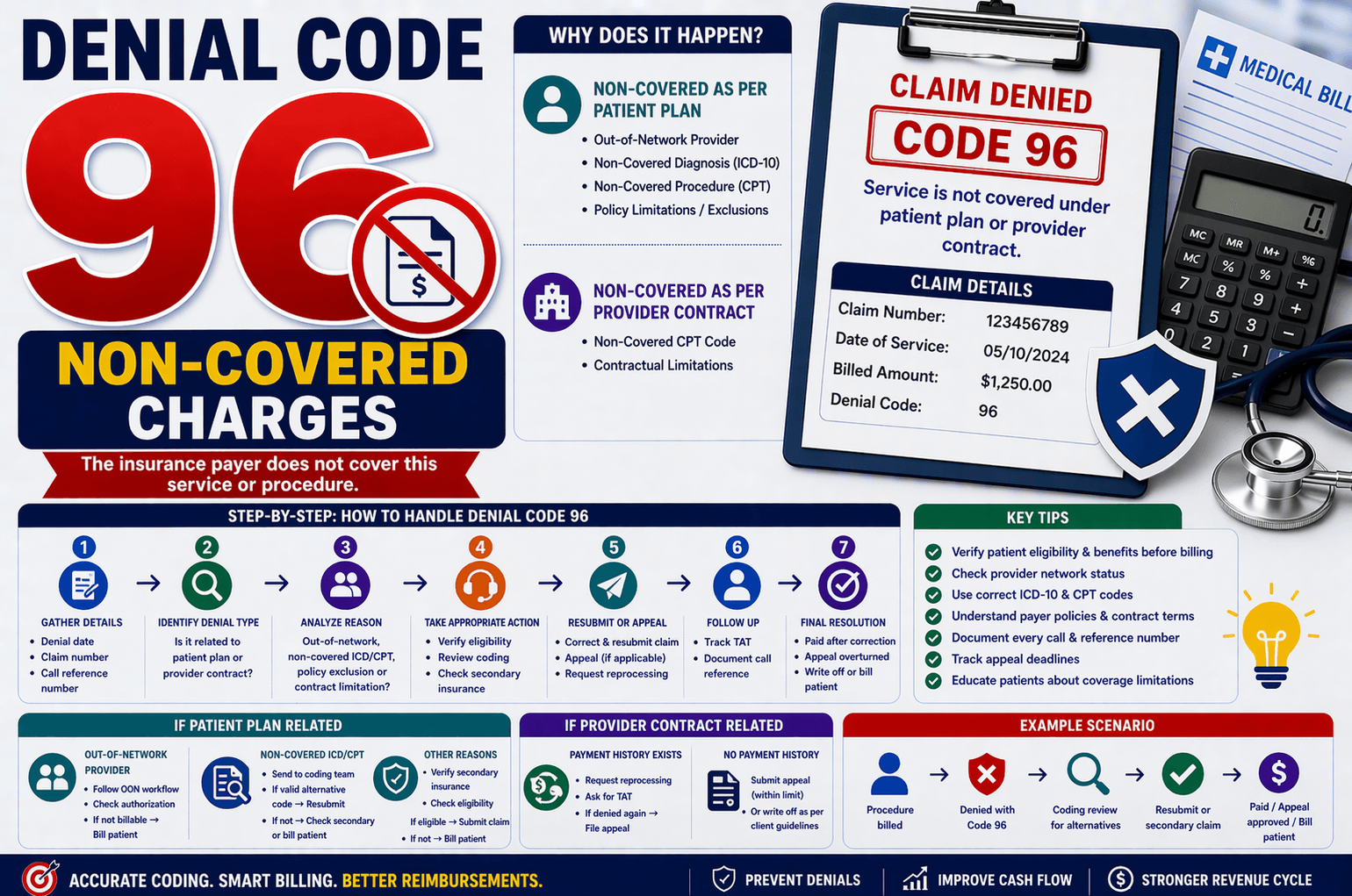
A non-covered charge refers to a medical service or procedure that an insurance payer does not cover. This means the insurance company will not reimburse the provider for that specific service.
These denials generally fall into two main categories:
- Non-Covered as per Patient Plan
This occurs when the patient’s insurance policy does not include coverage for the billed service. - Non-Covered as per Provider Contract
This happens when the provider’s agreement with the insurance company excludes certain services or procedures.
Understanding which category the denial falls under is the first and most critical step in resolving it.
Common Reasons for Non-Covered Charges
A. Under Patient Plan
Here are the most common causes:
Out-of-Network Provider
The provider is not part of the patient’s insurance network.
Non-Covered Diagnosis Code (ICD-10)
The diagnosis submitted is not recognized as payable under the policy.
Non-Covered Procedure Code (CPT)
The service itself is not included in the patient’s benefits.
Other Policy Limitations
Coverage limitations, exclusions, or benefit caps.
B. Under Provider Contract
Non-Covered CPT Code
The provider’s contract with the payer excludes certain procedures.
Contractual Limitations
Specific services may not be reimbursable based on negotiated agreements.
Step-by-Step Handling of Non-Covered Denials
Handling these denials requires a structured approach. Here’s how to manage them efficiently:
Step 1: Gather Basic Information
Always begin with:
Denial date
Claim number
Call reference number
These details are essential for documentation and follow-ups.
Step 2: Identify the Denial Type
Ask:
Is it patient plan-related or provider contract-related?
This determines your next steps.
How to Handle Non-Covered Charges (Patient Plan)
Scenario 1: Provider is Out of Network
Follow the out-of-network workflow
Check if prior authorization was required
If not billable, transfer responsibility to the patient
Scenario 2: Diagnosis Code Not Covered
Send the claim to the coding team
Request an alternative diagnosis code
Outcomes:
If a valid code is provided → Correct and resubmit the claim
If not → Move to secondary insurance or bill patient
Scenario 3: Other Reasons
Verify if the patient has secondary insurance
Check eligibility for the secondary payer
If eligible → Submit claim to secondary
If not → Bill the patient
How to Handle Non-Covered Charges (Provider Contract)
Step 1: Check Payment History
Look for:
Previous payments for the same CPT code
Same provider and insurance combination
Scenario 1: Payment Exists
Request the payer to reprocess the claim
If the representative agrees:
Ask for Turnaround Time (TAT)
Set a follow-up accordingly
If the representative refuses:
Request appeal submission details
Fax number or mailing address
Appeal filing limit
Scenario 2: No Payment History
You have two options:
Submit an appeal
Write off the claim (based on client guidelines)
Important Tips for Managing Non-Covered Denials
Here are some practical tips to improve your workflow:
Always verify eligibility before billing
Check patient coverage and benefits upfront
Maintain proper documentation
Record claim numbers, reference numbers, and call details
Use coding support wisely
Correct diagnosis codes can often resolve denials
Understand payer policies
Each insurance company has different coverage rules
Track appeal deadlines
Missing appeal limits can result in lost revenue
Real-Life Example
Imagine a claim is denied because the procedure is not covered under the patient’s plan.
What should you do?
Confirm the denial reason
Check if a different diagnosis code can justify the procedure
Send it to coding for review
If corrected → Resubmit
If not → Check secondary insurance or bill patient
This structured approach ensures no opportunity for reimbursement is missed.
Frequently Asked Questions (FAQs)
- What does “non-covered charges” mean in medical billing?
It means the insurance company will not pay for a specific service because it is not included in the policy or contract. - Can non-covered charges be appealed?
Yes, especially in provider contract cases. Appeals can be submitted if there is justification or prior payment history. - What happens if no alternative diagnosis code is available?
The claim can be billed to a secondary payer (if available) or transferred to patient responsibility. - How do I know if a provider is out of network?
You can verify this through the payer’s website or by calling the insurance company. - Should all non-covered denials be written off?
No. Always check:
Secondary insurance
Appeal options
Client-specific instructions
Conclusion:
Non-covered charge denials are a routine but critical part of medical billing. While they may seem straightforward, resolving them requires careful analysis of payer policies, provider contracts, and patient coverage.
By identifying the denial type early, following a structured workflow, and leveraging tools like coding support and eligibility verification, you can significantly reduce revenue loss and improve claim success rates.
Mastering this denial process not only enhances your efficiency but also strengthens the overall revenue cycle management of any healthcare organization.