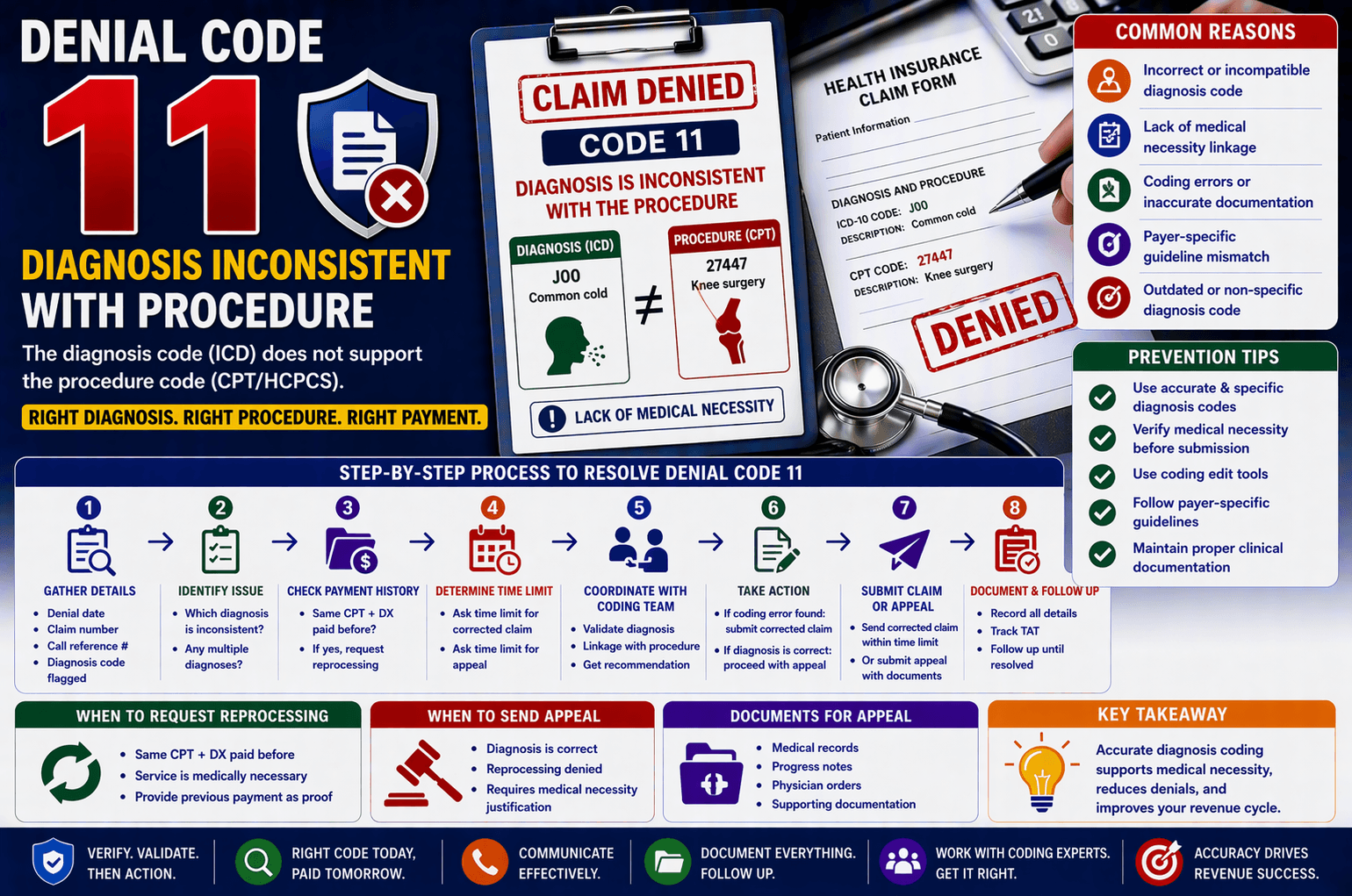
In medical billing, claim denials are a common challenge—but understanding the reason behind them is key to faster resolution and improved revenue cycle management. One frequent denial reason is: “Diagnosis is inconsistent with the procedure.” This denial occurs when the diagnosis code (ICD) does not support the medical necessity of the procedure code (CPT/HCPCS). For beginners in medical billing, this can seem complex, but with a structured approach, it becomes manageable. In this guide, we’ll break down what this denial means, how to investigate it, and the exact steps to resolve it efficiently.
What Does “Diagnosis Inconsistent with Procedure” Mean?
This denial indicates that the insurance payer believes:
The diagnosis code (DX) submitted does not justify the procedure code (CPT) performed.
There is a lack of medical necessity linkage between diagnosis and treatment.
Example:
If a claim includes:
Procedure (CPT): Knee surgery
Diagnosis (ICD): Common cold
The payer will deny the claim because the diagnosis does not support the procedure.
Step-by-Step Workflow to Handle This Denial
Handling this denial requires a systematic approach. Below is a proven workflow used by experienced billing professionals.
- Gather Basic Denial Information
Start by collecting essential details:
Denial date
Claim number
Call reference number
Specific diagnosis code flagged
These details help you track and escalate the issue properly. - Identify the Problematic Diagnosis Code
Ask:
Which diagnosis code is inconsistent?
Are there multiple diagnosis codes on the claim?
This step is crucial because sometimes only one diagnosis code causes the denial, not all. - Check Patient Payment History
Verify whether:
The same CPT + DX combination was previously paid
The payer has accepted this combination before
If YES:
Request reprocessing of the claim
Mention prior payment as proof of medical necessity consistency
If NO:
Move to correction or appeal process - Determine Timely Filing Limits
Time limits vary depending on the payer and action:
For Corrected Claims:
Ask: What is the time limit to submit a corrected claim?
For Appeals:
Ask: What is the time limit to send an appeal?
Missing deadlines can lead to permanent revenue loss. - Coordinate with the Coding Team
This is a critical step.
Why involve coding experts?
Because they:
Validate diagnosis accuracy
Ensure proper linkage between diagnosis and procedure
Recommend corrections if needed
Possible outcomes:
A. Coding Error Found
Update the correct diagnosis code
Submit a corrected claim (if within time limit)
B. Diagnosis Code is Correct
Proceed with an appeal - Submit Corrected Claim (If Applicable)
If the coding team provides a revised diagnosis:
Update the claim with the correct DX code
Resubmit within the allowed timeframe
Track reprocessing turnaround time (TAT) - Appeal the Denial (If Needed)
If the diagnosis is confirmed correct:
Request payer details:
Fax number
Mailing address
Submit a formal appeal with:
Medical records
Justification of medical necessity
Supporting documentation
Important:
Always calculate the appeal deadline from the denial date. - Special Scenarios
Sometimes workflows depend on client instructions:
Submit corrected claim even after deadline (client-specific policy)
Send appeal even if time limit is crossed
Write off claim if no further action is allowed
Always follow client guidelines in such cases.
Key Tips to Prevent This Denial
Prevention is always better than rework. Here are practical tips:
✔ Ensure Proper Coding
Use accurate and specific diagnosis codes
Avoid generic or unspecified codes
✔ Verify Medical Necessity
Confirm that the diagnosis supports the procedure
Use payer-specific guidelines
✔ Use Coding Edits Tools
Check CPT–ICD compatibility before submission
✔ Maintain Documentation
Ensure clinical notes justify the procedure
✔ Stay Updated
Keep up with coding changes (ICD/CPT updates)
Common Mistakes to Avoid
Submitting claims without validating diagnosis-procedure linkage
Ignoring payer-specific policies
Missing appeal deadlines
Not involving the coding team early
Resubmitting incorrect claims repeatedly
FAQs
- What causes a diagnosis inconsistent with procedure denial?
It occurs when the diagnosis code does not justify the medical necessity of the procedure performed. - Can I resubmit the same claim without changes?
No. Unless the denial was incorrect, you must either:
Correct the diagnosis, or
Submit an appeal with proper justification - What is the difference between corrected claim and appeal?
Corrected Claim: Submitted when there is an error in coding
Appeal: Submitted when you believe the original claim was correct - How do I know if I should appeal or correct the claim?
Consult the coding team:
If coding is wrong → Correct claim
If coding is right → Appeal - What happens if I miss the appeal deadline?
In most cases:
The claim may need to be written off
Some clients may still request submission depending on policy
Conclusion:
The “Diagnosis inconsistent with procedure” denial is one of the most common yet manageable issues in medical billing. The key lies in understanding the relationship between diagnosis and procedure codes and following a structured resolution process.
By:
Verifying diagnosis accuracy
Checking payer history
Coordinating with the coding team
Meeting deadlines
You can significantly improve claim acceptance rates and reduce revenue loss.
Mastering this denial workflow not only improves efficiency but also strengthens your expertise in revenue cycle management—an essential skill in today’s healthcare billing landscape.