
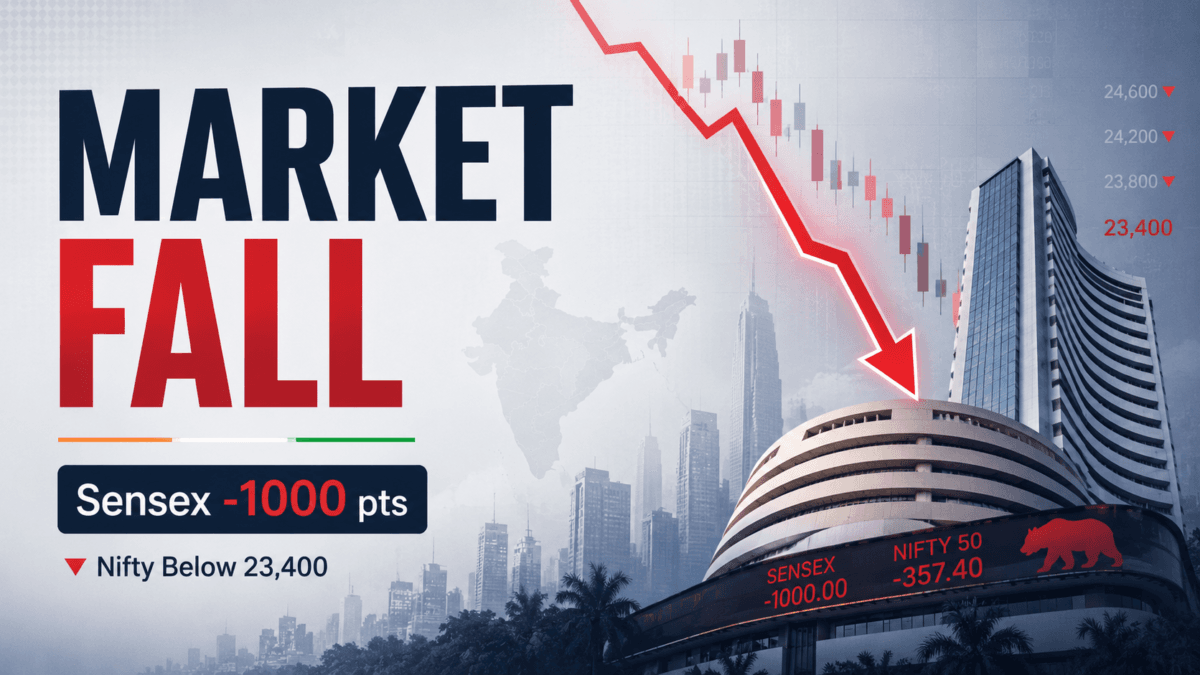
Indian stock markets began June 1, 2026, with early optimism, but that strength did not last. The Sensex and Nifty gave up their morning gains and ended the session in the red, showing how quickly investor mood can change when global risk, crude oil prices, foreign selling, and domestic concerns come together.
The Sensex closed 508.40 points, or 0.68%, lower at 74,267.34, while the Nifty ended 165.15 points, or 0.7%, lower at 23,382.60. During the day, the Sensex fell around 1,000 points from its intraday high of 75,367.93, and the Nifty slipped below the 23,400 mark after touching a high of 23,733.70.
The fall was not caused by one single trigger. It was the result of several pressures building at the same time. Here are the five key reasons behind the decline.
Main Content
1. Global Tensions Made Investors Nervous
US-Iran Uncertainty Hurt Risk Appetite
One of the biggest reasons for the decline was rising uncertainty around the US-Iran conflict and the fragile peace process. Markets dislike uncertainty because it makes future costs, trade routes, oil supply, and policy decisions harder to predict.
Reuters reported that Indian benchmarks extended their losing streak on concerns over foreign selling, weak monsoon expectations, and renewed Middle East tensions. The report also noted that the US had struck Iranian military sites, while Iran’s Revolutionary Guards said they had targeted a US base in response.
For investors, such geopolitical tension creates a risk-off mood. When global investors become cautious, they often reduce exposure to emerging markets, including India. This can lead to selling pressure in equities, pressure on currencies, and higher volatility.
Why Geopolitics Matters for Indian Markets
India may not be directly involved in the conflict, but it is still affected through oil prices, foreign investor flows, currency movement, and global sentiment. If tensions rise in the Middle East, the market quickly starts worrying about supply disruptions, inflation, and import costs.
This is why Indian equities reacted sharply even though the conflict was outside India.
2. Crude Oil Prices Jumped Sharply
Higher Oil Is a Major Concern for India
Rising crude oil prices were another major reason behind the market decline. India imports a large share of its oil requirement, so expensive crude can raise the import bill and increase inflation pressure.
Economic Times reported that Brent crude futures gained nearly 4% to around $94 per barrel, while WTI crude rose more than 4% to nearly $91 per barrel amid rising geopolitical tensions.
Reuters also reported that Brent crude futures rose about 3% to $93.8 per barrel, while traders remained focused on the difficult backdrop for net energy importers such as India.
How Oil Prices Affect Stocks
Higher crude prices can hurt several parts of the economy. Fuel becomes costlier, transport expenses rise, input costs increase for companies, and inflation risks grow. Sectors such as aviation, paints, chemicals, logistics, automobiles, cement, and consumer goods can feel pressure when oil stays high.
For the stock market, the bigger fear is not just one day of higher crude. The concern is what happens if oil remains elevated for weeks or months. Reuters quoted an analyst warning that if crude prices stay in the $90–$100 range and the Iran conflict is not resolved soon, FY27 earnings estimates could face downgrade risks.
3. Heavy FII Selling Added Pressure
Foreign Investors Continued to Sell
Foreign institutional investor selling was one of the strongest pressures on the market. When FIIs sell heavily, large-cap stocks and benchmark indices often come under pressure because foreign investors hold significant positions in India’s major companies.
Reuters reported that overseas investors sold a record $2.22 billion of Indian shares on Friday when MSCI’s May rebalancing came into effect. Economic Times reported that foreign investors net sold Indian equities worth ₹21,105.86 crore on Friday, citing NSE data, and described it as the highest single-day FII net selling in May.
Why FII Selling Matters
FII selling affects market confidence in two ways. First, it directly increases supply in the market, pushing prices lower. Second, it can make domestic investors cautious because they may fear more selling in the coming sessions. Heavy selling also affects financial stocks because foreign investors usually hold large positions in Indian banks and financial companies. Reuters reported that heavyweight financials slipped 1.4% during the session.
4. Weak Monsoon Concerns Hit Domestic Sectors
Rural Demand Worries Returned
Another important reason behind the decline was concern over the monsoon. India’s rural economy is still closely linked to rainfall. A weak monsoon can affect crop output, food prices, rural income, and demand for products such as two-wheelers, tractors, FMCG goods, and entry-level consumer items.
Reuters reported that consumer goods and automobile shares fell 1.7% and 2.3%, respectively, as the forecast of the weakest monsoon showers in 11 years raised concerns about crops, food prices, and economic growth. This explains why FMCG and auto stocks were under pressure. These sectors depend heavily on rural and semi-urban consumption. When investors worry about farm incomes and inflation, they often reduce exposure to consumption-linked stocks.
FMCG Stocks Led the Decline
Economic Times reported that Nifty FMCG crashed more than 2% and led sectoral losses, while IT stocks were one of the few bright spots. This sector rotation shows that investors were not selling everything equally. They were moving away from areas exposed to domestic inflation and consumption risk, while selectively buying IT stocks that benefited from stronger global technology sentiment.
5. Bond Yields, Volatility and Rate Worries Weighed on Sentiment
Rising Yields Made Equities Less Attractive
Higher bond yields also contributed to weak sentiment. When bond yields rise, fixed-income assets become more attractive compared with equities. This can reduce investors’ willingness to pay high valuations for stocks.
Economic Times reported that US Treasury yields inched higher, with the US 10-year yield rising to 4.469%, the 30-year yield to 4.994%, and the 2-year yield to 4.039%. Higher global yields can affect emerging markets because they make safer assets more attractive. This can lead to capital moving away from riskier markets.
RBI Policy Expectations Added Caution
Investors were also watching the Reserve Bank of India’s upcoming policy decision. Reuters reported that the central bank was expected to keep rates unchanged, but most economists polled by Reuters expected at least one rate increase by year-end because of high oil prices and pressure on the rupee from weak capital inflows. This matters because higher interest rates can affect borrowing costs, corporate earnings, bank valuations, housing demand, auto loans, and overall market liquidity.
Broader Market Weakness Made the Fall Look Deeper
Midcaps and Smallcaps Also Declined
The weakness was not limited to the Sensex and Nifty. Reuters reported that 14 of the 16 major sectors fell, while broader small-cap and mid-cap indices dropped 0.9% and 1.5%, respectively.
Moneycontrol reported weak market breadth, with about 1,505 shares advancing, 2,665 declining, and 180 remaining unchanged. Weak breadth shows that the decline was broad-based. When more stocks fall than rise, it signals that selling pressure is spread across the market rather than limited to a few heavyweight names.
Practical Tips for Investors During Such Market Falls
Avoid Reacting Only to Intraday Moves
A fall from the day’s high can look dramatic, but investors should avoid panic decisions based only on one session. It is better to look at whether the same risks continue for several days.
Track Crude Oil and the Rupee
For Indian markets, crude oil and the rupee are very important. If oil rises and the rupee weakens together, market pressure can intensify.
Watch FII Flows
Foreign investor activity can influence short-term market direction. Continued FII selling may keep large-cap indices under pressure, while a slowdown in selling can improve sentiment.
Focus on Quality Companies
During uncertain periods, companies with strong balance sheets, steady cash flows, pricing power, and lower debt often handle volatility better than highly leveraged or speculative businesses.
Key Takeaways
The Sensex closed 508.40 points lower at 74,267.34, while the Nifty ended below 23,400 at 23,382.60.
The Sensex fell around 1,000 points from the day’s high.
The main reasons were US-Iran tensions, rising crude oil prices, heavy FII selling, weak monsoon concerns, and rising bond yields.
FMCG, auto, financials, midcaps, and smallcaps came under pressure.
IT stocks showed resilience and helped cushion part of the broader decline.
Investors are now watching crude oil, FII flows, the rupee, monsoon updates, and the RBI policy decision.
Conclusion
The market decline on June 1, 2026, was a clear reminder that Indian equities are influenced by both domestic and global forces. The day began with gains, but the mood changed as investors focused on geopolitical tensions, higher crude oil prices, heavy foreign selling, weak monsoon expectations, and rising bond yields.
The Sensex’s fall of around 1,000 points from its day’s high showed how fragile sentiment can become when several risks appear together. However, such sessions are also useful because they reveal what the market is most worried about.
For now, the key question is whether these pressures ease or continue. If crude oil cools, FII selling slows, and domestic data remains stable, markets may regain confidence. But if geopolitical tensions rise further and oil remains expensive, volatility may stay high. Investors should therefore focus on risk management, quality stocks, and a clear long-term view rather than reacting emotionally to one difficult trading day.