
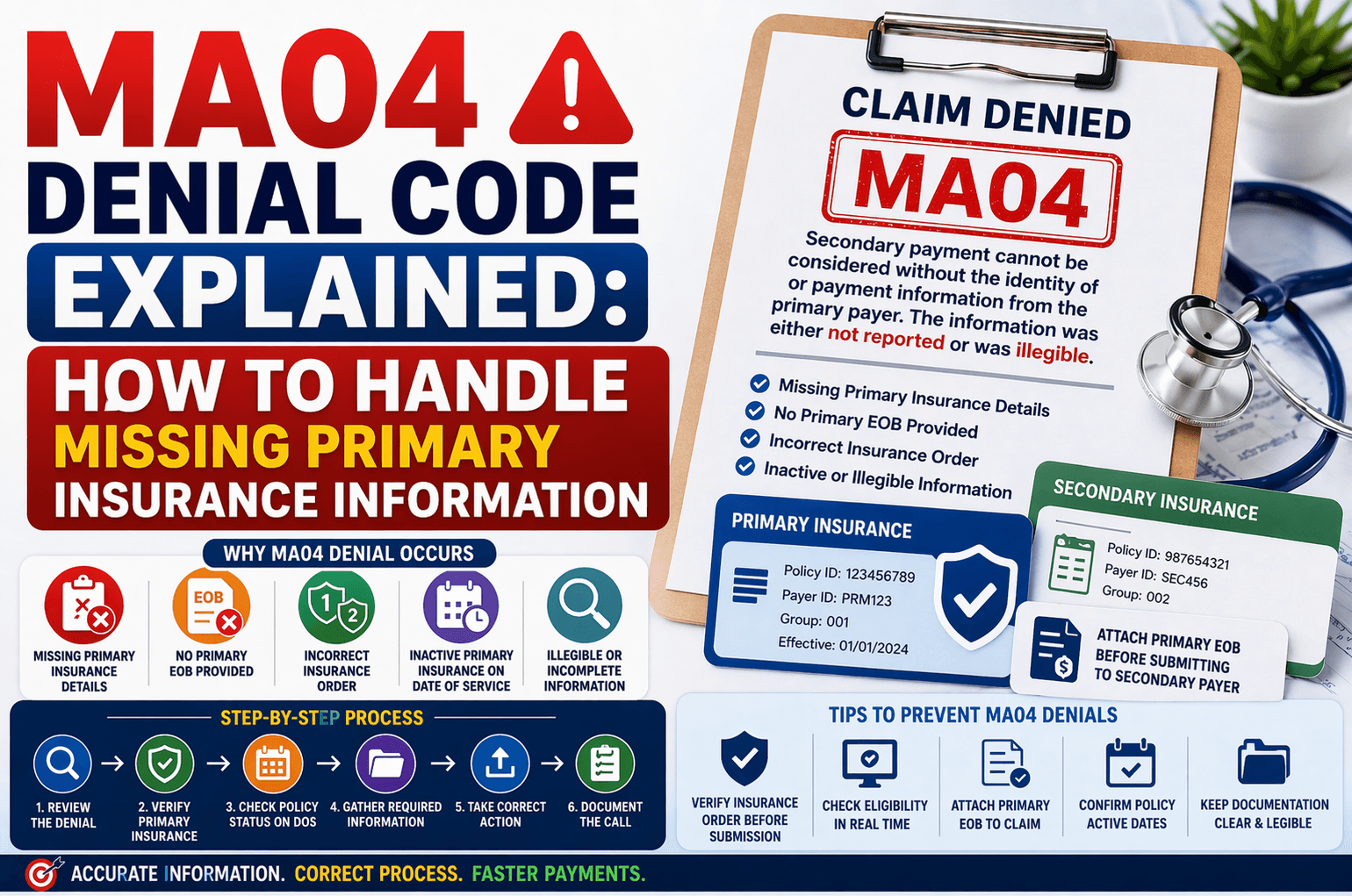
In medical billing, denial codes are a common challenge that healthcare providers and billing professionals must navigate efficiently. One such denial is MA04, which states:
“Secondary payment cannot be considered without the identity of or payment information from the primary payer. The information was either not reported or was illegible.”
This denial typically arises when a claim is submitted to a secondary insurance without proper details of the primary insurance. Understanding how to resolve MA04 denials is crucial for timely reimbursements and reducing claim rejections.
In this article, we’ll break down what MA04 means, why it occurs, and how to resolve it step by step in a clear and beginner-friendly way.
What Does MA04 Denial Mean?
MA04 indicates that the secondary payer cannot process the claim because:
The primary insurance information is missing, or
The primary payer’s payment details (EOB) are not provided, or
The submitted information is unclear or illegible
In simple terms, the secondary insurance needs proof that the primary insurance has already processed the claim before they can consider payment.
Why Does MA04 Denial Occur?
There are several common reasons behind this denial:
- Missing Primary Insurance Details
Policy ID not included
Payer ID not mentioned
Mailing address not provided - No Primary EOB (Explanation of Benefits)
Claim submitted to secondary without primary payment details - Incorrect Insurance Order
Secondary insurance billed as primary - Inactive Primary Insurance
Primary policy expired or not active on Date of Service (DOS) - Illegible or Incomplete Data
Scanned documents unclear
Incorrect formatting in claim submission
Step-by-Step Process to Handle MA04 Denial
Here’s a practical workflow you can follow when dealing with MA04 denials:
Step 1: Review the Denial
Start by identifying:
Denial date
Claim details
Insurance billed
Ask:
Which insurance was billed?
Is it actually secondary?
Step 2: Verify Primary Insurance
Contact the payer or check internal systems:
Ask: Which insurance is primary?
Confirm:
Policy ID
Payer ID
Effective and termination dates
Step 3: Check Policy Status on DOS
Determine whether the primary insurance was active:
If Active:
Proceed with primary billing
If Inactive:
Request reprocessing or update insurance order
Step 4: Gather Required Information
If details are available, collect:
Primary insurance name
Policy ID
Payer ID
Mailing address
EOB (if already processed)
Step 5: Take Appropriate Action
Scenario A: Primary Insurance is Active
Submit claim to primary insurance
Wait for EOB
Then submit to secondary with EOB attached
Scenario B: Primary Insurance is Inactive
Ask payer to reprocess claim
Or bill secondary as primary if applicable
Scenario C: No Primary Insurance Details Available
Check:
Patient records
Payment history
Insurance databases
If found:
Verify eligibility
Submit claim accordingly
If not found:
Bill patient directly
Step 6: Document the Call
Always record:
Claim number
Call reference number
Representative details
Turnaround time (TAT)
Important Tips for Resolving MA04 Denials
Always verify insurance order before claim submission
Use payer portals to check eligibility in real-time
Ensure all documents are clear and legible
Attach primary EOB when billing secondary
Double-check policy active dates
Maintain proper documentation for audit purposes
Example Scenario
Let’s simplify with an example:
Situation:
A claim is submitted to Insurance B (secondary), but MA04 denial is received.
Action Taken:
Contact payer → Confirm Insurance A is primary
Check eligibility → Insurance A active on DOS
Submit claim to Insurance A
Receive EOB
Resubmit claim to Insurance B with EOB
Result:
Claim processed successfully
FAQs
- What is the main cause of MA04 denial?
The primary cause is missing or incomplete information about the primary insurance, including absence of EOB. - Can I bill secondary insurance directly?
No. Secondary insurance requires proof that the primary payer has already processed the claim. - What if the primary insurance is inactive?
If inactive on the date of service, request reprocessing or update the insurance hierarchy accordingly. - How can I find primary insurance details?
You can check:
Patient records
Billing system
Insurance portals
Payment history - What should I do if no other insurance is found?
If no valid primary insurance exists, the claim can be transferred to patient responsibility.
Conclusion:
MA04 denial may seem complex at first, but it mainly revolves around one core issue: missing or incorrect primary insurance information. By following a structured approach—verifying insurance details, checking eligibility, and ensuring proper documentation—you can resolve these denials efficiently.
For billing professionals, mastering MA04 handling not only improves claim success rates but also reduces delays in reimbursement. Consistency, attention to detail, and proactive verification are key to avoiding such denials in the future.
By implementing the steps and tips outlined above, you can confidently manage MA04 denials and streamline your revenue cycle process.









Heya i’m for the primary time here. I came across this board and I find It truly useful & it helped
me out much. I hope to offer something again and help others like you aided me.