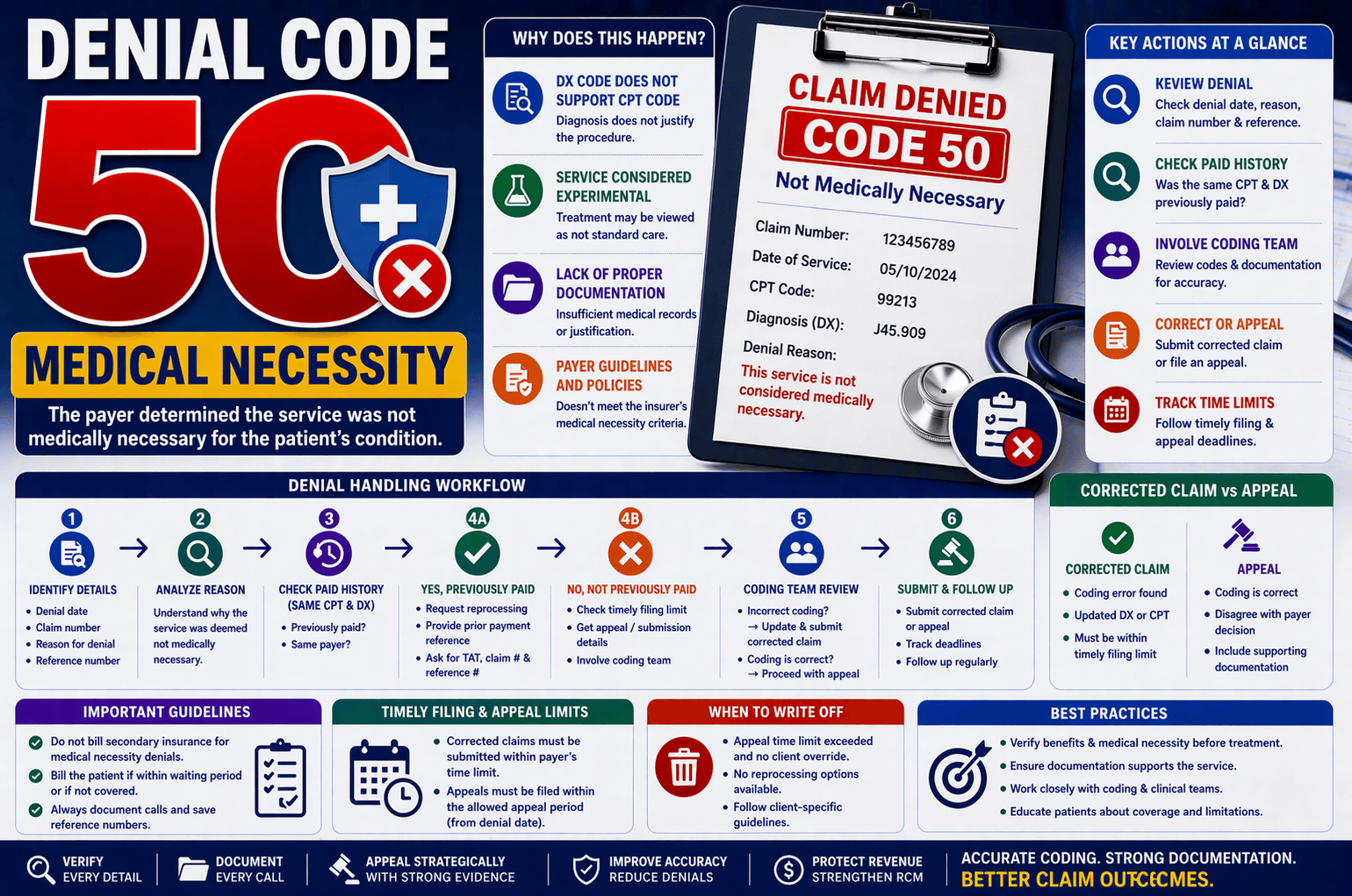
In medical billing, claim denials are a common challenge—but not all denials are created equal. One of the most frequent and often confusing types is the “medical necessity” denial. This occurs when an insurance payer determines that a service or procedure was not essential for the patient’s condition, based on their guidelines.
For beginners in medical billing or revenue cycle management, understanding how to handle these denials effectively is critical. This guide breaks down the concept in simple terms, explains the workflow, and provides actionable steps to resolve such denials efficiently.
What Is a Medical Necessity Denial?
A medical necessity denial means the insurance company believes that the treatment, procedure, or service provided was not required for diagnosing or treating the patient’s condition.
In simple terms:
The payer is saying: “We don’t think this service was needed based on the diagnosis provided.”
Common Reasons for This Denial:
Diagnosis (DX code) does not support the procedure (CPT code)
Service is considered experimental or not standard care
Lack of proper documentation
Mismatch between patient condition and treatment
Step-by-Step Workflow for Handling the Denial
When you encounter a claim denied due to medical necessity, follow a structured approach:
- Identify Key Information
Start by gathering essential details:
Denial date
Claim number
Reason for denial
Call reference number (if contacted payer) - Analyze the Denial Reason
Ask:
Why was the service deemed not medically necessary?
Is it due to coding issues or payer policy?
Understanding this is crucial before taking further action.
Decision Path: Paid History Check
One of the most important steps is checking the patient’s payment history.
Scenario 1: Same CPT & DX Previously Paid
If the same combination of:
CPT code (procedure)
DX code (diagnosis)
was previously paid by the same payer:
Action Steps:
Request reprocessing of the claim
Mention prior payment as justification
Ask for:
Turnaround Time (TAT)
Updated claim status
This strengthens your case significantly because it shows inconsistency in payer decisions.
Scenario 2: No Previous Payment History
If no prior claims were paid with the same CPT and DX:
Next Steps:
Check the timely filing limit for corrected claims
Gather submission details:
Fax number or mailing address
Appeal submission guidelines
Corrected Claim vs Appeal: What’s the Difference?
Understanding when to submit a corrected claim versus an appeal is essential.
Corrected Claim
Submitted when:
There is an error in coding (DX or CPT)
Coding team provides updated diagnosis
Requirements:
Must be within the payer’s timely filing limit
Updated and accurate coding
Appeal
Submitted when:
Coding is correct
You disagree with the payer’s decision
Key Points:
Must be submitted within appeal time limits
Should include:
Supporting medical records
Justification letter
Role of the Coding Team
The coding team plays a critical role in resolving medical necessity denials.
When to Involve Coding Team:
When diagnosis code may be incorrect
When documentation needs review
Possible Outcomes:
Coding Error Found
Update DX code
Submit corrected claim
Coding Is Correct
Proceed with appeal
Timely Filing and Appeal Limits
Time limits are critical in denial management.
Key Guidelines:
Corrected claims must be submitted within payer-defined timelines
Appeals must be calculated from the denial date
Important Note:
Sometimes clients may request:
Submission even after time limits are exceeded
In such cases:
Follow client instructions
Document actions clearly for audit purposes
When to Write Off the Claim
If:
Time limit for appeal is exceeded
No client override is provided
Then:
The claim may need to be written off
Best Practice:
Always verify:
Client-specific instructions
Contractual obligations
Key Tips for Handling Medical Necessity Denials
Always verify denial reason carefully before taking action
Check past payment history—this can save time
Communicate clearly with payers and document call references
Work closely with coding teams for accurate corrections
Track timelines strictly to avoid missed opportunities
Maintain proper documentation for appeals
Example Scenario
Let’s simplify with a real-world example:
A claim for a lab test is denied for medical necessity
You check and find the same test was paid last month with the same diagnosis
What should you do?
Contact payer
Request reprocessing
Provide reference to previously paid claim
If no such history exists:
Send to coding team
Update diagnosis if needed
Submit corrected claim or appeal
FAQs
- What does “not medically necessary” mean in billing?
It means the insurance payer believes the service provided was not required based on the diagnosis or medical guidelines. - Can a denied claim be reprocessed without correction?
Yes, if you can prove that a similar claim was previously paid with the same CPT and DX codes. - What is the difference between a corrected claim and an appeal?
A corrected claim fixes errors (like wrong codes), while an appeal challenges the payer’s decision when coding is correct. - What happens if the time limit is crossed?
Typically, the claim is written off unless the client instructs otherwise or special exceptions apply. - Why is the coding team important in this process?
They ensure that diagnosis and procedure codes are accurate and compliant, which is critical for claim approval.
Conclusion:
Medical necessity denials can seem complex, but with a structured approach, they become manageable. The key lies in understanding the root cause, verifying coding accuracy, checking payment history, and acting within time limits.
By following a clear workflow—reviewing denial reasons, involving coding teams, and deciding between corrected claims or appeals—you can significantly improve claim recovery rates.
Consistency, attention to detail, and strong documentation practices will make you more effective in handling these denials and reducing revenue loss.