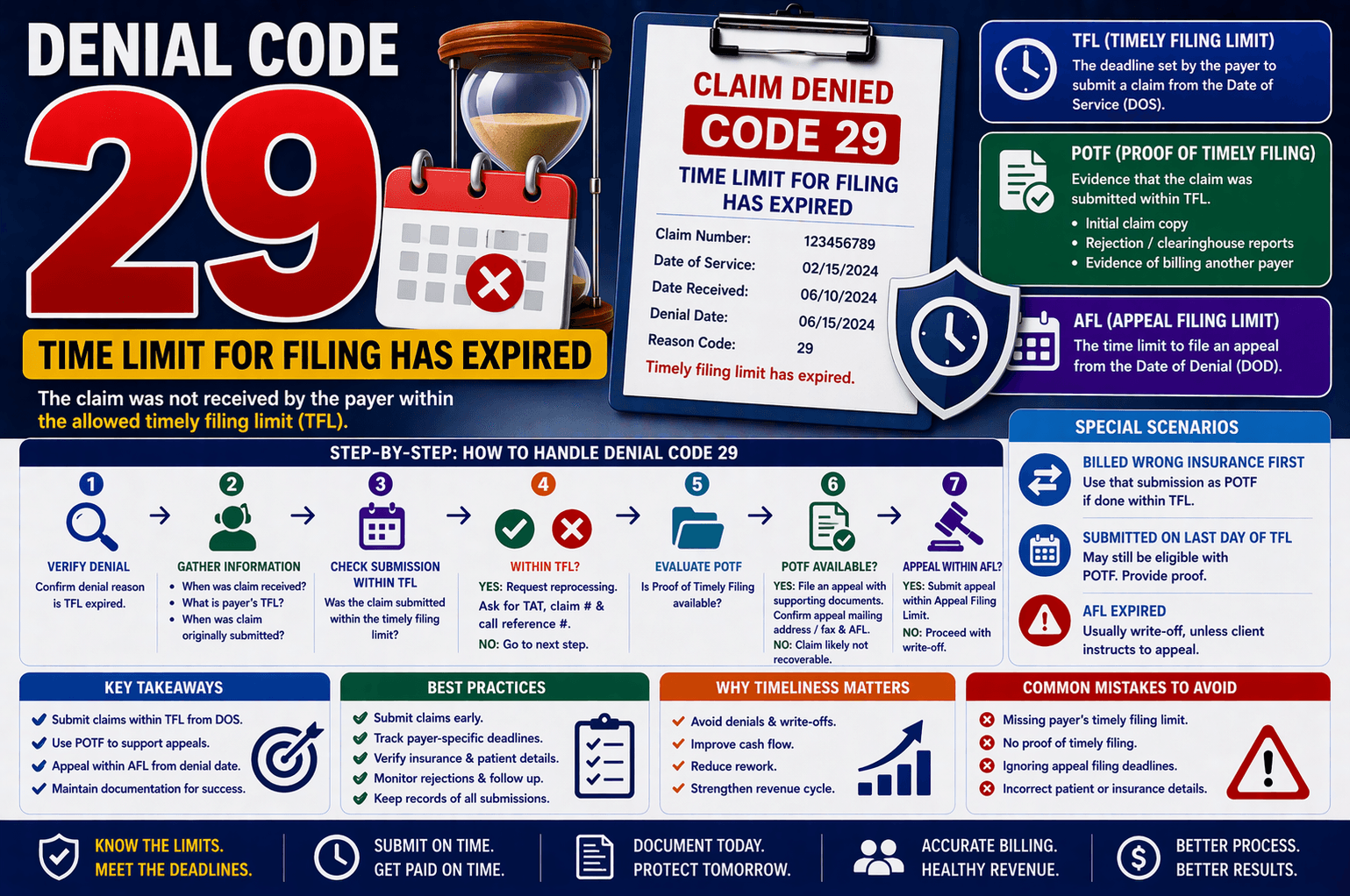
In medical billing, one of the most common and frustrating claim denials is Denial Code 29: Time Limit for Filing Has Expired. This denial occurs when a healthcare provider submits a claim to an insurance company after the allowed time frame has passed.
For beginners, this might sound complicated, but it’s actually a straightforward concept once you understand the key terms and workflow involved. This article will break down everything you need to know about Timely Filing Limits (TFL), Proof of Timely Filing (POTF), Appeal Filing Limits (AFL), and how to handle such denials effectively.
What Is a Timely Filing Limit (TFL)?
A Timely Filing Limit (TFL) is the deadline set by an insurance company within which a healthcare provider must submit a claim.
Key Points:
TFL is calculated from the Date of Service (DOS).
Each insurance payer has a different TFL (e.g., 90 days, 180 days, or 1 year).
Claims submitted after this period are usually denied automatically.
Example:
If a patient received treatment on January 1st and the TFL is 90 days, the claim must be submitted by March 31st. Any submission after that may result in Denial Code 29.
Why Do TFL Denials Occur?
Understanding the root causes helps prevent future issues. Common reasons include:
Late claim submission by the billing team
Incorrect patient or insurance details causing delays
Claims sent to the wrong payer initially
Technical or system errors
Delays in receiving necessary documentation
What Is Proof of Timely Filing (POTF)?
Proof of Timely Filing (POTF) is evidence that shows the claim was submitted within the allowed TFL.
Accepted Forms of POTF:
A copy of the initial claim submission
Rejection reports showing earlier submission attempts
Clearinghouse reports
Evidence of billing to another insurance (primary/secondary)
Example:
If a claim was first submitted to the wrong insurance within TFL and later corrected, that initial submission can serve as POTF.
What Is Appeal Filing Limit (AFL)?
The Appeal Filing Limit (AFL) is the time frame within which you can appeal a denied claim.
Key Details:
AFL is calculated from the Date of Denial (DOD).
If AFL expires, you may lose the opportunity to appeal.
Each payer has its own AFL policy.
Step-by-Step Handling of TFL Denials
When you encounter a claim denied due to TFL expiration, follow this structured approach:
- Verify the Denial
Confirm that the denial reason is indeed TFL expired.
Note the denial date. - Gather Key Information
Ask or check:
When was the claim received by the payer?
What is the payer’s TFL?
When was the claim originally submitted? - Check If Claim Was Submitted Within TFL
If YES:
Request the insurance representative to reprocess the claim.
Ask for:
Turnaround time (TAT)
Claim reference number
Call reference number
If NO:
Move to the next step.
Evaluate Proof of Timely Filing
If POTF Is Available:
Prepare and send an appeal with supporting documents.
Include:
Initial claim submission proof
Rejection or clearinghouse reports
Confirm:
Appeal mailing address or fax number
Appeal filing limit
If POTF Is NOT Available:
The claim is usually not recoverable.
Proceed with adjustment or write-off based on your organization’s policy.
Special Scenarios You Should Know
- Claim Sent to Wrong Insurance First
If billed to another payer within TFL, use that as POTF.
Submit an appeal to the correct payer. - Claim Submitted on Last Day of TFL
If billed on the final day but received late, it may still be appealed.
Provide submission proof as POTF. - AFL Has Expired
Typically, the claim must be written off.
However, some clients may still request an appeal—follow internal guidelines.
Practical Tips to Avoid TFL Denials
Preventing denials is always better than fixing them. Here are some best practices:
Stay Organized
Track deadlines for each payer.
Use billing software with alerts for TFL.
Submit Claims Early
Don’t wait until the last day.
Aim to submit claims within 30 days of service.
Verify Insurance Details
Confirm patient eligibility and coverage before submission.
Monitor Rejections
Act quickly on rejected claims and resubmit promptly.
Maintain Documentation
Keep records of all submissions and reports for POTF.
Key Takeaways
TFL is the deadline from the Date of Service to submit claims.
POTF can help recover denied claims if submission was timely.
AFL determines how long you have to appeal a denial.
Always verify timelines before deciding on reprocessing, appeal, or write-off.
Strong documentation and timely action are crucial in revenue cycle management.
Frequently Asked Questions (FAQs)
- What happens if a claim is submitted after the TFL?
The claim will usually be denied with Code 29, and payment will not be processed unless valid POTF is provided. - Can a denied claim be reopened?
Yes, if you can prove the claim was submitted within TFL using POTF, you can request reprocessing or file an appeal. - What is the difference between TFL and AFL?
TFL is the time to submit a claim, while AFL is the time to appeal a denied claim. - Is billing to the wrong insurance considered timely filing?
Yes, if done within TFL, it can be used as POTF when appealing to the correct payer. - What should I do if both TFL and AFL have expired?
In most cases, the claim must be written off unless special instructions are given by the client.
Conclusion
Denial Code 29 can significantly impact revenue if not handled correctly. However, with a clear understanding of Timely Filing Limits, Proof of Timely Filing, and Appeal Filing Limits, you can confidently manage and even recover many denied claims.
The key lies in timely action, accurate documentation, and structured follow-up. By implementing best practices and staying proactive, you can reduce TFL denials and improve overall billing efficiency.
Mastering this process is essential for anyone working in medical billing and revenue cycle management—and it becomes easier with consistent practice and attention to detail.