
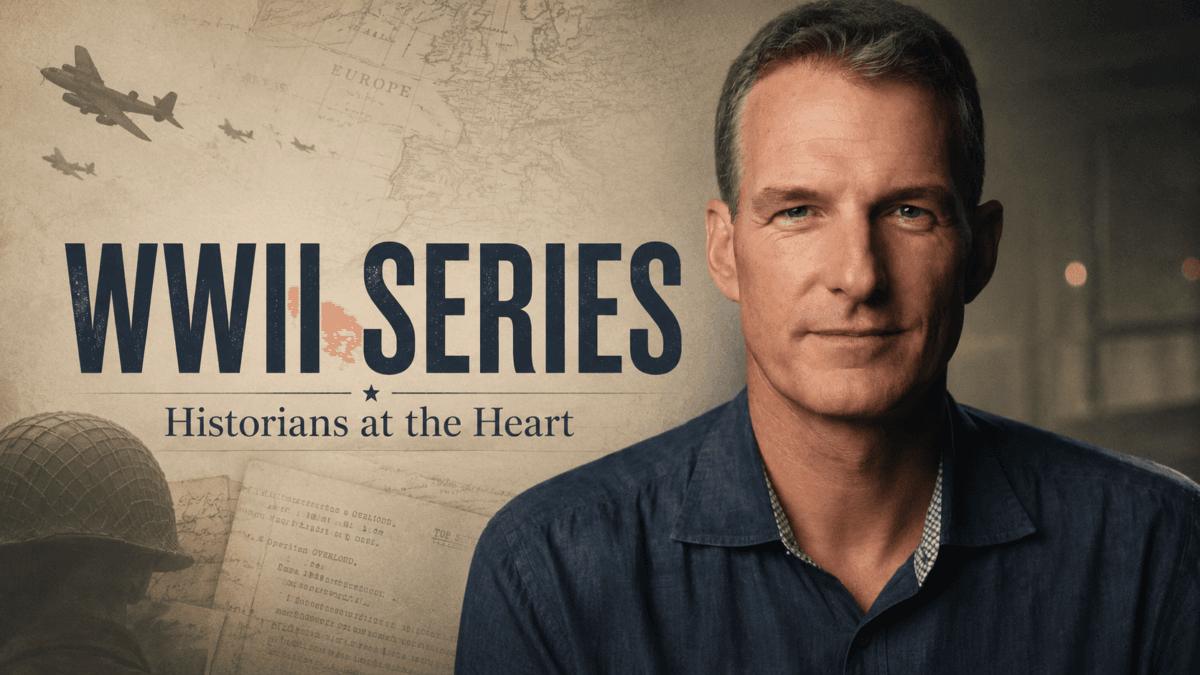
World War II has been shown on screen many times, but every generation needs a careful way to understand it again. The danger with such a familiar subject is that it can become either too cinematic or too simplified. Battles, leaders, tanks, aircraft, and famous speeches are important, but they are not enough on their own. A serious documentary also needs context, evidence, and voices that can explain why events happened and how ordinary people experienced them.
That is where World War II with Tom Hanks tries to stand apart. The Sky HISTORY docuseries is led by Tom Hanks, an actor strongly associated with Second World War storytelling through projects such as Saving Private Ryan, Band of Brothers, and Greyhound. But the series does not rely only on his screen presence. It brings in historians, writers, public scholars, military specialists, intelligence experts, and Holocaust researchers to guide viewers through the war’s complexity. Sky HISTORY describes the programme as a 20-episode run that combines archive footage with expert contributions across the conflict.
Main Content
A Documentary Built Around More Than One Voice
Tom Hanks as Guide, Not the Whole Story
Tom Hanks gives the series a familiar face and voice, but the subject is too large for celebrity narration alone. The National WWII Museum describes the series as a 20-hour documentary event that follows the war from the rise of fascism in Europe to the fall of Berlin, Pearl Harbor, Hiroshima, and the uneasy peace that followed.
That broad scope demands expert interpretation. A viewer may know the names of Dunkirk, Stalingrad, Pearl Harbor, D-Day, and Hiroshima, but knowing a name is not the same as understanding its meaning. Historians help connect events, explain strategy, correct myths, and give moral weight to subjects that should never be treated as entertainment alone.
Why Experts Matter in War Documentaries
War documentaries can easily become collections of dramatic footage. Explosions, aircraft, ruins, and marching soldiers create emotion, but they do not automatically create understanding. Historical experts help answer deeper questions: Why did leaders make certain decisions? What did civilians face? How did intelligence shape outcomes? How did racism, ideology, industry, propaganda, and geography affect the war?
Virgin Media’s preview of the series highlights that the programme uses both eyewitness testimony and expert interpretation, including historians who are “buttressed by the incontrovertible facts” of the conflict.
Meet the Historians and Specialists Behind the Series
Dan Snow: Making Big History Accessible
Dan Snow is one of Britain’s best-known history presenters. His strength is public storytelling: he can take large events and explain them in a clear, direct way for modern viewers. In the series, Sky HISTORY says he contributes to many episodes and discusses how Britain adapted to wartime pressure, including rationing and intelligence networks.
His role matters because the British home front is often reduced to a few familiar images: air raids, ration books, and Churchill speeches. Snow helps show that survival required organization, sacrifice, communication, and constant adjustment.
Sir Antony Beevor: Explaining the Brutality of the Eastern Front
Sir Antony Beevor is one of the most respected military historians working today. He is widely known for books such as Stalingrad and The Second World War. In World War II with Tom Hanks, he focuses especially on the Eastern Front and the Battle of Stalingrad, which he presents as one of the most pitiless theatres of the conflict.
This is important because many English-language audiences still learn World War II mainly through Britain, America, D-Day, and the Pacific. The Eastern Front was central to the war’s outcome and involved enormous loss, ideological violence, and urban destruction. Beevor’s presence helps ensure that the series does not narrow the war into only familiar Western stories.
Dr Tessa Dunlop: Women, Intelligence, and Hidden Labour
Dr Tessa Dunlop brings attention to women’s wartime roles, especially in intelligence and codebreaking. Sky HISTORY notes that she discusses the work of women at Bletchley Park and their contribution to breaking Nazi encrypted communications.
This kind of expertise is valuable because war history has often focused heavily on generals, soldiers, and battlefield decisions. Women’s work in factories, intelligence offices, hospitals, farms, resistance networks, and military support roles was essential. Dunlop helps viewers see the war as a whole-society struggle, not only a military contest.
Saul David: Battlefields From Dunkirk to Okinawa
Saul David brings military-history depth, particularly around the Pacific theatre and major campaign turning points. Sky HISTORY notes his work on Okinawa, Dunkirk, and North Africa in the series.
This matters because each campaign had a different character. Dunkirk was about evacuation and survival. North Africa involved supply lines, desert warfare, and imperial geography. Okinawa showed the devastating final stages of the Pacific war. A specialist can help viewers understand why each battlefield mattered in its own way.
Dr James Bulgin: Handling the Holocaust With Care
Some parts of World War II history require particular seriousness, and the Holocaust is one of them. Dr James Bulgin, Head of Public History at the Imperial War Museum in London, appears as a Holocaust expert. Sky HISTORY says he explains the ideological roots of Hitler’s antisemitism and how it became genocidal policy.
His role is essential because the Holocaust should never be treated as a side topic. It was central to Nazi ideology and to the moral meaning of the war. Expert guidance helps prevent simplification, denial, or careless comparison.
Guy Walters: Deception, Intelligence, and Nazi Pursuits
Guy Walters is known for writing about Nazi war criminals, intelligence, and hidden wartime operations. In the series, he discusses how the Allies exploited weaknesses in German intelligence, including Operation Mincemeat.
This gives viewers a useful reminder: wars are not won only by firepower. Deception, secrecy, planning, and misinformation can shape battlefield outcomes. Intelligence history also shows how fragile decision-making can be when leaders believe false information.
Simon Sebag Montefiore: Stalin and the Soviet Dimension
Simon Sebag Montefiore brings expertise on Stalin and Soviet power. In the series, Sky HISTORY says he discusses the Molotov-Ribbentrop Pact and the rupture caused by Operation Barbarossa, Germany’s invasion of the Soviet Union in 1941.
This helps viewers understand that World War II was not simply a battle between two neat sides from the beginning. Alliances shifted. Dictators made temporary arrangements. Ideology, fear, ambition, and betrayal shaped the course of events.
Other Notable Expert Voices
The series also features Matthew Hefler on intelligence history, Max Brooks on crisis thinking and U-boat pressure, Dan Carlin on the darker narratives of war, James Holland as a Second World War specialist, Sir Dermot Turing on Enigma and Alan Turing’s legacy, Alexandra Richie on Poland and Central Europe, and Sarada Peri on American political decision-making.
Together, these contributors give the series range. Instead of treating World War II as one simple story, they open different doors: military strategy, civilian suffering, codebreaking, ideology, leadership, resistance, propaganda, and memory.
Why This Historian Lineup Strengthens the Series
It Avoids a Single-Country View
A major weakness in many World War II retellings is national narrowness. British audiences may focus on the Blitz and Dunkirk. American audiences may focus on Pearl Harbor, D-Day, and the Pacific. Russian memory often centres on the Great Patriotic War. Each view contains truth, but none is complete alone.
By using historians with different specialties, the series can move between Europe, North Africa, the Atlantic, the Soviet Union, the Pacific, and the home front. That broader approach is necessary because World War II was truly global.
It Connects Strategy With Human Experience
The National WWII Museum says the series explores battlefield decisions, hidden networks, and the aftershocks that still shape the modern world. That mix is important. Strategy explains how campaigns unfolded, but human experience explains what the war cost.
The strongest war history does both. It explains why leaders acted, but it also remembers civilians under bombing, soldiers in fear, prisoners, displaced families, resistance workers, codebreakers, and victims of genocide.
It Helps a New Generation Understand the War
Hanks has said his early interest in World War II was shaped by adults whose lives were divided into before, during, and after the war. Sky HISTORY’s interview notes that he sees the subject as personally important and still relevant.
That matters because living memory of the war is fading. As fewer eyewitnesses remain, historians become even more important. They help preserve evidence, explain testimony, and protect the subject from myth-making.
Practical Tips for Watching the Series Thoughtfully
Do Not Watch Only for Famous Battles
Pay attention to episodes or sections about intelligence, logistics, civilians, ideology, occupation, and aftermath. These areas often explain the war more deeply than battle scenes alone.
Notice the Difference Between Memory and History
Eyewitness testimony is powerful, but historians help place memory into context. Both are valuable. Personal accounts show what events felt like; historical analysis explains how those events fit into the larger picture.
Look Up the Experts After Watching
Many contributors have written books, presented documentaries, or worked with museums. Following their work can help viewers go beyond the series and build a deeper understanding of specific topics.
Be Careful With Simple Lessons
World War II is often used for easy moral slogans. Some lessons are clear, especially about fascism, genocide, aggression, and courage. But many details are complex. A good viewer should be open to learning, not just confirming what they already think.
Key Takeaways
World War II with Tom Hanks is a 20-part Sky HISTORY documentary series guided by Tom Hanks and supported by expert historians.
The series covers the wider arc of the war, from fascism’s rise and early invasions to Pearl Harbor, Berlin, Hiroshima, and the postwar world.
Contributors include Dan Snow, Sir Antony Beevor, Dr Tessa Dunlop, Saul David, Dr James Bulgin, Guy Walters, Simon Sebag Montefiore, James Holland, Sir Dermot Turing, Alexandra Richie, Dan Carlin, Max Brooks, Matthew Hefler, and others.
The experts help explain military strategy, intelligence, the Eastern Front, women’s wartime work, the Holocaust, Soviet policy, deception operations, and civilian experience.
The series matters because World War II is moving from living memory into history, making careful interpretation more important than ever.
Conclusion
World War II with Tom Hanks uses a famous narrator, but its real strength comes from combining storytelling with scholarship. Tom Hanks gives the series warmth, seriousness, and public appeal. The historians give it structure, evidence, and depth.
That balance is important. World War II should not be remembered only through dramatic images or familiar heroic moments. It should be understood as a global catastrophe shaped by ideology, fear, courage, cruelty, technology, leadership, resistance, and ordinary people forced into impossible situations.
By bringing together respected experts from different fields, the series gives viewers a better chance to see the war clearly. Not as a simple legend, and not as distant black-and-white footage, but as a human event whose consequences still reach into the present.