
When people imagine dinosaurs, they often picture sharp claws, giant jaws, and terrifying predators. But some of the most fascinating dinosaurs were not hunters at all. They were plant-eaters with strange bodies shaped by millions of years of adaptation. One of the best examples is Nigersaurus, a long-necked dinosaur with one of the most unusual mouths ever found in the fossil record.
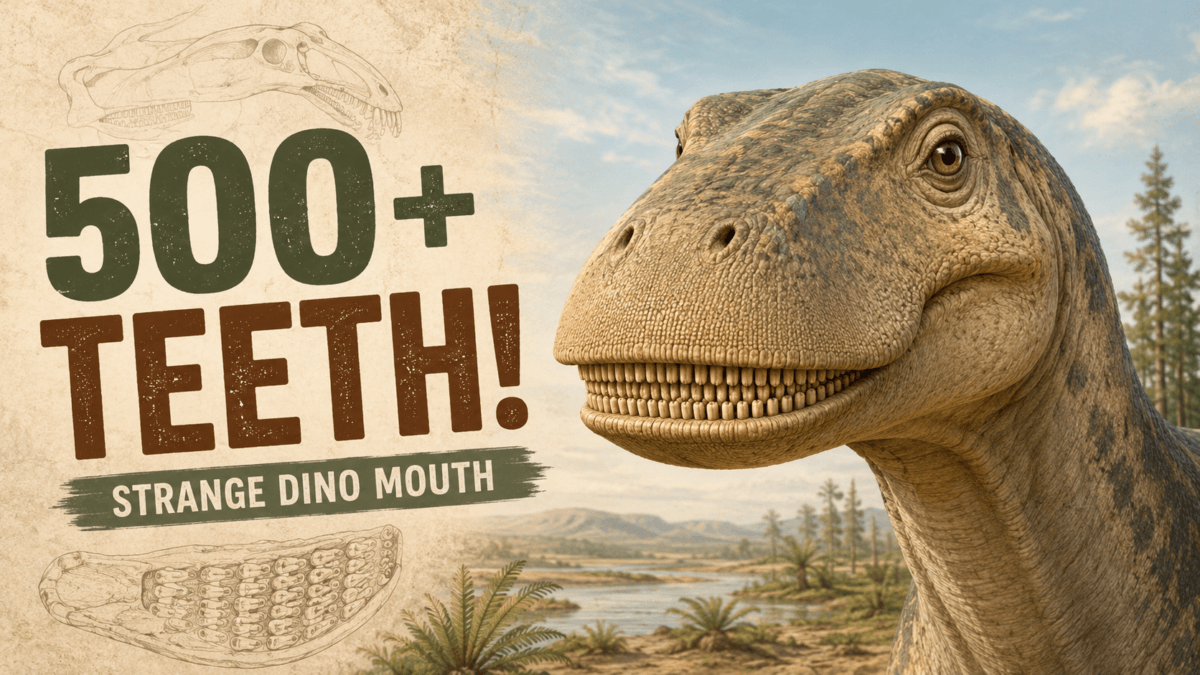
Nigersaurus did not have a mouth built for biting prey. It had a broad, straight-edged muzzle packed with more than 500 replaceable teeth. Paleontologist Paul Sereno’s website describes it as a bizarre long-necked dinosaur with a wide muzzle tipped with more than 500 replaceable teeth, and its skull became one of the first dinosaur skulls digitally reconstructed from CT scans.
This dinosaur shows that prehistoric life was not only about size and danger. Sometimes, the most memorable creatures were strange because they solved ordinary survival problems in extraordinary ways.
Main Content
What Was Nigersaurus?
A Sauropod From Ancient Africa
Nigersaurus, officially known as Nigersaurus taqueti, was a sauropod dinosaur. Sauropods are the group famous for long necks, long tails, and plant-based diets. However, Nigersaurus was not as massive as giants like Argentinosaurus or Brachiosaurus. It was relatively modest for a sauropod, often described as about 30 feet long.
Its fossils were found in Niger, in the Sahara region of Africa. The dinosaur lived during the Cretaceous Period, more than 100 million years ago. The name “Nigersaurus” simply means “Niger lizard,” connecting the animal to the country where its remains were discovered.
What makes Nigersaurus special is not its length or weight. Its real claim to fame is its head.
The Mouth That Made Nigersaurus Famous
More Than 500 Teeth in One Skull
The most surprising feature of Nigersaurus was its dental system. It had more than 500 active and replacement teeth packed into its jaws. A scientific paper published in PLOS ONE describes Nigersaurus as having extreme adaptations, including a very light skull and tooth batteries located at the far end of the jaws.
These were not large, stabbing teeth like those of a meat-eating dinosaur. They were small, narrow teeth arranged in rows. Many were not being used at the same time. Instead, they waited behind the working teeth, ready to replace worn ones.
This made the mouth work almost like a natural conveyor belt. As older teeth wore down, new ones moved into place. National Geographic notes that Nigersaurus is known for having around 500 teeth and replacing them very quickly, with a commonly reported replacement cycle of about 14 days.
A Mouth Built for Cropping Plants
Nigersaurus had a wide, flat muzzle. Instead of having teeth spread throughout the mouth like many animals, its teeth were gathered near the front. This arrangement gave it a mouth that looked almost like a straight-edged tool.
That shape was useful for feeding close to the ground. Nigersaurus probably cropped soft plants such as ferns and horsetails. It may have moved its head along low vegetation, clipping plants with its front teeth in a way that has often been compared to a lawn mower.
This comparison is simple, but helpful. Imagine a large animal slowly sweeping its head near the ground, cutting plant material with a wide row of tiny teeth. That gives a good picture of how different Nigersaurus was from the classic image of a high-browsing long-necked dinosaur reaching into tall trees.
Why Did It Need So Many Teeth?
Plant Eating Can Be Hard on Teeth
Eating plants may sound easy, but it can be rough on teeth. Many plants contain tough fibers. Some grow close to soil, which means grit and tiny particles can stick to them. Over time, chewing or cropping this material wears teeth down.
Nigersaurus solved this problem through constant replacement. Instead of depending on a few strong teeth for a long time, it used many small teeth that could be replaced again and again.
This is a practical survival strategy. Modern plant-eating animals also show special dental adaptations. Cows, horses, elephants, and some rodents all have teeth suited to heavy wear. Nigersaurus had its own ancient version of this idea.
A Specialized Feeding Machine
Nigersaurus was not a general-purpose feeder. Its skull, jaws, and teeth suggest a dinosaur highly adapted for a specific feeding style. The PLOS ONE study describes an expanded muzzle facing downward and a skull of extremely light construction, showing how unusual its feeding anatomy was.
That specialization probably helped Nigersaurus succeed in its environment. By focusing on low-growing plants, it may have avoided direct competition with other herbivores that fed at different heights.
A Surprisingly Delicate Skull
Thin Bones and Modern Technology
One of the most interesting things about Nigersaurus is how fragile parts of its skull were. Fossil skulls are often difficult to study because they are broken, crushed, or incomplete. In this case, CT scanning helped scientists understand the shape of the skull without destroying the fossil.
Digital reconstruction allowed researchers to examine the skull in detail and study how the jaws, teeth, and head may have worked together. Sereno’s research page notes that the original fossil skull was among the first dinosaur skulls digitally reconstructed using CT scans.
This matters because technology can reveal details that traditional fossil study may miss. With delicate fossils, careful scanning can help scientists see hidden structures and build more accurate reconstructions.
Light but Functional
A lightweight skull may seem weak, but in a long-necked dinosaur it made sense. A heavy head at the end of a long neck would require more muscle and energy to support. By having a light skull, Nigersaurus could feed efficiently without carrying unnecessary weight.
The skull was strange, but not poorly designed. It was shaped for its job: low feeding, rapid tooth replacement, and repeated cropping of vegetation.
How Nigersaurus Changes the Way We See Dinosaurs
Not Every Dinosaur Was a Predator
Popular culture often focuses on dinosaurs like Tyrannosaurus rex, Velociraptor, and Spinosaurus. These animals are exciting because they were predators. But herbivorous dinosaurs were just as important to prehistoric ecosystems.
Nigersaurus reminds us that plant-eaters could be just as unusual as meat-eaters. Its mouth was not scary in the traditional sense, but it was remarkable. It shows how evolution can produce surprising tools for everyday survival.
Strange Does Not Mean Primitive
It is easy to look at Nigersaurus and call it odd or awkward. But its unusual body was not a mistake. It was a highly specialized design that helped the animal live in its environment.
The wide muzzle, tooth batteries, light skull, and low-feeding posture all worked together. These features made Nigersaurus different from many other sauropods, but difference is not weakness. In nature, unusual features often reveal smart solutions.
Real-World Lessons From Nigersaurus
Adaptation Is About Fit, Not Perfection
Nigersaurus teaches an important lesson: survival is not about being the strongest in every way. It is about being well suited to a specific way of life.
This idea applies beyond paleontology. A tool, skill, business, or habit becomes useful when it fits the right situation. Nigersaurus did not need the strongest bite or the tallest reach. It needed a mouth that could efficiently gather the plants available to it.
Small Features Can Tell Big Stories
A single tooth may seem like a small fossil. But in Nigersaurus, teeth reveal diet, feeding behavior, skull structure, and even lifestyle. Paleontologists often build large stories from small clues.
This is why fossil science requires patience. A jaw fragment, tooth pattern, or bone texture can change how scientists understand an extinct animal.
Practical Tips for Learning About Dinosaurs Like Nigersaurus
Look Beyond the Famous Dinosaurs
Start with well-known dinosaurs, but do not stop there. Lesser-known species often have the most surprising adaptations. Nigersaurus is a good example because its story is more about design and feeding than size or violence.
Use Reliable Science Sources
When reading about dinosaurs, choose museums, universities, scientific papers, and respected science publications. Dinosaur facts can easily become exaggerated online, especially when unusual details like “500 teeth” become popular.
Compare Body Parts With Behavior
Ask what each feature helped the animal do. For Nigersaurus, the teeth, muzzle, and skull all point toward a low-feeding herbivore. This makes the dinosaur easier to understand as a living animal, not just a strange fossil.
Remember That Science Can Change
New fossils and new technology can update old ideas. CT scans, digital models, and microscopic tooth studies have improved how scientists interpret dinosaurs. A good dinosaur article should leave room for future discoveries.
Key Takeaways
Nigersaurus taqueti was a plant-eating sauropod from ancient Africa.
It is famous for having more than 500 active and replacement teeth.
Its teeth were arranged near the front of a wide, straight-edged mouth.
Its mouth likely helped it crop low-growing plants close to the ground.
Rapid tooth replacement helped it handle tooth wear from constant feeding.
CT scans helped scientists digitally reconstruct its delicate skull.
Nigersaurus shows that herbivorous dinosaurs could be just as strange and fascinating as predators.
Conclusion
Nigersaurus was not the biggest dinosaur, the fastest dinosaur, or the most dangerous dinosaur. Yet it remains one of the most unforgettable because its mouth was unlike anything people expect from a long-necked plant-eater. With more than 500 replaceable teeth, a wide muzzle, and a lightweight skull, it was built for a very specific way of life.
Its story helps us see dinosaurs with more imagination and more accuracy. Prehistoric life was not only filled with roaring predators and giant battles. It was also full of quiet specialists: animals that survived by grazing, browsing, digging, flying, swimming, and adapting in remarkable ways.
Nigersaurus proves that sometimes the most amazing dinosaur is not the one with the biggest bite, but the one with the strangest smile.