
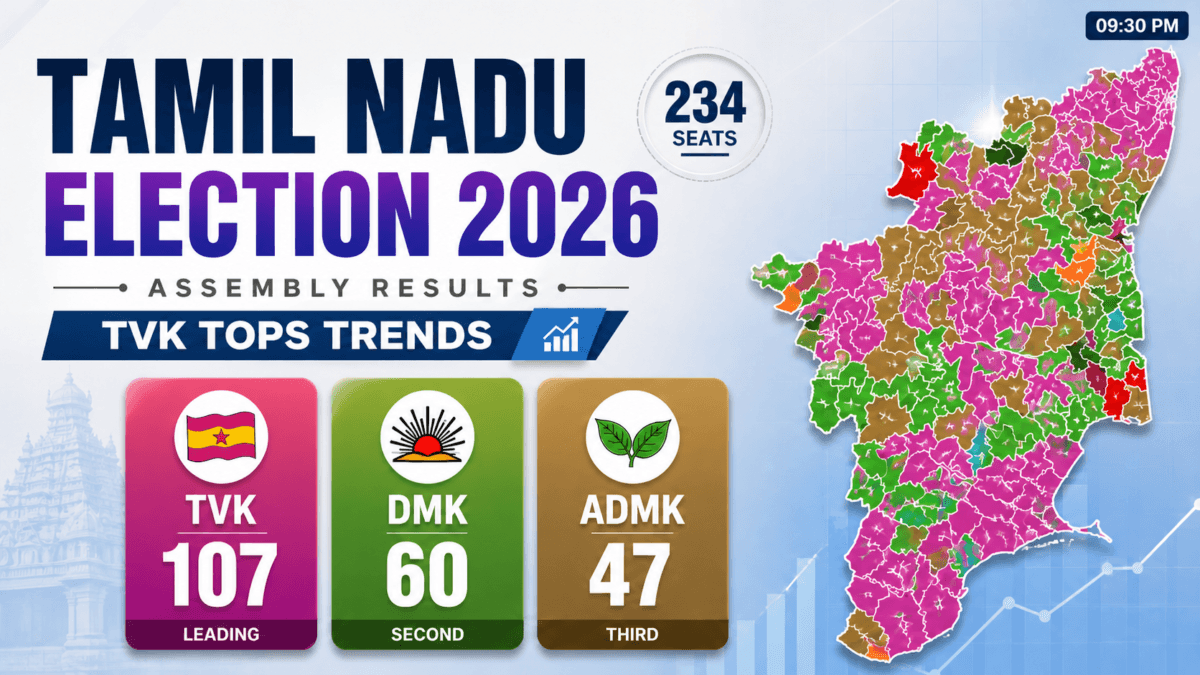
Tamil Nadu politics has always been intense and emotionally charged. Every election reflects not just the opinions of the people, but also their hopes and confidence in the future. Looking at the latest trends of the 2026 Assembly elections, this is not just a game of numbers—it signals the beginning of a major political shift.
Out of the total 234 constituencies in the state, the party currently leading is Tamilaga Vettri Kazhagam (TVK). The party has secured or is leading in 107 seats overall. Among these, it has already won 95 seats and is ahead in another 12. This is not an ordinary victory—it indicates growing public trust in new leadership. In a state historically dominated by major parties, the rise of a new force in such a strong manner is a significant development.
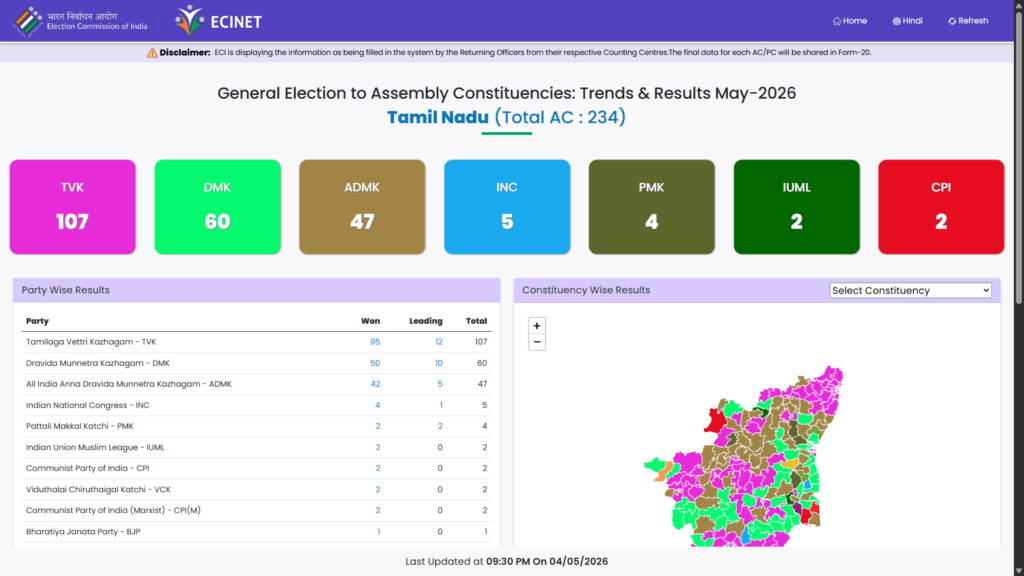
Meanwhile, the Dravida Munnetra Kazhagam (DMK) stands in second place with 60 seats, including 48 wins and 12 leads. For a party that once held the top position, this appears to be a decline. Similarly, the All India Anna Dravida Munnetra Kazhagam (ADMK) is in the race with 47 seats, having won 41 of them. Although still politically relevant, the party seems to be striving to regain its past dominance.
The role of smaller parties is also noteworthy this time. The Indian National Congress (INC) has won 5 seats, while Pattali Makkal Katchi (PMK) has secured 4. Parties like IUML, CPI, VCK, and CPI(M) have each won 2 seats. The Bharatiya Janata Party (BJP) is limited to just one seat. Even though these numbers are small, they could play a crucial role in government formation.
Another interesting aspect is the constituency map. Instead of being dominated by a single party, the map shows a mix of different colors across the state. This suggests that voters are no longer committed to one party alone, but are making decisions based on local issues and candidate performance.
There is also an emotional story behind these election results. The people of Tamil Nadu have always used their vote responsibly. This time, their verdict clearly signals a desire for change. Voters are looking for new ideas, new leadership, and better governance.
These results are also significant at the national level. Political changes in an important state like Tamil Nadu can influence other states as well. The outcomes may shape future alliances and political strategies across the country.
As of 9:24 PM on May 4, 2026, these trends are not yet final, but the direction is quite clear. A new chapter is beginning in Tamil Nadu politics.
In conclusion, these elections are not just about victory or defeat. They represent the voice of the people—their aspirations, their future, and their vision for the state. Tamil Nadu is now stepping toward change, and the scale of that change will unfold in the days to come.