
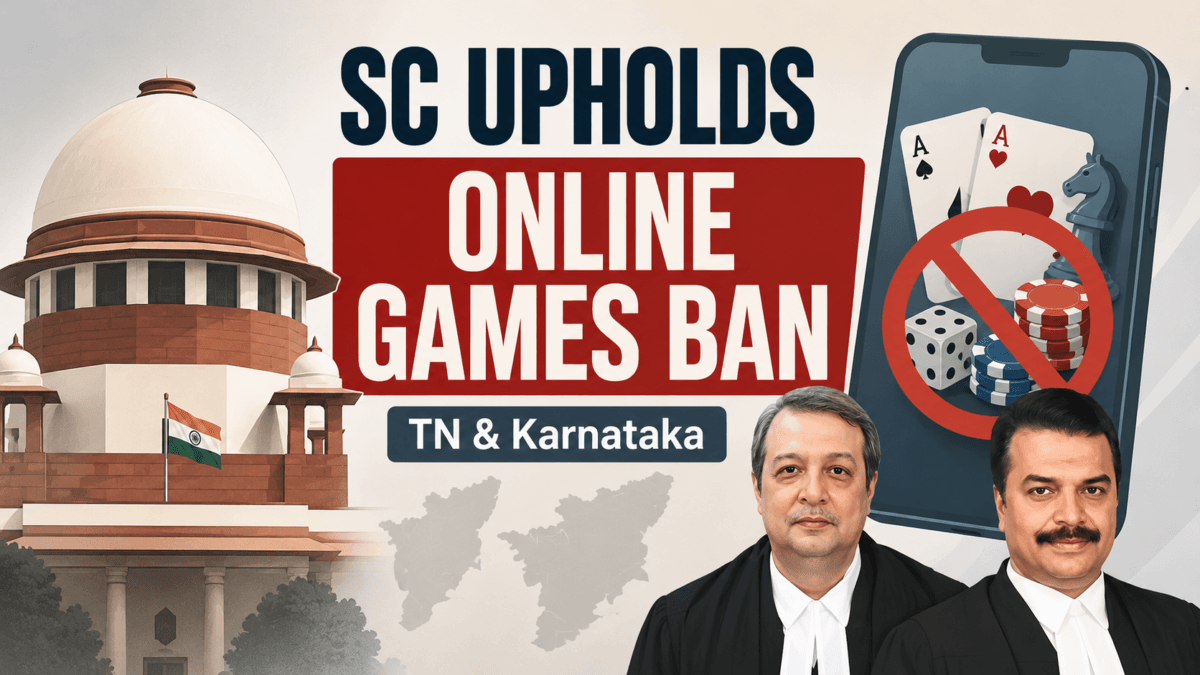
Online games have become a daily habit for many people. Some play for entertainment, some for competition, and many are drawn by the chance to win money. The legal question becomes serious when a game of skill is played with real stakes. The Supreme Court has now made an important distinction: a game may involve skill, but betting on that game does not automatically get constitutional protection. The Court upheld Tamil Nadu and Karnataka laws restricting online games played for money or stakes, including games such as rummy, poker, and fantasy sports.
Understanding the Supreme Court’s Ruling
Skill Game and Betting Are Not the Same
For years, Indian law has treated games of skill differently from pure games of chance. A game like rummy may involve memory, judgment, and strategy. However, the Supreme Court clarified that the legal protection available to skill-based games does not extend to betting or wagering placed on them.
This means the Court looked beyond the nature of the game itself. Once money is staked on an uncertain result, the activity can fall within the area of betting and gambling. The Court held that states are competent to regulate or prohibit such betting under Entry 34 of the State List, which deals with “betting and gambling.”
No Fundamental Right to Betting
The gaming companies argued that offering skill-based games was a business protected under Article 19(1)(g) of the Constitution, which protects the right to practise any profession or carry on trade or business. The Supreme Court rejected protection for betting-related activity, holding that there is no fundamental right to conduct betting and gambling as a trade.
This is important because if no fundamental right exists, the Court does not examine the restriction in the same way it would examine restrictions on ordinary business activities.
Why Tamil Nadu and Karnataka Laws Matter
State Power to Regulate Online Money Gaming
Tamil Nadu and Karnataka had amended their laws to control online games played for money or stakes. These laws were challenged by online gaming companies. Earlier, the Madras High Court and Karnataka High Court had taken a more favourable view of skill games. The Supreme Court set aside those High Court judgments and upheld the states’ power to act.
The judgment strengthens the role of state governments in dealing with online betting platforms. It also gives other states a legal basis to frame stricter rules where money-based online gaming is seen as harmful.
Public Order and Social Harm
The Court also considered the wider effect of online money gaming. Concerns such as addiction, financial loss, and distress among users were treated as relevant to public order. The judgment noted that online money gaming can become more accessible and normalised through digital platforms, making regulation necessary.
This does not mean every online game is illegal. Free-to-play games, casual games, and skill-based competitions without betting may still stand on a different legal footing. The key issue is the presence of money or stakes tied to the outcome.
Practical Impact of the Judgment
For Online Gaming Companies
Gaming platforms must review whether their business model involves stakes, entry fees, prize pools, or wagering linked to game outcomes. If they operate in Tamil Nadu, Karnataka, or any state with similar restrictions, compliance becomes essential.
Companies may need to separate entertainment gaming from real-money betting models. They may also need clearer user warnings, age checks, responsible gaming tools, and state-specific compliance systems.
For Players and Families
Players should understand that “game of skill” does not always mean “legally safe” when money is involved. A platform may appear professional, but if it offers betting in a restricted state, users may face legal and financial risks.
Families should watch for signs of gaming-related harm, such as repeated borrowing, hiding losses, late-night play, emotional distress, or chasing losses. Early conversation is often more useful than blame.
Practical Tips
Check whether an online game involves real money, stakes, or cash prizes before playing.
Read the platform’s terms and confirm whether it is allowed in your state.
Avoid borrowing money or using credit cards for online games.
Set strict spending and time limits.
Seek help if gaming starts affecting studies, work, family life, or finances.
Key Takeaways
A game of skill is legally different from betting on that game.
The Supreme Court upheld Tamil Nadu and Karnataka laws banning online games with stakes.
There is no fundamental right to conduct betting or gambling as a business.
States can regulate or prohibit online money gaming under constitutional powers.
Players should be careful before joining real-money gaming platforms.
Conclusion
The Supreme Court’s ruling draws a clear legal line between playing a skill-based game and betting money on its result. The judgment recognises that digital platforms can make wagering easy, attractive, and risky. For governments, it confirms regulatory power. For companies, it demands careful compliance. For citizens, it is a reminder that skill alone does not remove the legal and personal risks of online betting.