
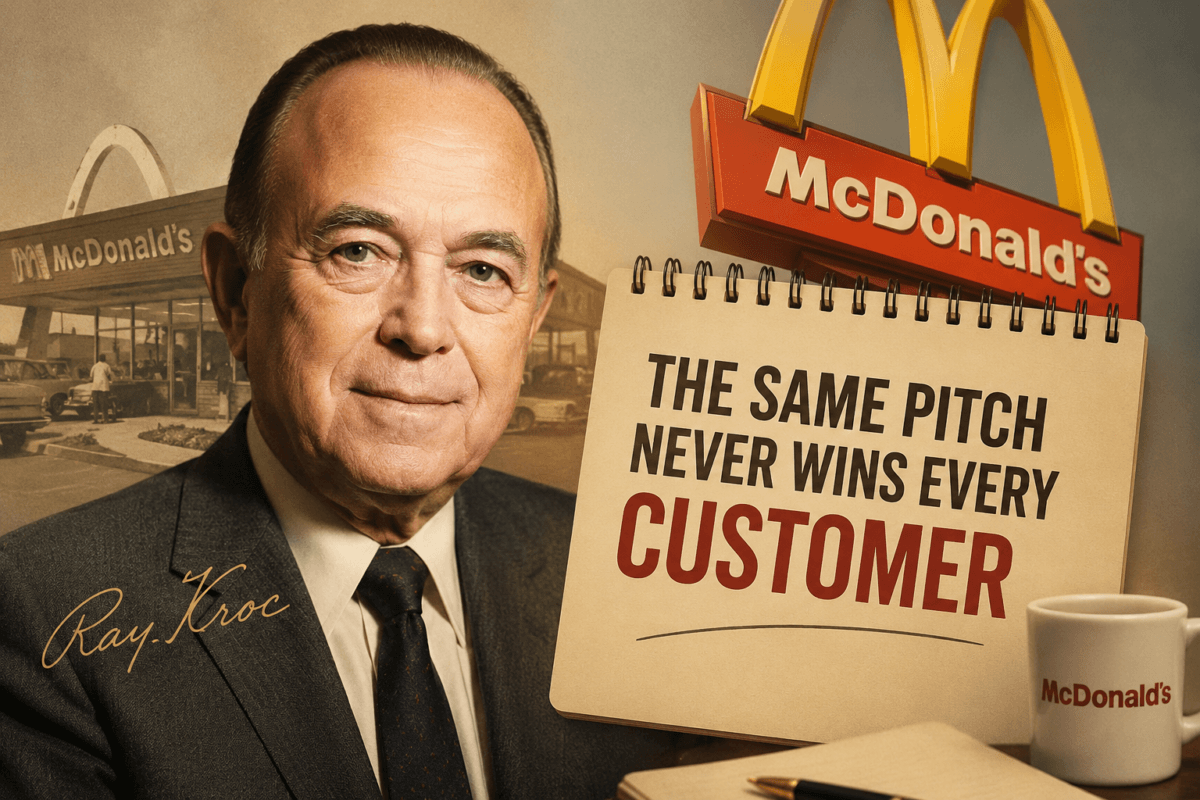
Sales is not only about speaking well. It is about understanding people. A good salesperson knows that every customer has different needs, doubts, budgets, and reasons for buying. This idea is captured strongly in Ray Kroc’s famous business quote: “No self-respecting pitcher throws the same way to every batter and no self-respecting salesman makes the same pitch to every client.”
Kroc, best known for transforming McDonald’s into a global fast-food brand, understood that selling requires flexibility. His quote is still useful for entrepreneurs, sales teams, small business owners, and anyone who deals with customers.
Main Content
Who Was Ray Kroc?
Ray Kroc was a salesman before he became one of the most recognized names in business history. In 1954, he visited the McDonald brothers’ restaurant in San Bernardino while selling Multimixer machines. He was impressed by the speed and efficiency of their restaurant system and later became their franchising agent. McDonald’s official history notes that Kroc saw a bigger future in hamburgers after that visit.
His success did not come only from having a product to sell. It came from seeing opportunity, understanding systems, and convincing others to believe in a business model.
The Real Meaning of the Quote
Kroc’s quote compares sales with baseball. A pitcher studies each batter and changes the throw based on the situation. In the same way, a salesperson should not use one fixed pitch for every customer.
Some customers want low cost. Some want quality. Some want speed. Some want trust and after-sales support. If the salesperson gives the same message to everyone, the pitch may sound lazy and disconnected.
Good selling begins with listening. The best pitch is not the one that sounds impressive; it is the one that matches the customer’s real problem.
Why Personalization Matters in Sales
Modern customers have more choices than ever. They can compare prices, read reviews, check competitors, and reject a product within seconds. This makes personalization essential.
A small business owner selling accounting software to a startup should not speak the same way to a large manufacturing company. The startup may care about affordability and ease of use. The manufacturing company may care about security, reporting, and integration with existing systems.
One Product, Many Customer Needs
The same product can solve different problems for different buyers. A fitness membership may help one customer lose weight, another manage stress, and another build discipline. A salesperson who understands this can explain the same service in different ways without being dishonest.
This is not manipulation. It is relevance. The product remains the same, but the explanation changes according to the customer’s need.
Business Lessons from Kroc’s Sales Thinking
Listening Is a Sales Skill
Many salespeople talk too much too early. They explain features before understanding the customer. A better approach is to ask simple questions: What challenge are you facing? What have you tried before? What matters most to you?
These questions help create a meaningful conversation.
Adaptation Builds Trust
Customers can sense when a salesperson is using a memorized script. A flexible conversation feels more respectful. It shows that the seller values the buyer’s time and situation.
Systems Still Matter
Kroc’s business success was also connected to consistency. McDonald’s grew because the experience could be repeated across locations. Britannica notes that Kroc launched McDonald’s Systems, Inc. in 1955 and opened a franchise in Des Plaines, Illinois.
The lesson is clear: personalize the pitch, but keep the business process reliable.
Practical Tips
Segment Your Customers
Divide customers by need, budget, industry, or buying purpose. This helps you prepare better conversations.
Ask Before You Explain
Do not start with a long product speech. First, understand what the customer wants to achieve.
Connect Features to Benefits
A feature tells what a product has. A benefit explains why it matters. Customers usually buy benefits, not features.
Review Failed Sales
When a deal is lost, study why. The pitch may have been too generic, too rushed, or focused on the wrong point.
Key Takeaways
A strong sales pitch should match the customer’s needs.
Personalization improves trust and relevance.
Listening is as important as presenting.
Different customers may value the same product for different reasons.
A business should combine flexible selling with consistent delivery.
Conclusion
Ray Kroc’s quote remains powerful because it reminds businesses that customers are not all the same. A fixed pitch may be easy, but it rarely creates deep connection. Real sales success comes from preparation, listening, adaptation, and honest communication.
For today’s entrepreneurs and sales professionals, the lesson is simple: do not sell like a machine. Understand the person in front of you. When your message fits the customer’s need, selling becomes less about pressure and more about solving a problem.