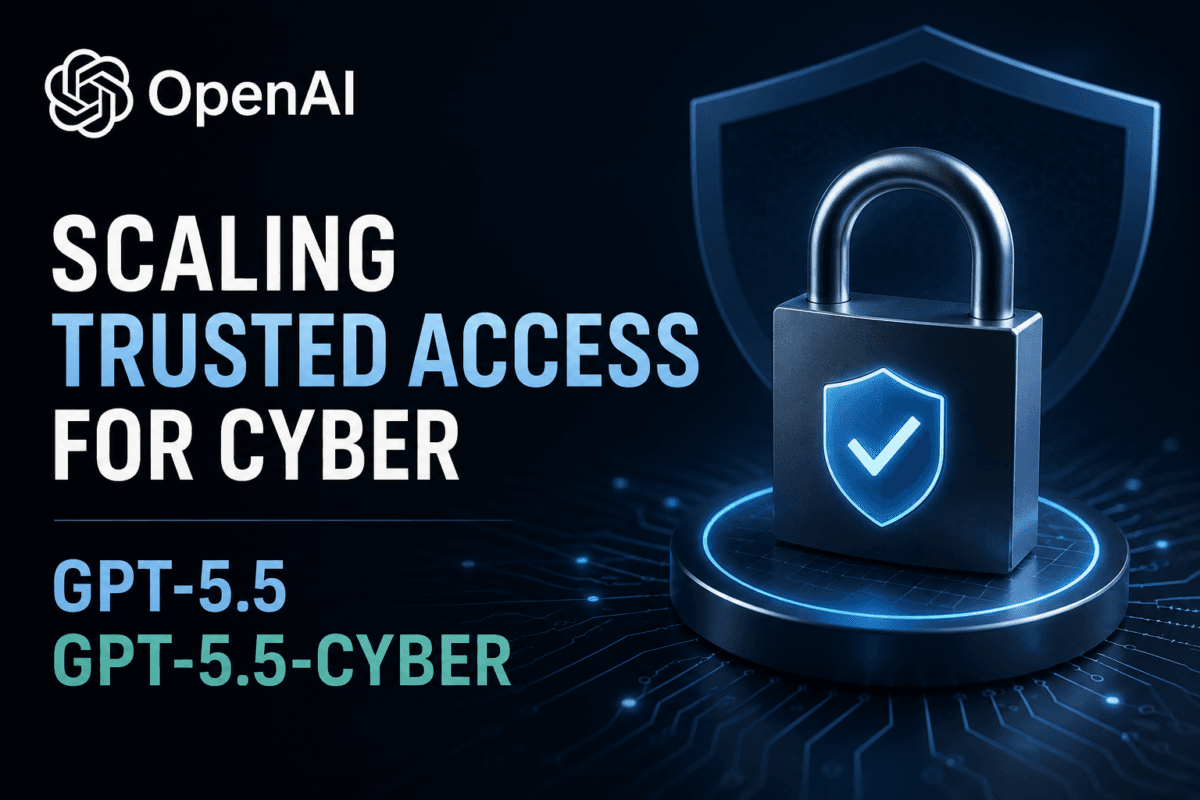
Cybersecurity teams need speed, accuracy, and control. AI can help analysts review alerts, summarize logs, write reports, and understand risks faster. But in cybersecurity, powerful AI access must be handled carefully. A model that helps defenders can also create risk if it is connected to sensitive systems without proper limits.
OpenAI describes GPT-5.5 as a model designed for complex work such as coding, research, data analysis, and reliable tool use, with a large context window available through its API. In a cyber environment, this makes trusted access even more important.
Main Content
What Trusted Access Means in Cybersecurity
Trusted access means giving the right user the right AI capability for the right task. Not every employee should have the same level of access.
A help desk worker may only need help writing a password-reset guide. A SOC analyst may need alert summaries. A senior incident responder may need deeper investigation support. Each role should have clear limits.
Why Access Control Matters
Cybersecurity data often includes IP addresses, usernames, logs, business systems, and sometimes sensitive customer information. If this data is shared carelessly, it can create privacy and security problems.
Trusted access helps reduce that risk through role-based permissions, identity checks, approval flows, data masking, and activity logging.
How GPT-5.5 Can Support Cyber Teams
GPT-5.5 can be useful for daily defensive work. It can help explain technical alerts, draft incident reports, summarize policy documents, and review secure coding practices.
For example, instead of reading hundreds of lines of log notes, an analyst could ask for a short summary of unusual activity. The final decision should still remain with a trained human.
Using GPT-5.5 Safely
The safest approach is to connect GPT-5.5 only to approved data sources. Organizations should avoid sending passwords, private keys, confidential files, or raw personal data into prompts.
Where GPT-5.5-Cyber Fits
GPT-5.5-Cyber can be treated as a cyber-focused model or controlled deployment layer for higher-risk security work. It should be limited to vetted defenders and approved defensive workflows.
For example, it may help incident responders organize evidence, compare suspicious behavior, or prepare containment steps. It should not be used as an unrestricted tool for unknown users.
Practical Tips
Start with Low-Risk Tasks
Begin with documentation, report writing, alert summarization, and internal training support.
Use Role-Based Access
Give users only the AI permissions needed for their job. Review access regularly.
Protect Sensitive Data
Remove secrets, personal data, and confidential business details before using AI tools.
Keep Audit Logs
Track prompts, outputs, user activity, and tool actions. This supports accountability.
Keep Humans in Control
Require human approval for major actions such as account suspension, firewall changes, or incident containment.
Key Takeaways
Trusted access is essential for safe AI use in cybersecurity.
GPT-5.5 can improve speed and clarity in daily cyber operations.
GPT-5.5-Cyber should be restricted to trained security users and defensive tasks.
Good governance, logging, and human review reduce risk.
Conclusion
Scaling AI in cybersecurity is not only about using stronger models. It is about building safe controls around them. GPT-5.5 can help teams work faster, while a cyber-focused layer such as GPT-5.5-Cyber can support advanced defensive tasks. The best results come from combining AI capability with careful access control, strong data protection, and responsible human judgment.