
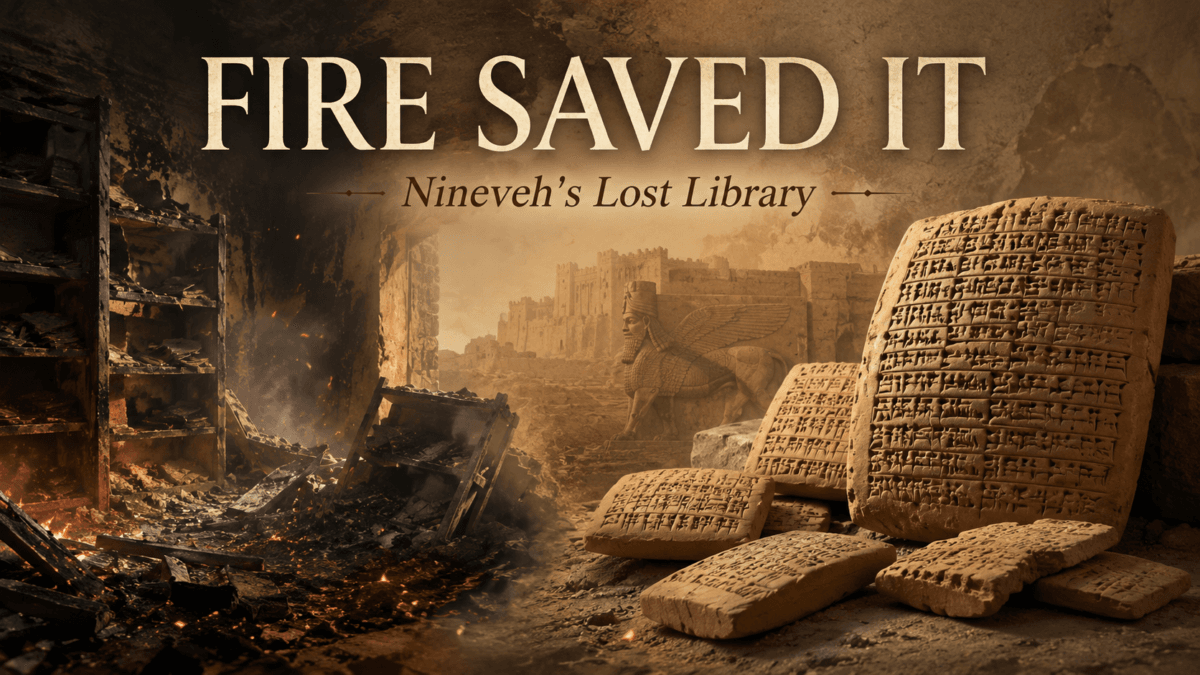
Some of history’s greatest losses happened in fire. Palaces burned, scrolls vanished, wooden shelves collapsed, and generations of knowledge disappeared in a single night. But the Library of Ashurbanipal offers a rare and almost poetic exception. When Nineveh fell in 612 BC, fire did not erase every trace of the Assyrian royal library. In a strange twist, it helped preserve many of its clay tablets.
The library, gathered under King Ashurbanipal of Assyria, contained more than 30,000 clay tablets and fragments written in cuneiform. These tablets were discovered in the ruins of Nineveh, near modern Mosul in Iraq, and today they are among the most important sources for understanding ancient Mesopotamian literature, science, religion, medicine, and statecraft. The story matters because it shows how fragile knowledge can be, but also how unexpectedly it can survive.
Main Content
The King Who Collected Knowledge
Ashurbanipal Was More Than a Warrior King
Ashurbanipal ruled Assyria in the 7th century BC, when the empire was one of the most powerful forces in the ancient Near East. Like many Assyrian kings, he was known for military campaigns and imperial authority. But he was also unusual because of his deep interest in scholarship.
Britannica describes Ashurbanipal as the last great king of Assyria and credits him with assembling the first systematically organized library in Mesopotamia and the ancient Middle East.
This was not a public library in the modern sense. It was a royal collection, built for power, learning, ritual, administration, and prestige. Knowledge helped kings rule. Omens, medical texts, prayers, myths, royal inscriptions, lists, and scholarly works all had practical value in a world where politics, religion, and cosmic order were closely connected.
A Library Written in Clay
The “books” in Ashurbanipal’s library were not paper books. They were clay tablets marked with cuneiform script. Cuneiform was made by pressing a reed stylus into soft clay, creating wedge-shaped signs. The British Museum explains that cuneiform means “wedge-shaped” and was used in Mesopotamia for thousands of years.
Clay was heavy, but it had one huge advantage: it could survive conditions that would destroy paper, leather, or wood. Once dried or fired, a clay tablet could remain readable for thousands of years, even if broken.
The Fall of Nineveh in 612 BC
An Empire Comes Under Attack
Nineveh was the capital of the Assyrian Empire. In 612 BC, it was attacked and destroyed by a coalition that included Babylonians and Medes. Some accounts also mention other groups involved in the fall of the city.
The destruction of Nineveh was not just the fall of one city. It marked the collapse of Assyrian imperial power. Palaces were burned, buildings were ruined, and the political center of one of the ancient world’s strongest empires was shattered.
Fire as a Destroyer and Preserver
Normally, fire is the enemy of libraries. It turns paper to ash and burns wooden storage systems. But in Nineveh, many texts were written on clay. When the palace burned, the heat baked many clay tablets harder, helping preserve them instead of destroying them. The British Museum notes that when Nineveh was consumed by fire around 612 BC, the clay tablets were in many cases baked harder and became some of the best-preserved documents from Mesopotamian history.
This does not mean every part of the library survived. Organic materials such as wax boards, leather, papyrus, or wooden writing boards would have been far more vulnerable. What survives today is probably only part of what once existed. But the clay tablets endured in enough quantity to transform modern knowledge of Mesopotamia.
What Was Found in the Library?
More Than Myths and Poems
The Library of Ashurbanipal is often remembered because it preserved great works of literature, but its contents were much broader. The British Museum says the collection included texts on many subjects, including medicine, astronomy, divination, literature, and royal administration.
This variety shows that ancient Mesopotamian scholarship was highly organized. Scholars studied the heavens, interpreted omens, copied older texts, preserved rituals, and recorded practical information. The library was not just a treasure chest of stories. It was a working archive of knowledge.
The Epic of Gilgamesh
The most famous literary work linked to Ashurbanipal’s library is the Epic of Gilgamesh. The British Museum identifies one tablet from the collection as Tablet 11 of the Epic of Gilgamesh, containing the story of the Flood.
This discovery changed how modern readers understood ancient literature. Gilgamesh is one of the oldest surviving epic traditions in the world. Through the tablets from Nineveh, readers today can encounter grief, friendship, kingship, fear of death, and the human search for meaning from a world more than two and a half thousand years old.
That is the emotional power of this story. A palace was burned to end an empire, but the fire helped carry ancient poetry into the modern age.
Why the Survival of the Tablets Matters
They Opened a Door Into Mesopotamian Thought
Before cuneiform was deciphered, the tablets were silent objects. After scholars learned to read the script, they became voices from the ancient Near East. The texts helped historians understand how Mesopotamians thought about gods, kings, illness, dreams, astronomy, law, fate, and storytelling.
World History Encyclopedia notes that the discovery of more than 30,000 texts from the library, once cuneiform was deciphered, greatly expanded understanding of world history. The library matters because it does not preserve only royal propaganda. It preserves a wide intellectual world.
It Shows That Knowledge and Power Were Connected
Ashurbanipal’s library was not simply a peaceful scholarly project. It was also tied to empire. Kings collected knowledge because knowledge could strengthen authority. Texts could guide rituals, support decisions, interpret danger, and display cultural dominance.
This makes the library more complex. It was both a monument of learning and a tool of rule. The same king who valued texts also ruled through military power. The survival of his library allows us to see both sides of ancient empire: its intellectual richness and its violence.
The Irony of Destruction
A Failed Erasure
The attackers of Nineveh likely wanted to destroy Assyrian power, not preserve Assyrian learning. Yet the burning palace created the conditions that helped many clay tablets survive. This is one of history’s great ironies.
Still, it is important to avoid exaggeration. We cannot prove that every attacker intended to destroy the library specifically. What we can say is that the destruction of the palace, meant to end Assyrian dominance, accidentally preserved a major part of its written culture.
Broken Does Not Mean Lost
Many surviving tablets are fragments. Some are cracked, incomplete, or difficult to join. But even broken tablets can be valuable. A single fragment may preserve a line of poetry, a medical recipe, a name, a ritual instruction, or a clue that helps scholars reconstruct a larger text.
This is why archaeology often depends on patience. Ancient history is not always recovered as complete books. Sometimes it returns as pieces that must be compared, translated, and carefully rebuilt.
Practical Lessons From Ashurbanipal’s Library
Preserve Knowledge in Durable Forms
The Library of Ashurbanipal reminds us that the medium matters. Clay tablets survived fire better than many organic materials. Today, we face different risks: digital decay, data loss, censorship, hacking, and neglect. Important knowledge should be backed up, copied, and stored in more than one form.
Protect Cultural Heritage Before Crisis
Many ancient losses happened during war, invasion, looting, or political collapse. Modern societies should protect archives, museums, libraries, and heritage sites before emergencies happen. Once a collection is destroyed, it may never be fully recovered.
Read the Past With Care
Ancient texts are powerful, but they need context. A royal library reflects elite concerns. It does not represent every person in Mesopotamia equally. Readers should value what survives while remembering that many voices were never written down or have been lost.
Key Takeaways
The Library of Ashurbanipal was a major royal collection in ancient Nineveh.
More than 30,000 clay tablets and fragments from the library were found in the ruins of the city.
Nineveh was destroyed in 612 BC, ending Assyrian imperial power.
The palace fire helped bake many clay tablets harder, preserving them for thousands of years.
The library preserved texts on literature, medicine, astronomy, divination, administration, and religion.
The Epic of Gilgamesh is one of the most famous works connected to the collection.
The story shows that attempts to destroy power can sometimes preserve memory by accident.
Conclusion
The Library of Ashurbanipal survives as one of history’s most remarkable accidents. Nineveh burned, the Assyrian Empire fell, and much of the royal world that created the library disappeared. Yet the clay tablets remained, hardened by the same fire that destroyed the palace around them.
Because of those tablets, modern readers can still hear ancient Mesopotamian voices. We can read stories of kings and heroes, fears about death, prayers to gods, records of healing, observations of the heavens, and the administrative language of empire.
The lesson is both humbling and hopeful. Knowledge is always vulnerable. It can be attacked, buried, broken, or forgotten. But sometimes it survives in ways no one expected. In Nineveh, destruction became preservation, and a burned palace became one of the world’s greatest windows into the ancient mind.