
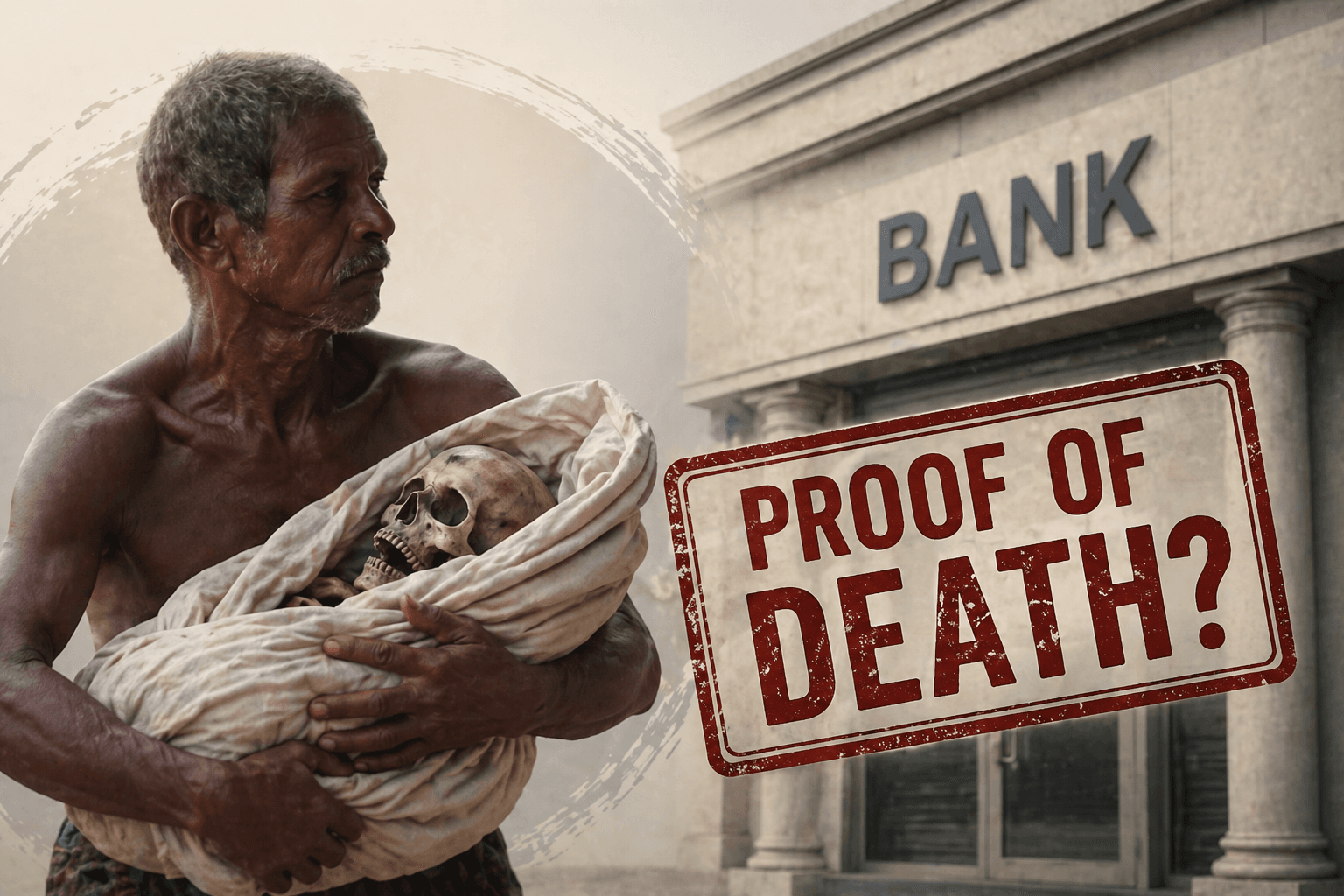
An incident that took place in Odisha has sparked nationwide outrage and deep reflection. What began as a simple financial issue for a family escalated into a situation that questions humanity itself. A man being forced to carry his sister’s bones to a bank just to prove her death highlights serious flaws in the system.
A 52-year-old man, Jitu Munda, tried to withdraw money from his deceased sister’s bank account. For many families in rural areas, such money is crucial for survival. However, the bank required a death certificate to process the request. Obtaining this document proved extremely difficult for him due to the distance of government offices, complicated procedures, time constraints, and financial burdens.
Despite visiting the bank multiple times, his requests were repeatedly denied due to a lack of proper documentation. Frustrated and helpless, he took an extreme step. According to police reports, Jitu Munda exhumed his sister’s remains and brought her bones to the bank as proof of her death. A video of the incident went viral on social media, triggering widespread public reaction across the country.
Later, Jitu Munda clarified that he had no intention of making a spectacle. He said he was driven purely by circumstances and saw this as his last option. His actions reflect the depth of his struggle and desperation to secure financial support for his family.
On the other hand, bank officials denied wrongdoing. They stated that they only asked for legally required documents and emphasized that such rules are necessary to prevent fraud. However, this explanation has not fully calmed public anger.
This incident brings attention to a larger issue—the gap between government systems and the everyday lives of common people. While rules and regulations are necessary, their rigid implementation without compassion can lead to such tragic situations. This is especially true for people living in rural areas, where accessing services is often more difficult.
Death is treated with great respect in every culture, especially in India. In such a context, a man being forced to exhume and carry his sister’s remains is a deeply disturbing reality and a serious warning for society.
This घटना reminds us of an important truth—progress is not just about rules and systems, but also about how they impact human lives. The story of Jitu Munda is not just about one man’s suffering; it reflects a harsh reality and signals the urgent need for change in the system.