
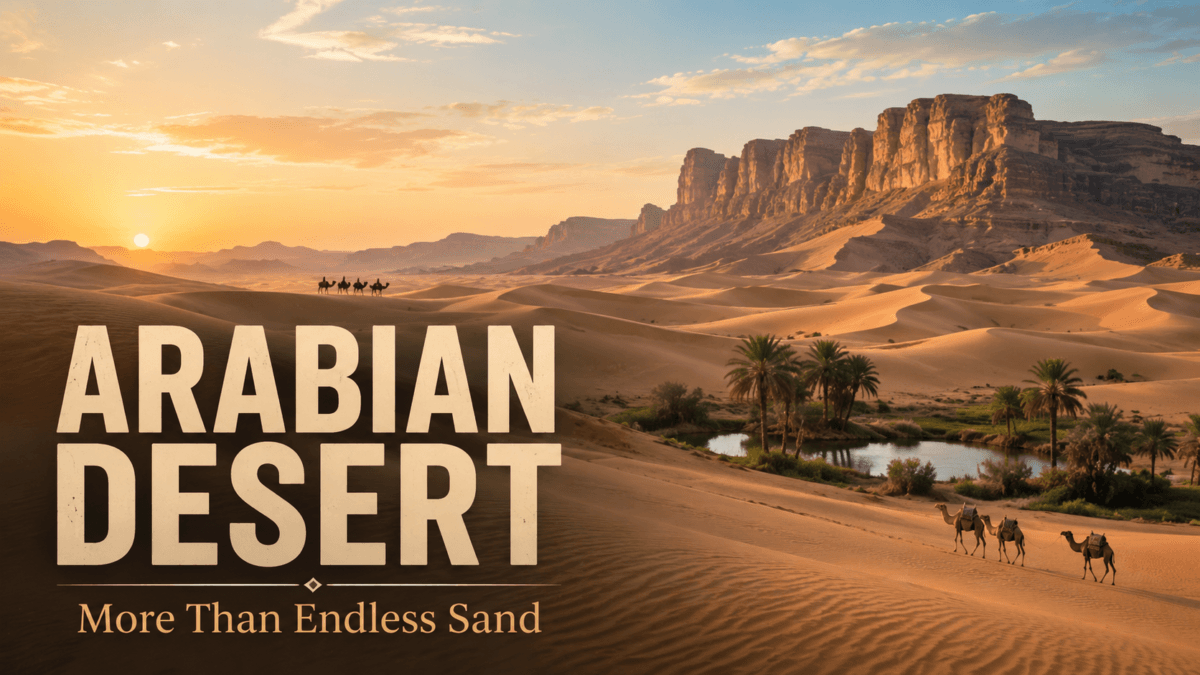
The largest desert in Asia is the Arabian Desert. It covers about 900,000 square miles, or roughly 2.3 million square kilometers, across the Arabian Peninsula and nearby regions of southwestern Asia. Britannica describes it as the largest desert area on the Asian continent.
Many people quickly answer “Gobi Desert” when asked about Asia’s largest desert, and that confusion is understandable. The Gobi is one of Asia’s most famous deserts and is often highlighted in school geography. However, by total area, the Arabian Desert is larger. The Gobi covers about 500,000 square miles, or 1.3 million square kilometers, while the Arabian Desert covers about 900,000 square miles.
The Arabian Desert is not just a huge stretch of sand. It is a region of dunes, gravel plains, rocky plateaus, mountains, dry valleys, oases, ancient trade routes, oil-rich landscapes, wildlife, and human adaptation. Understanding it helps us see how deserts shape climate, culture, economy, travel, and survival.
What Is the Arabian Desert?
Asia’s Largest Desert by Area
The Arabian Desert occupies almost the entire Arabian Peninsula. It lies mainly in Saudi Arabia, but it also extends into countries such as Yemen, Oman, the United Arab Emirates, Qatar, Kuwait, Jordan, and Iraq. Britannica notes that large portions of the desert extend across several countries of the Arabian Peninsula and surrounding areas.
Its size alone makes it one of the world’s major desert regions. It is larger than many countries and contains several smaller desert zones within it. These include famous areas such as the Rub’ al Khali, also known as the Empty Quarter, and the An Nafud Desert in northern Saudi Arabia.
Why It Is Sometimes Confused With the Gobi
The Gobi Desert is extremely well known because it stretches across Mongolia and northern China and has strong links with Central Asian history, the Silk Road, dinosaur fossils, and cold desert landscapes. Britannica estimates the Gobi’s area at about 500,000 square miles, or 1.3 million square kilometers.
The Arabian Desert, however, is significantly larger. The confusion often happens because the Gobi is sometimes described as the largest desert in Asia in older general references or school materials, while other sources classify the Arabian Desert more clearly as Asia’s largest desert by total area. The best answer is: the Arabian Desert is the largest desert in Asia by area, while the Gobi is one of Asia’s largest and most famous cold deserts.
Geography of the Arabian Desert
A Desert Across the Arabian Peninsula
The Arabian Desert stretches from Yemen toward the Persian Gulf and from Oman toward Jordan and Iraq. Its location gives it a major role in the geography of the Middle East. It sits between important seas, trade routes, oil fields, and historic settlement zones.
The desert’s landscape is not the same everywhere. Some parts are covered with sand dunes, while others are rocky, gravelly, or mountainous. Britannica describes the Arabian Desert as having broken relief, mountain ranges, high escarpments, and elevations reaching up to about 12,000 feet in some areas. This variety matters because many people imagine a desert as one endless sea of sand. In reality, deserts can include stone plains, salt flats, dry riverbeds, cliffs, plateaus, and isolated vegetation.
The Empty Quarter
The Rub’ al Khali, or Empty Quarter, is one of the most famous parts of the Arabian Desert. It is a vast sand desert spread across parts of Saudi Arabia, Oman, the United Arab Emirates, and Yemen. Its dunes, silence, heat, and scale have made it one of the most iconic desert landscapes in the world.
The Empty Quarter is often used as a symbol of extreme desert wilderness. But even here, the environment is not meaningless or empty in a historical sense. Nomadic routes, oil exploration, Bedouin knowledge, and modern scientific studies have all connected people to this harsh region.
Climate and Living Conditions
Extreme Heat and Very Low Rainfall
The Arabian Desert is known for hot temperatures, dry air, and very limited rainfall. In many areas, rain is rare and unpredictable. Long dry periods can be interrupted by sudden storms that briefly fill dry channels before the water disappears into sand or evaporates.
This kind of climate creates serious challenges for plants, animals, and people. Water becomes the most important resource. Settlements traditionally developed around wells, springs, oases, coastal zones, or trade routes where survival was possible.
Desert Nights Can Be Cold
Although the Arabian Desert is famous for heat, desert nights can become surprisingly cool, especially away from cities and during winter. This happens because dry air and clear skies allow heat to escape quickly after sunset. This daily temperature difference is one reason desert travel has always required skill. Travelers must prepare not only for daytime heat but also for colder nights, strong winds, sandstorms, and limited water.
Life in the Arabian Desert
Plants That Survive Harsh Conditions
The Arabian Desert may look empty from a distance, but life exists in adapted forms. Desert plants often have deep roots, small leaves, waxy surfaces, or short life cycles that allow them to respond quickly after rain.
Some plants remain dormant during dry periods and grow only when moisture becomes available. Others survive in dry valleys or near underground water. These plants help hold soil, provide food for animals, and support traditional grazing systems.
Animals Adapted to the Desert
Animals in the Arabian Desert survive by avoiding heat, conserving water, moving long distances, or becoming active at night. Reptiles, insects, birds, foxes, rodents, and desert ungulates all have survival strategies suited to dry environments.
The camel is the most famous desert animal associated with Arabia. It played a major role in transport, trade, milk production, and nomadic life. Without camels, long-distance movement across many desert regions would have been far more difficult.
Human History and Culture
Bedouin Knowledge and Desert Survival
For centuries, Bedouin communities developed deep knowledge of the desert. They understood water sources, grazing lands, weather signs, animal behavior, stars, and travel routes. This knowledge allowed people to live in places that outsiders often considered impossible. Desert life shaped values such as hospitality, endurance, mobility, and resourcefulness. In harsh environments, sharing water, food, and shelter was not just kindness. It could be a matter of survival.
Trade Routes and Oases
The Arabian Desert was never completely isolated. Trade routes crossed desert regions, connecting inland communities with coastal ports, agricultural zones, and distant markets. Oases served as rest points, trading centers, and settlement areas. Caravans carried goods, ideas, languages, and religious influences across desert routes. This made the desert a space of movement, not just emptiness.
Economic Importance of the Arabian Desert
Oil, Gas, and Modern Development
The Arabian Desert is linked closely with the modern energy economy. Parts of the region contain some of the world’s major oil and gas reserves. These resources transformed the economies of Gulf countries and changed the global importance of the desert.
Modern cities, highways, pipelines, airports, and industrial zones now exist in areas that were once crossed mainly by caravans and nomads. This transformation shows how geography can shape economic power.
Tourism and Desert Adventure
Today, desert tourism is growing in parts of the Arabian Peninsula. Visitors come for dune driving, camping, camel rides, stargazing, desert photography, heritage villages, and luxury desert resorts. However, tourism must be managed carefully. Desert ecosystems are fragile. Vehicle damage, litter, overdevelopment, and careless camping can harm landscapes that recover very slowly.
Why Deserts Matter
Deserts Are Not Wastelands
Calling deserts “wastelands” is misleading. Deserts have ecosystems, histories, cultures, minerals, fossils, trade routes, and climate importance. They may support fewer plants and animals than rainforests, but the life they do support is highly specialized. The Arabian Desert teaches us that harsh environments can still be rich in meaning. They shape human behavior, influence politics, and preserve ancient forms of knowledge.
Climate Lessons From Desert Regions
Deserts also help us understand water scarcity, heat adaptation, and sustainable living. As many parts of the world face rising temperatures and water stress, desert communities offer lessons in conservation, architecture, clothing, movement, and respect for limited resources. Traditional desert life used shade, ventilation, seasonal movement, and careful water use long before modern climate planning became common.
Practical Tips for Remembering Asia’s Largest Desert
Use the Size Comparison
A simple way to remember the answer is this:
The Arabian Desert is about 2.3 million square kilometers, while the Gobi Desert is about 1.3 million square kilometers. So, the Arabian Desert is larger by area.
Remember the Region
The Arabian Desert is in Southwest Asia, mainly across the Arabian Peninsula. If a question asks for the largest desert in Asia, think of the Arabian Peninsula first.
Know the Gobi’s Correct Importance
The Gobi is still extremely important. It is one of Asia’s great deserts and one of the world’s major cold desert regions. But it is not larger than the Arabian Desert by total area.
Key Takeaways
The largest desert in Asia is the Arabian Desert.
It covers about 900,000 square miles, or around 2.3 million square kilometers.
It occupies most of the Arabian Peninsula.
It extends across Saudi Arabia and parts of several neighboring countries.
The Gobi Desert is famous and very large, but it is smaller than the Arabian Desert.
The Arabian Desert includes sand dunes, rocky plains, mountains, escarpments, and dry valleys.
It has shaped trade, culture, settlement, energy politics, and desert survival traditions.
Conclusion
The Arabian Desert is Asia’s largest desert, but its importance goes far beyond size. It is a landscape of extremes, where heat, dryness, wind, and distance have shaped human life for thousands of years. It has supported nomadic cultures, guided trade routes, influenced settlement patterns, and become central to the modern energy economy.
The Gobi may be better known in some geography lessons, but the Arabian Desert is larger by area and holds a unique place in Asia’s physical and human geography. It proves that deserts are not empty spaces on a map. They are powerful landscapes that shape history, culture, survival, and global connections.