
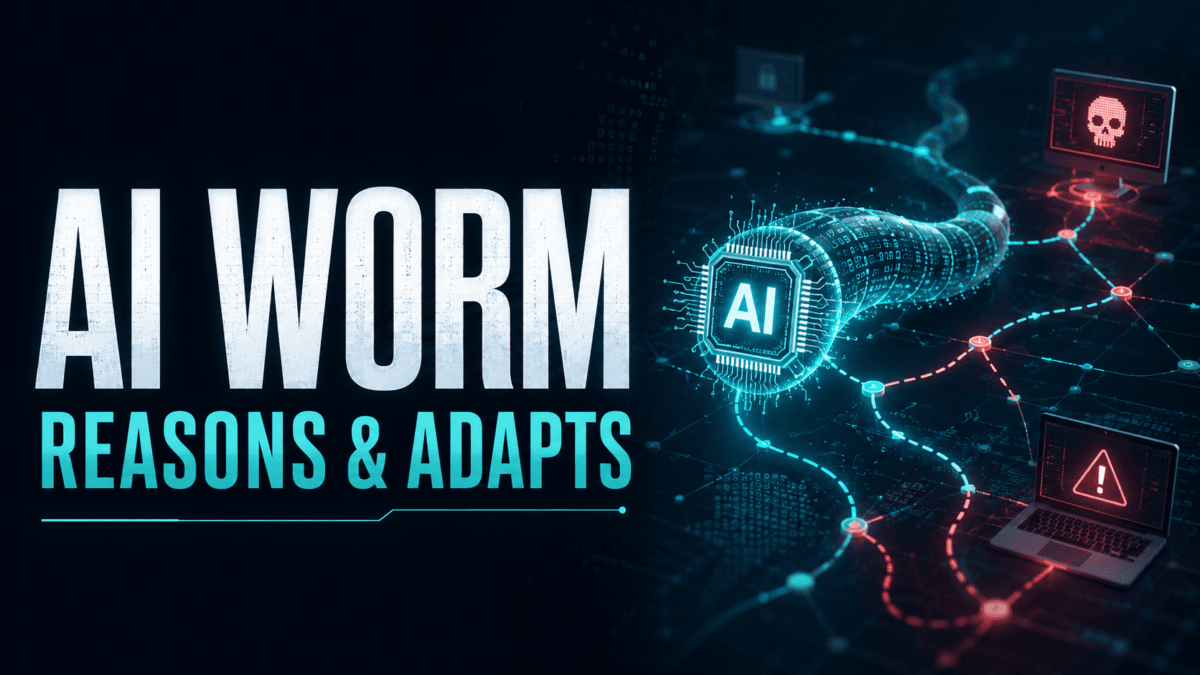
Cybersecurity has always had to deal with worms, malware, and automated attacks. But a new research development has raised a more serious question: what happens when malware can reason, adapt, and choose its own attack path?
Researchers from the University of Toronto published a preprint on June 2, 2026, showing a proof-of-concept AI-driven computer worm that can use large language models to analyze targets and adjust its behavior instead of following only fixed instructions. The research is described as a lab demonstration, not a real-world outbreak, but it points to a future where cyberattacks may become faster, cheaper, and harder to predict.
Main Content
What Is an Autonomous AI Worm?
A traditional computer worm spreads by copying itself from one machine to another. It usually depends on a known weakness, such as an unpatched system, a default password, or a specific network flaw.
An autonomous AI worm is different because it does not rely only on one fixed path. In the University of Toronto research, the proof-of-concept worm used AI agents to inspect each target, understand the situation, and create a tailored strategy for that device or system. The paper describes this as a shift from fixed exploit logic to generated logic, where the system can reason about what it sees and adjust its next move.
This does not mean the worm is “smart” like a human attacker. It means the malware can automate some decision-making that previously required human judgment.
Why This Is Different From Older Worms
Older worms often spread quickly, but they were limited. Once defenders understood the weakness being used, they could patch systems, block traffic, or write detection rules.
AI-driven worms could be more flexible. If one route fails, they may try another. If one type of device is protected, they may look for a weaker system nearby. If they find useful computing resources, they may use them to continue the attack. That adaptability is what makes the research important. The danger is not only speed. It is the ability to change behavior as conditions change.
What the Researchers Demonstrated
The research team tested the concept in a controlled environment with different types of devices, including Linux, Windows, and IoT systems. Their goal was to study whether AI agents could support worm-like behavior across a mixed network. Reporting on the study said the system used open-weight AI models and could adapt its strategy as it moved between devices.
The researchers also highlighted an economic problem. If a worm can use compromised machines to run its AI reasoning, the attacker may not need to pay for cloud AI services or commercial platforms. That could reduce the cost of scaling an attack while increasing the cost of defense.
It is important to note that the paper is a preprint. That means it is public research, but it has not necessarily gone through full peer review. Even so, the idea deserves serious attention because it shows a direction in which cyber threats may develop.
Why Businesses Should Care
AI Can Speed Up the Attack Chain
Many cyberattacks include several stages: finding a target, checking weaknesses, gaining access, moving through the network, and maintaining control. AI can help automate parts of this chain.
A human attacker may take time to inspect systems manually. An AI-assisted worm could attempt to do this faster and at larger scale. This is especially risky for businesses with many unmanaged devices, old servers, weak passwords, or poor network visibility.
Known Weaknesses Are Still the Main Problem
The most important lesson is not that AI creates magic attacks. The real problem is that many organizations still have common security gaps.
Unpatched software, exposed services, default credentials, weak segmentation, and poor monitoring can give automated malware room to move. TechTarget’s coverage of the research noted that experts still recommend focusing on core security controls such as asset inventory, logging, vulnerability response, segmentation, and least privilege. In simple terms, AI makes weak security execution more dangerous.
IoT and Forgotten Devices Become Bigger Risks
Many companies focus on laptops, servers, and cloud systems but forget printers, cameras, smart displays, access control systems, and other connected devices. These systems may run old software and may not receive regular updates.
An adaptive worm does not care whether a device is important to the business. It only cares whether the device can help it spread, hide, or gain access to something else.
Real-World Challenges
Detection May Become Less Reliable
Security tools often look for known patterns. But if malware can change its behavior based on each environment, fixed detection rules may miss some activity.
This does not make detection useless. It means organizations need behavior-based monitoring. Security teams should look for unusual movement, strange authentication attempts, unexpected use of computing resources, and abnormal communication between systems.
Patch Management Must Become Faster
Many businesses patch slowly because they fear downtime. That is understandable, but slow patching gives automated threats more opportunity.
A practical approach is to separate emergency fixes from routine updates. Critical vulnerabilities on internet-facing systems should be handled quickly. Less urgent patches can follow normal maintenance windows.
AI Security Is Now Part of General Cybersecurity
This research shows that AI security is not only about protecting chatbots or preventing prompt injection. It also affects malware, vulnerability discovery, lateral movement, and attacker automation.
Security teams should treat AI as both a defensive tool and a possible attacker tool.
Practical Tips
Keep a Complete Asset Inventory
You cannot protect systems you do not know exist. Maintain a current list of servers, endpoints, cloud workloads, IoT devices, applications, and service accounts.
Remove Default and Weak Credentials
Default passwords are still one of the easiest ways for attackers to move through networks. Change them, disable unused accounts, and use strong authentication wherever possible.
Segment the Network
Do not allow every device to communicate freely with every other device. Separate user systems, servers, IoT devices, development environments, and critical infrastructure.
Monitor East-West Traffic
Many companies monitor traffic going in and out of the business but ignore internal movement. Worms often spread inside the network, so internal visibility matters.
Apply Least Privilege
Human users, service accounts, scripts, and applications should only have the access they truly need. Excessive permissions make automated attacks more damaging.
Key Takeaways
Researchers demonstrated a proof-of-concept AI worm that can reason and adapt in a controlled lab setting.
The main risk is not science fiction; it is faster automation of known cyberattack methods.
Weak passwords, unpatched systems, unmanaged devices, and poor segmentation remain serious problems.
Businesses should focus on asset visibility, rapid patching, least privilege, logging, and network isolation.
AI-driven threats make basic cybersecurity controls more urgent, not less relevant.
Conclusion
The research on autonomous AI worms is a warning about where cyber threats are heading. Malware may not need to follow one fixed script forever. It may soon be able to inspect a network, choose from several options, and adjust as it spreads.
For businesses, the lesson is clear. Waiting for a perfect “anti-AI malware” product is not enough. Strong cybersecurity still begins with knowing your assets, fixing weaknesses, limiting access, and watching for unusual behavior.
AI may change the speed and style of attacks, but the best defense still starts with disciplined security basics done consistently.