Online scams are no longer simple messages written in poor English by one person behind a laptop. In parts of Southeast Asia, scam compounds have grown into organized, technology-driven operations where fraud, cybercrime, human trafficking, money laundering, and artificial intelligence now overlap.
This makes the problem far bigger than ordinary online fraud. AI tools can help criminals create fake identities, translate messages, clone voices, generate realistic images, and automate conversations. When these tools are used inside large scam networks, they become a serious cybersecurity threat for individuals, banks, businesses, and governments.
Main Content
What Are Southeast Asian Scam Compounds?
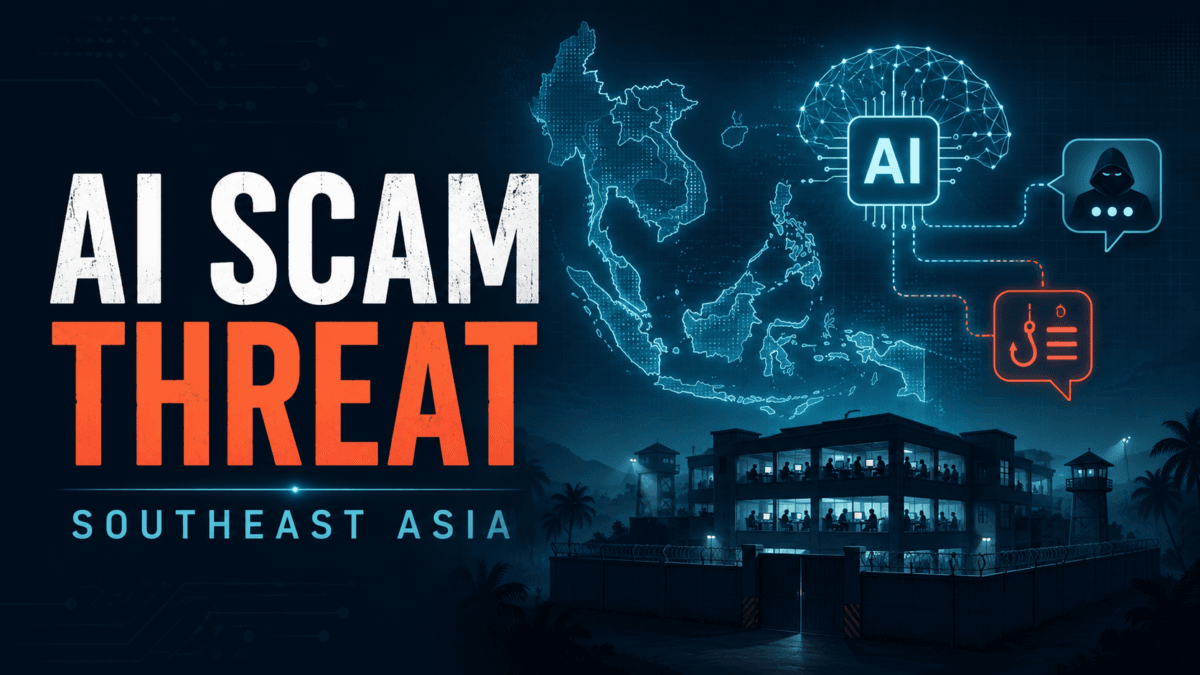
Scam compounds are controlled locations where people are forced, tricked, or recruited into running online fraud schemes. These operations have been reported in countries such as Cambodia, Myanmar, Laos, and the Philippines. Many are linked to organized criminal networks, and some victims inside the compounds are trafficked through fake job offers.
These compounds often target people around the world through romance scams, fake investment platforms, cryptocurrency fraud, impersonation, and phishing. The victims are not only the people who lose money online. Many workers inside these centers are also victims, facing threats, violence, debt bondage, and restricted movement. INTERPOL has described this as a globalizing crime trend, with trafficking victims from many countries being pulled into online scam centers.
How AI Makes Scam Compounds More Dangerous
AI Creates More Believable Fake Identities
In the past, scammers often depended on stolen photos, fake social media profiles, and scripted messages. Today, AI can make those profiles far more convincing. Criminals can generate realistic profile pictures, adjust writing style, and create fake personalities that match a victim’s language, age, interests, or emotional state.
This is especially dangerous in romance and investment scams. A victim may believe they are speaking to a real person for weeks or months. AI can help scammers keep the conversation natural, personal, and emotionally persuasive.
Deepfakes Increase Trust
One of the biggest changes is the use of face-swapping and deepfake tools. Reports have shown that some AI face-swapping services can be used during live video chats, allowing scammers to appear as someone else in real time.
This weakens one of the most common safety checks: “Can we video call?” A victim may feel reassured after seeing a face on camera, not knowing that the video itself may be manipulated. For businesses, this also creates risks in remote hiring, customer verification, and executive impersonation.
Chatbots Help Scale Conversations
Scam compounds rely on volume. The more people they contact, the more chances they have to find someone vulnerable. AI chatbots can help criminals handle many conversations at once, answer common questions, and maintain engagement across different languages.
This does not mean every message is fully automated. Often, AI supports human scammers by drafting replies, translating text, improving grammar, or suggesting emotional responses. The result is faster, smoother, and more scalable fraud.
Why This Is a Cybersecurity Threat
Scams Now Connect to Credential Theft
Modern scam operations are not limited to asking people to transfer money. They may also push fake login pages, malware links, malicious apps, or fake investment portals that collect personal data and passwords.
Once criminals steal credentials, they can access bank accounts, email inboxes, crypto wallets, workplace systems, or cloud accounts. This turns a personal scam into a wider cybersecurity incident.
Businesses Can Become Indirect Victims
A company may think scam compounds only target consumers, but employees are also targets. A worker could be tricked through a fake recruiter, fake vendor, fake executive message, or investment scam. If the attacker gains access to the employee’s device or email, the company may face data theft, business email compromise, or financial fraud.
AI makes these attacks harder to detect because the messages may be well-written, personalized, and timed carefully.
Fraud Networks Use Digital Infrastructure
Scam compounds depend on websites, payment channels, messaging apps, crypto wallets, stolen data, fake accounts, and hosting services. This means cybersecurity teams must watch for more than malware. They must also monitor suspicious domains, unusual login behavior, fake customer accounts, mule activity, and social engineering patterns.
UNODC has warned that organized crime groups in Southeast Asia are rapidly adopting AI and automation to expand cybercrime operations.
Real-World Challenges
Detection Is Becoming Harder
Traditional scam detection often looked for poor grammar, reused photos, strange links, or suspicious payment requests. AI reduces many of these warning signs. Messages can sound professional. Photos can look original. Fake websites can appear polished.
This means people need better digital awareness, and businesses need stronger technical controls.
Law Enforcement Faces Cross-Border Barriers
A victim may live in one country, the scammer may message from another, the website may be hosted elsewhere, and the money may move through cryptocurrency or mule accounts. This makes investigation slow and difficult.
Reuters reported that the United States sanctioned networks linked to cyber scam operations in Myanmar and Cambodia, showing how governments are treating these operations as a major financial and human security issue.
Practical Tips
For Individuals
Do not trust a person only because they can video call. Deepfake and face-swap tools are improving. Be careful if someone online quickly builds emotional closeness, avoids meeting in person, or pushes you toward an investment.
Never install apps from unknown links. Do not share OTPs, passwords, recovery phrases, or remote access to your device. If an online contact asks for crypto payments, loan help, investment deposits, or “account verification” money, treat it as a warning sign.
For Businesses
Train employees to recognize AI-enhanced social engineering. Use multi-factor authentication, but prefer phishing-resistant methods where possible. Monitor for unusual login locations, impossible travel, new device access, and suspicious email forwarding rules.
Companies should also verify vendors, recruiters, and payment changes through trusted channels. A simple phone call to a known number can prevent a costly fraud.
For Security Teams
Security teams should combine fraud intelligence with cybersecurity monitoring. Watch for fake domains, credential stuffing, mule account patterns, synthetic identities, and repeated account creation from suspicious infrastructure.
AI-based defense tools can help, but human review is still important. Attackers use emotion and timing, not just technical tricks.
Key Takeaways
Southeast Asian scam compounds are linked to fraud, cybercrime, trafficking, and money laundering.
AI helps criminals create realistic fake identities, deepfakes, chatbots, and multilingual messages.
These scams can lead to credential theft, malware infection, business email compromise, and financial loss.
Video calls are no longer guaranteed proof of identity.
Individuals, businesses, banks, and law enforcement need stronger awareness, verification, and cross-border cooperation.
Conclusion
AI has changed the scale and quality of online scams. In the hands of organized scam compounds, it helps criminals appear more human, more local, and more trustworthy. That is what makes the threat so serious.
The answer is not fear of technology, but smarter protection. People must slow down before trusting online relationships or investments. Businesses must strengthen identity checks, employee training, and fraud monitoring. Governments and technology companies must work together to disrupt the networks behind these operations.
Southeast Asia’s scam compounds show a clear lesson for the world: when artificial intelligence is combined with organized crime, cybersecurity is no longer only about protecting systems. It is also about protecting trust.