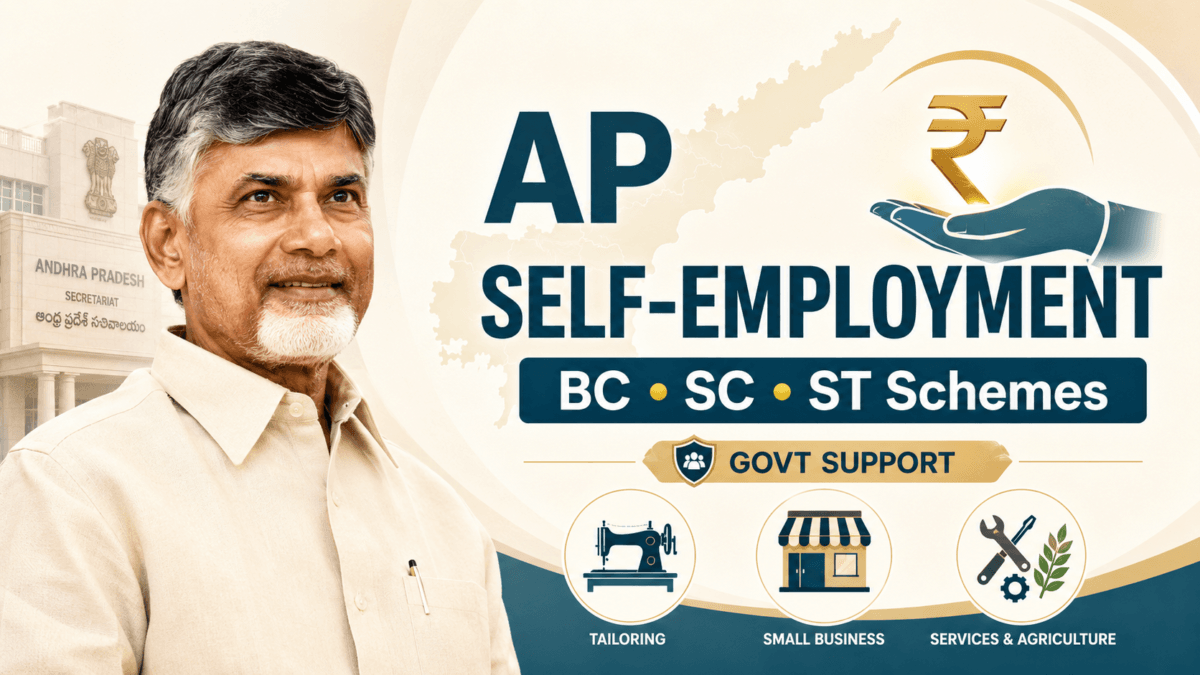
Self-employment schemes matter because many families need more than short-term financial help. They need a way to earn regular income. In Andhra Pradesh, the BC, SC and ST Corporation self-employment schemes aim to support eligible people through subsidy, bank linkage, training and local verification. After N. Chandrababu Naidu returned as Chief Minister, public interest in corporation loans has increased, so applicants should rely on official portals and district offices instead of social media claims. The official Andhra Pradesh district portal lists Sri Nara Chandra Babu Naidu as Chief Minister of the state.
Main Content
What Are These Corporation Schemes?
These are economic support schemes connected with welfare corporations. Their main purpose is to help eligible unemployed youth, artisans, small workers and poor families create income-generating assets.
The AP OBMMS portal says it supports Economic Support Schemes and helps maintain transparency in subsidy transfer. It also lists BC Corporation, SC Corporation and ST Corporation under the welfare system.
BC Corporation Self-Employment Support
The BC Corporation supports Backward Classes through livelihood activities such as agriculture, animal husbandry, industries, services, business, minor irrigation and traditional occupations. Official district information says the corporation provides financial assistance for income-generating assets and artisan livelihood improvement.
For bank-linked BC self-employment schemes, official district details mention subsidy support of 50% or up to ₹1,00,000, whichever is lower, with the remaining amount generally linked to bank finance. Activities may include small shops, service units, transport, dairy, fisheries, tailoring, repair work and other viable local businesses.
SC Corporation Economic Support
The SC Corporation focuses on the economic development of Scheduled Caste households. Official district information says its objectives include financial assistance for income-generating assets and training programmes for educated unemployed youth.
SC Corporation schemes may be bank-linked or non-bank-linked. The official SC schemes page mentions eligibility conditions such as age, preference for atrocity victims, inter-caste married couples, trained candidates, first-time beneficiaries and women beneficiaries. It also says only one economic support scheme is generally provided per family as defined in the ration card.
ST Corporation Support
ST Corporation schemes are meant for eligible Scheduled Tribe beneficiaries. The OBMMS portal includes ST Corporation under Economic Support Schemes. ST applicants should check the official portal and local Tribal Welfare or ITDA office for current targets, eligible sectors and district-specific instructions.
Why These Schemes Matter Now
From Subsidy to Livelihood
A subsidy becomes useful only when it supports a practical business. A dairy unit, kirana shop, tailoring unit, auto, food stall or repair service can support a family if there is local demand and the beneficiary has the required skill.
Transparency Through OBMMS
OBMMS records beneficiary registration, sanctions, fund release, bank linkage, geo-tagging and utilisation certificates. This makes the process more transparent and reduces the role of middlemen.
Practical Tips
Choose a Realistic Business
Applicants should not select a unit only because subsidy is available. A good choice depends on local demand, skills, location, family support and repayment capacity.
Keep Documents Ready
Useful documents may include Aadhaar, caste certificate, income proof, ration card or family details, bank passbook, photograph and sector-specific documents such as driving licence for transport units.
Verify Before Applying
Applicants should verify details through OBMMS, district corporation offices, Sachivalayams or Mandal-level officials. Avoid brokers who promise guaranteed sanction.
Key Takeaways
BC, SC and ST Corporation schemes support self-employment and income-generating assets.
BC schemes cover many sectors, including services, transport, business and traditional occupations.
SC schemes focus on economic support, skill development and priority support for eligible vulnerable groups.
ST applicants should follow OBMMS and local Tribal Welfare or ITDA guidance for updated details.
Conclusion
The BC, SC and ST Corporation self-employment schemes can help poor and eligible families move from dependence to income generation. But the real benefit depends on proper selection, genuine applications, timely bank support and practical business planning. In the current Andhra Pradesh context, the safest approach is to follow only official sources and choose a livelihood activity that can survive beyond the subsidy.