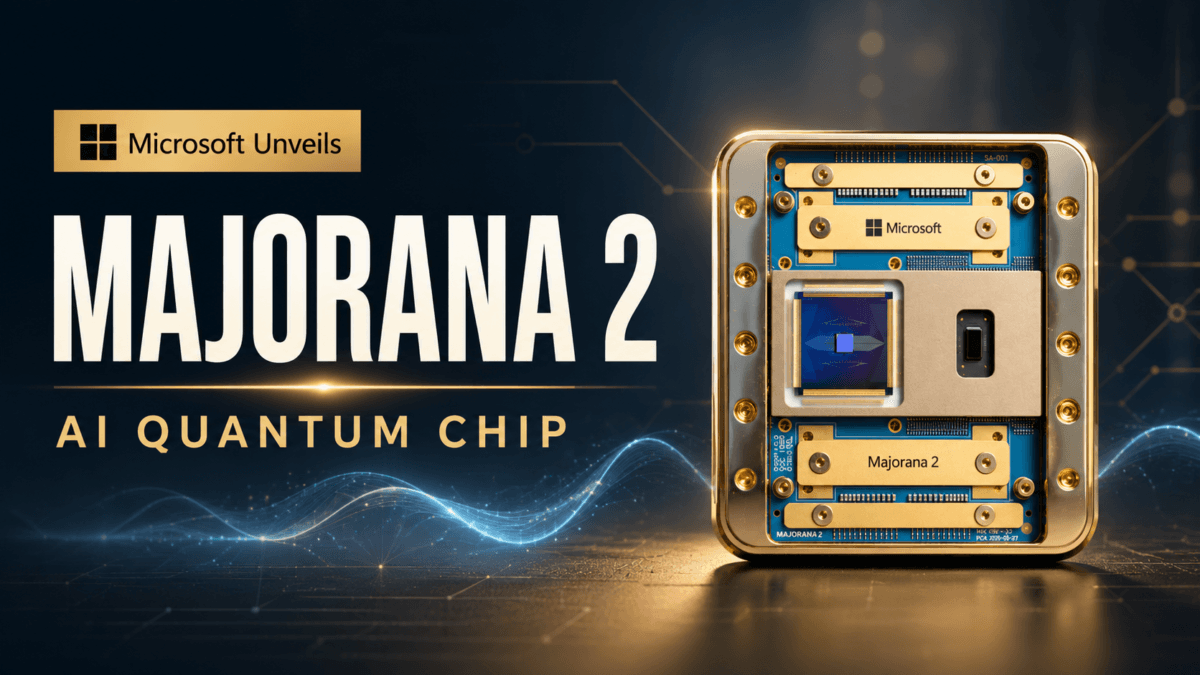
Microsoft’s unveiling of the Majorana 2 quantum chip has brought fresh attention to the race for practical quantum computing. The company says the chip was improved with the help of its Microsoft Discovery agentic AI platform and is designed to make quantum machines more stable and useful. Microsoft also says this progress has helped it aim for a scalable quantum computer by 2029.
What Is Majorana 2?
A Quantum Chip Built for Stability
Majorana 2 is Microsoft’s latest topological quantum processor. In simple terms, it is a chip designed to hold and process quantum information in a more stable way than many traditional quantum systems.
Quantum computers use qubits instead of normal computer bits. A normal bit is either 0 or 1. A qubit can represent more complex states, which may help solve difficult problems much faster in the future. The challenge is that qubits are extremely sensitive to noise, heat, and tiny disturbances.
Microsoft’s topological qubit approach is meant to protect quantum information better by storing it in special physical properties of a system, rather than depending only on fragile individual particles.
How AI Helped the Chip
The most interesting part of Majorana 2 is Microsoft’s claim that AI helped improve the chip’s material design. The company says the new chip uses a different materials stack and delivers qubits that are 1,000 times more reliable than the previous generation. Microsoft has also reported a mean qubit lifetime of 20 seconds, with some cases lasting up to one minute.
This does not mean AI built the chip alone. Human scientists, engineers, and researchers still played the main role. AI helped speed up discovery by testing and narrowing down material possibilities more efficiently.
Why This Announcement Matters
Quantum Computing Could Solve Hard Problems
Practical quantum computers could help in areas where today’s computers struggle. These include drug discovery, advanced materials, climate research, logistics, finance, cybersecurity, and chemical simulations.
For example, a pharmaceutical company could use quantum computing to study how molecules behave. A battery maker could explore better materials for energy storage. A logistics company could improve route planning across thousands of variables.
Microsoft Wants to Compete in the Quantum Race
Microsoft is not alone in this field. IBM, Google, Amazon, and several research groups are also working on quantum computing. Reuters reported that Microsoft’s 2029 target puts it closer to IBM’s public timeline for useful quantum systems.
This makes Majorana 2 important not only as a scientific announcement but also as a business and technology signal. Companies are racing to build the first truly useful quantum computer.
Benefits of Majorana 2
Faster Scientific Discovery
If Microsoft’s approach works at scale, it could reduce the time needed for complex scientific research. AI and quantum computing together may help researchers test ideas faster before moving to physical experiments.
Stronger Cloud and Enterprise Tools
Microsoft already offers Azure Quantum, which gives users access to quantum tools and related computing resources. A more mature Microsoft quantum chip could eventually strengthen its cloud business and attract researchers, universities, and companies.
Long-Term Technology Leadership
For Microsoft, Majorana 2 is also about long-term leadership. Artificial intelligence is already changing software. Quantum computing could become the next major computing shift.
Challenges and Concerns
Claims Need Independent Validation
Quantum computing is a difficult field, and major claims are often closely examined. Reuters noted that some physicists want more transparent and reproducible data around Microsoft’s Majorana-related claims. Microsoft says it has shared enough data with agencies such as DARPA, but wider scientific confidence may take time.
Commercial Use Is Still Years Away
Majorana 2 is a step forward, but it is not the same as a ready-made commercial quantum computer. Scaling from a promising chip to a reliable, useful system will require better hardware, error correction, cooling systems, software tools, and real-world testing.
Practical Tips
For Students
Students interested in future careers should learn physics, computer science, mathematics, and AI fundamentals. Quantum computing will need people who understand both hardware and software.
For Businesses
Companies should not rush to expect instant benefits. A smart approach is to follow developments, test cloud-based quantum tools, and identify problems that may benefit from quantum computing later.
For General Readers
The key point is simple: Majorana 2 is promising, but still experimental. It shows progress, not a finished revolution.
Key Takeaways
Microsoft has unveiled Majorana 2, an AI-assisted topological quantum chip.
The company claims major reliability improvements over its earlier quantum processor.
Microsoft now aims to build a scalable quantum computer by 2029.
The announcement is important, but independent validation and real-world scalability remain major challenges.
Conclusion
Microsoft’s Majorana 2 chip is an important current affairs development in advanced technology. It brings together two powerful trends: artificial intelligence and quantum computing. The chip may help Microsoft move closer to practical quantum machines, but the journey is far from complete. The real test will be whether Majorana 2 can move beyond laboratory progress and become part of a reliable, scalable system. If that happens, it could open a new chapter in computing, science, and industrial innovation.