
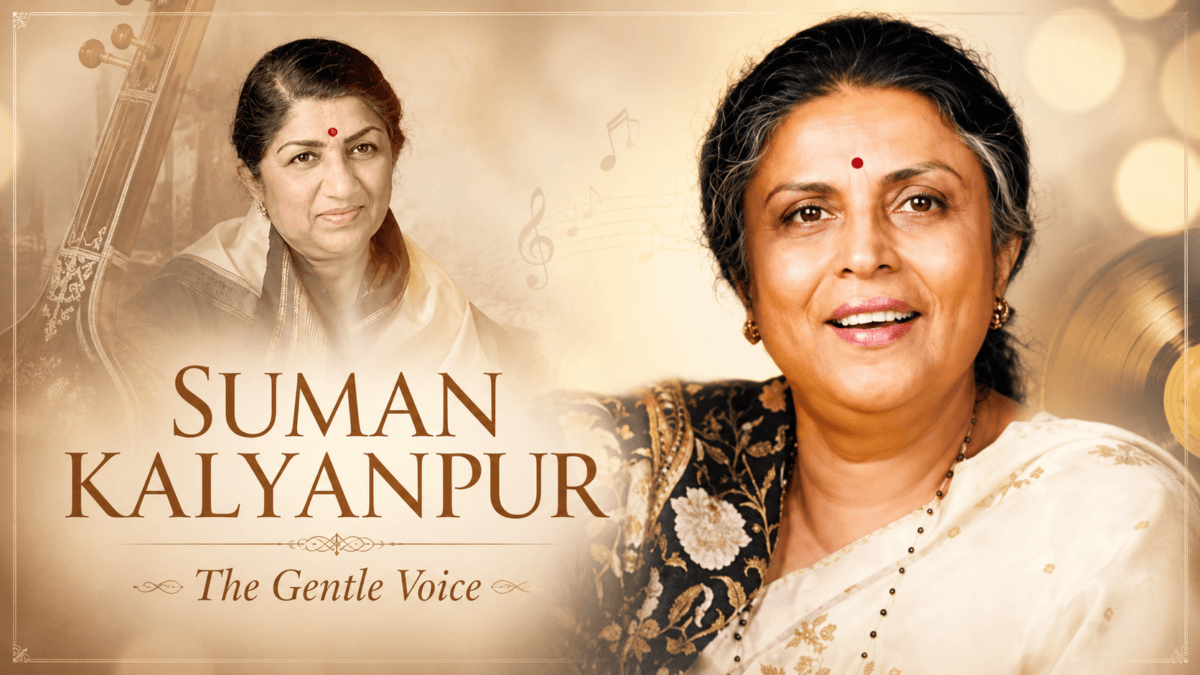
Veteran playback singer Suman Kalyanpur’s passing at the age of 89 has brought a wave of sadness across the Indian music world. She died on May 31, 2026, in Mumbai, leaving behind a musical legacy that touched generations of listeners. Her last rites were performed the next day at the Santa Cruz crematorium in Mumbai with full state honours, a recognition of her deep contribution to Indian cinema and music.
Suman Kalyanpur was not the loudest public personality of her time, but her voice had a quiet power. It carried sweetness, purity, and emotion without needing dramatic display. For many listeners, her songs became part of family memories, radio evenings, wedding playlists, and old film nostalgia. She belonged to an era when playback singing was not only about technical skill but also about feeling every word with sincerity.
The Maharashtra government’s decision to accord her full state honours reflected the respect she earned over decades. Mourners, admirers, and people from the music fraternity gathered to pay tribute during her final journey. Reports described the atmosphere as emotional, with people remembering not just her songs but also her humility and graceful nature.
Maharashtra Governor Jishnu Dev Varma also paid tribute to the legendary singer, calling her music immortal. In his condolence message, he remembered the sweetness, delicacy, and purity of her voice, and said her songs had the rare ability to touch listeners’ hearts. His tribute captured what many fans have felt for years: Suman Kalyanpur’s music was gentle, but its impact was lasting.
One of the most discussed parts of Suman Kalyanpur’s career was the frequent comparison between her voice and Lata Mangeshkar’s. Many listeners often mistook some of her songs for Lata’s because of the similarity in tone. However, Suman Kalyanpur always handled this comparison with dignity. In an old interview, she said she never fully understood why their voices sounded so alike and humorously suggested that perhaps God had blessed both of them in the same way.
What made her response special was its warmth. She did not sound bitter about being compared to another great singer. Instead, she spoke with humility and respect. She also recalled having a cordial relationship with Lata Mangeshkar. This attitude showed her maturity as an artist. In a field where comparisons can create insecurity, she chose grace over rivalry.
Suman Kalyanpur built her own place in Indian music through memorable songs such as “Na Na Karte Pyar Tumhi Se Kar Baithe,” “Aajkal Tere Mere Pyar Ke Charche,” “Na Tum Hamen Jano,” and “Dil Ek Mandir Hai.” Her voice suited romance, devotion, classical-based melodies, and soft emotional songs. She worked across several languages and remained active for more than three decades, from the 1950s to the late 1980s.
Her career also reminds us that fame does not always depend on constant publicity. Some artists become unforgettable because their work continues to live quietly in people’s hearts. Suman Kalyanpur was one such artist. She may not have always occupied the loudest space in public conversation, but her songs remained alive through radio, records, television, and digital platforms.
For today’s music lovers, her journey offers an important lesson. A singer’s greatness is not only measured by awards, headlines, or controversy. It is measured by how deeply a voice connects with people over time. Suman Kalyanpur’s music had that rare quality. It could calm the mind, bring back memories, and make simple lyrics feel deeply personal.
The key takeaway from her life is that true artistry does not need noise. Her discipline, simplicity, and emotional honesty helped her create songs that still feel fresh. She proved that a soft voice can leave a strong legacy, and that humility can be as powerful as fame.
In conclusion, Suman Kalyanpur’s passing marks the end of a precious chapter in Indian playback singing. Yet her music remains beyond time. The state honours, public tributes, and heartfelt memories all point to one truth: she was not just a singer of beautiful songs, but a voice that became part of India’s emotional and cultural memory.