
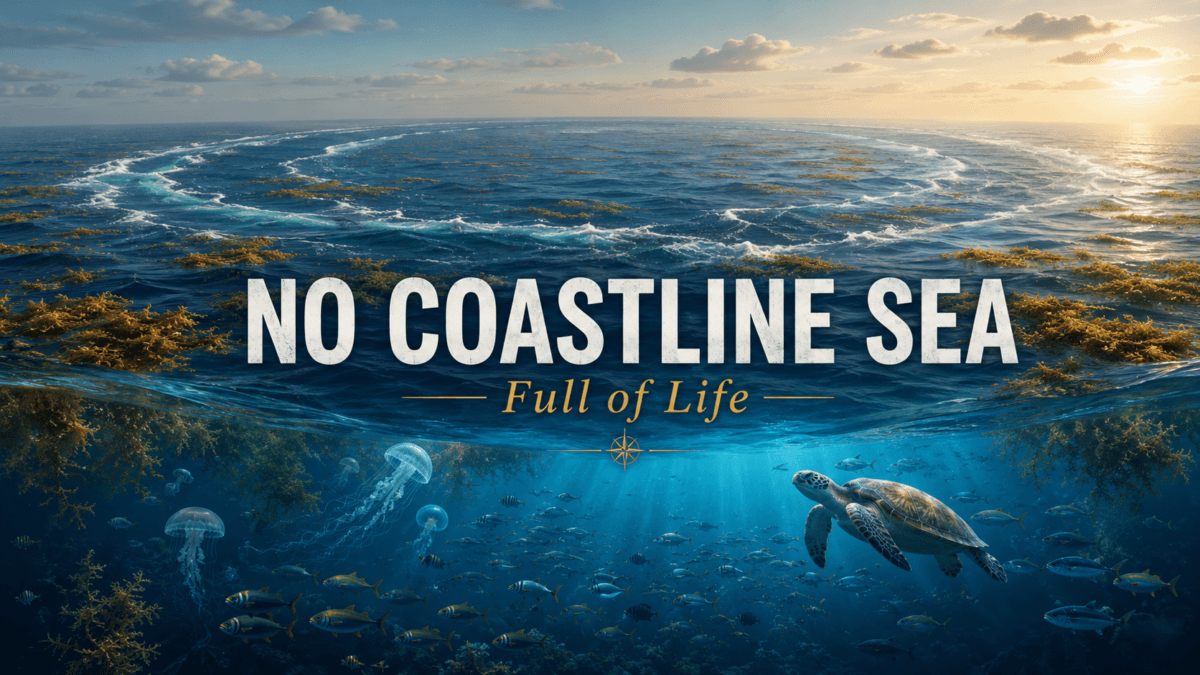
Most seas are easy to imagine because they touch land. The Mediterranean has Europe, Africa, and Asia around it. The Arabian Sea borders South Asia and the Arabian Peninsula. The Caribbean Sea is framed by islands and coastlines. But one sea breaks this familiar rule.
The Sargasso Sea is widely known as the only sea on Earth defined not by land, but by ocean currents. It sits in the North Atlantic Ocean, surrounded by moving water instead of shores. NOAA explains that while other seas are defined at least partly by land boundaries, the Sargasso Sea is defined only by currents within the North Atlantic Subtropical Gyre.
What makes it even more remarkable is that this coastless sea is not empty. It is filled with floating golden-brown Sargassum seaweed, which creates a living habitat for fish, crabs, shrimp, turtles, eels, sharks, whales, and many specialized species. The Sargasso Sea is a reminder that life does not always need reefs, coastlines, or islands to build a rich ecosystem.
What Is the Sargasso Sea?
A Sea Without a Shore
The Sargasso Sea is located in the North Atlantic Ocean. Instead of being bordered by continents, it is enclosed by four major currents. NOAA identifies these as the Gulf Stream to the west, the North Atlantic Current to the north, the Canary Current to the east, and the North Atlantic Equatorial Current to the south.
These currents form a large rotating system called the North Atlantic Subtropical Gyre. Inside this rotating ocean space, waters are relatively calm and clear compared with more turbulent surrounding areas. Britannica describes the Sargasso Sea as an elliptical area of the North Atlantic, relatively still, and known for free-floating seaweed of the genus Sargassum.
Why It Is Different From Other Seas
Most seas are attached to geography in a familiar way. They are next to countries, islands, peninsulas, or continents. The Sargasso Sea is different because its “borders” are moving currents. This means its edges are not fixed like a coastline. They can shift depending on ocean conditions. That makes it a living, changing region rather than a sea with clear land-based boundaries.
Why Is It Called the Sargasso Sea?
The Floating Seaweed That Gives It Its Name
The Sargasso Sea gets its name from Sargassum, a type of brown seaweed that floats freely on the ocean surface. Unlike many seaweeds, which attach to rocks or the seafloor, the Sargassum found here can live its whole life drifting in open water.
This floating seaweed forms mats, patches, and long lines on the surface. To early sailors, these mats may have seemed mysterious or even dangerous. Over time, the sea became associated with stories of still waters, drifting weed, and ships moving slowly through golden-brown floating vegetation. Scientifically, however, Sargassum is not a threat to the open ocean. It is the foundation of a special ecosystem.
A Floating Habitat in the Open Atlantic
Sargassum Works Like a Mobile Forest
In many oceans, life gathers around reefs, rocky shores, seagrass beds, or coastal shallows. The Sargasso Sea has none of those land-connected habitats. Instead, its floating Sargassum acts like a mobile forest.
The Sargasso Sea Commission describes it as a refuge of life in the open ocean, with a surface ecosystem based on Sargassum that supports unique communities, nursery areas, feeding areas, and migration routes.
Small animals hide among the weed. Young fish use it as shelter. Tiny creatures attach to it. Predators search around it for food. In an otherwise open-water environment, these floating mats provide structure, shade, protection, and feeding opportunities.
A Nursery for Marine Life
The Sargasso Sea is especially important as a nursery. The Sargasso Sea Commission says Sargassum provides critical nursery habitat for many pelagic fish and several species of sea turtle.
Young sea turtles are known to use floating Sargassum as a safe place during early life. The mats give them cover from predators and access to small prey. For a tiny turtle in the open Atlantic, a patch of Sargassum can be like a floating shelter.
Fish also benefit from this habitat. Some species spend part of their lives in and around Sargassum before moving into deeper or wider ocean areas.
The Sea Where Eels Begin Their Journey
A Mysterious Spawning Ground
One of the most fascinating facts about the Sargasso Sea is its connection to eels. The Sargasso Sea Commission identifies it as the only known spawning area for two species of endangered anguillid eel. These eels breed in the ocean and later move toward freshwater feeding habitats.
This life cycle is extraordinary. European and American eels travel huge distances between rivers, coasts, and the open Atlantic. For a long time, their breeding habits were one of nature’s great mysteries. The Sargasso Sea remains central to understanding their survival.
Why This Matters
If the Sargasso Sea is damaged, the effect may not stay in the middle of the Atlantic. It could affect species that travel across ocean basins and support ecosystems far away. This is why the Sargasso Sea is not only a strange geographic fact. It is part of a wider Atlantic system connecting continents, coastlines, fisheries, and migration routes.
What Animals Live in the Sargasso Sea?
Endemic and Migratory Species
The Sargasso Sea supports both resident and traveling life. The FAO notes that Sargassum supports ten endemic species that have adapted to live their whole lives on the open sea. It also acts as nursery habitat for many pelagic fish and all species of Atlantic sea turtle.
Endemic species are especially important because they are found naturally in a specific place or habitat. Some animals living in Sargassum are camouflaged to match the seaweed, helping them hide from predators and ambush prey. The area is also used by larger animals. NOAA says the Sargasso Sea is a spawning site for threatened and endangered eels, as well as white marlin and dolphinfish, and that humpback whales migrate through the region annually.
A Crossroads of the Atlantic
Because it sits in the open Atlantic, the Sargasso Sea works like a meeting place. Species pass through it, breed in it, feed in it, or use it as shelter during vulnerable stages of life. This makes the sea important even for animals that do not live there permanently. A whale may only pass through. A turtle may use it while young. An eel may begin life there before traveling toward rivers. Together, these connections make the Sargasso Sea a biological crossroads.
Why the Water Looks So Clear and Blue
Calm Water and Ocean Circulation
The Sargasso Sea is often associated with deep blue, clear water. This is partly because it lies inside a large gyre, where surface waters circulate in a broad clockwise pattern. Britannica notes that the region is relatively still and lies within an ocean-current system.
Clear water does not mean lifeless water. In fact, the Sargasso Sea shows how life can concentrate around floating habitats even when the surrounding open ocean appears empty.
Life Is Not Always Obvious
A coral reef immediately looks alive because fish, corals, and colors are visible. The Sargasso Sea is more subtle. Its life is organized around floating weed, microscopic organisms, small animals, and migrating species. To understand it, we need to look closely. The sea’s richness is not always dramatic from a distance, but it is deeply important.
Threats to the Sargasso Sea
Plastic Pollution and Human Activity
Because ocean currents gather floating material, the Sargasso Sea can collect not only seaweed, but also human-made debris. Plastic waste, fishing gear, and other pollution can harm marine animals that mistake debris for food or become tangled in it. The same currents that help define the Sargasso Sea can also carry problems from far away. This means protecting the region requires international cooperation, not just local action.
Overfishing and Ecosystem Pressure
Open-ocean ecosystems are difficult to manage because they often lie beyond national borders. The Sargasso Sea is largely a high-seas ecosystem, and the FAO describes it as stretching over more than 5 million square kilometers within the North Atlantic subtropical gyre.
That size and location make protection challenging. Fisheries, shipping, pollution, and climate change can all affect the region, even if the sea itself has no coastline.
Practical Tips for Understanding the Sargasso Sea
Do Not Confuse It With Beach Sargassum Problems
Sargassum in the open Sargasso Sea is ecologically valuable. Large seaweed arrivals on beaches in the Caribbean, Gulf of Mexico, or Atlantic coastlines can create environmental and economic problems when it decays. These are related by seaweed type, but the open-ocean habitat itself is not simply a nuisance.
Think of It as a Floating Ecosystem
The easiest way to understand the Sargasso Sea is to imagine a drifting rainforest of seaweed. It has no soil, no trees, and no coastline, but it gives shelter and food to many animals.
Remember That Boundaries Can Be Natural, Not Political
The Sargasso Sea teaches an important geography lesson. Not every important place is defined by land borders. Some are shaped by wind, water, currents, and ecological relationships.
Key Takeaways
The sea with no coastline is the Sargasso Sea.
It is located in the North Atlantic Ocean.
It is defined by ocean currents, not land boundaries.
Its main floating habitat is made of Sargassum seaweed.
The Sargasso Sea supports endemic species, fish, sea turtles, eels, sharks, rays, whales, and other marine life.
It is the only known spawning area for two endangered eel species.
Its floating seaweed mats act as nurseries, shelters, feeding zones, and migration support areas.
Pollution, overfishing, climate change, and weak high-seas protection are major concerns.
Conclusion
The Sargasso Sea is one of the most unusual places on Earth. It has no coastline, no beaches, and no land-based borders, yet it is a true sea shaped by powerful Atlantic currents. Its identity comes not from shores, but from movement.
More importantly, it is full of life. Its floating Sargassum seaweed supports a unique open-ocean ecosystem that shelters young turtles, fish, eels, crabs, shrimp, and specialized species found nowhere else. It also serves as a migration route and breeding area for animals that connect the wider Atlantic world.
The Sargasso Sea proves that nature does not always fit human expectations. A sea does not need a coastline to be real, and an open ocean does not need to be empty. Sometimes, a drifting mat of seaweed in the middle of the Atlantic can become one of the planet’s most remarkable living worlds.