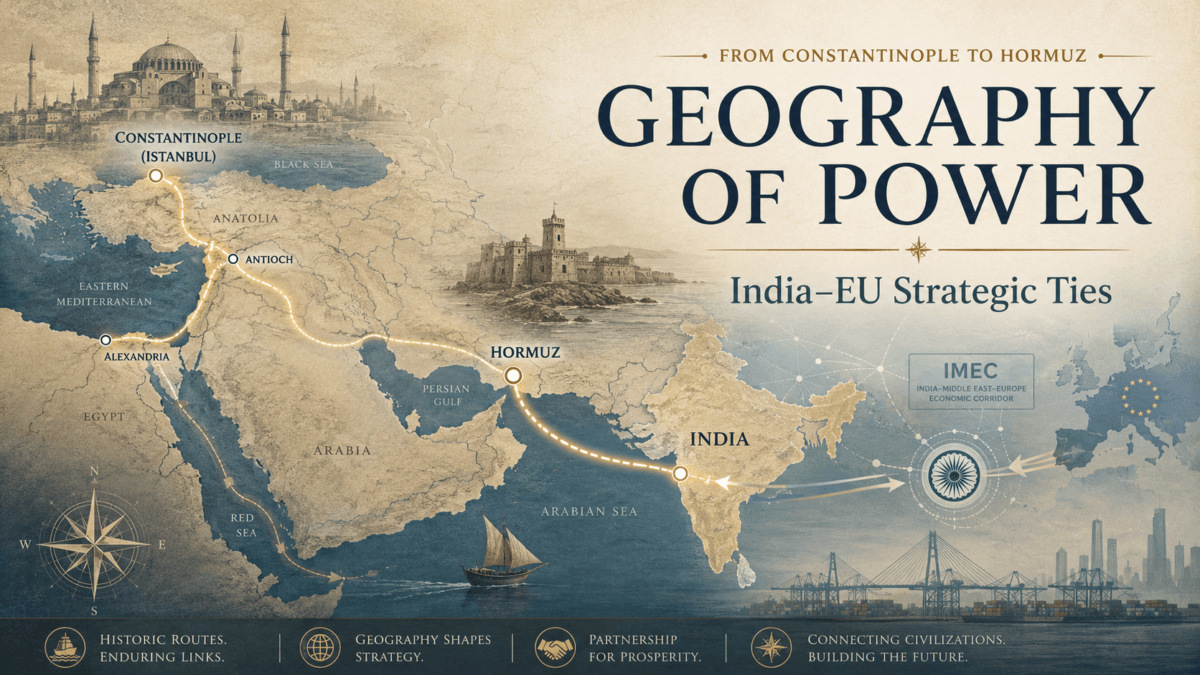
Geography is often treated as background, but in world politics it is usually the first fact that matters. Empires rise near ports, trade follows narrow seas, armies worry about mountain passes, and modern supply chains still depend on old maritime routes. The journey from Constantinople to Hormuz is not only a historical line on a map. It is a reminder that trade, power, security, and diplomacy are shaped by places that cannot be ignored.
The fall of Constantinople in 1453 marked the Ottoman conquest of a city that had long stood as a bridge between Europe and Asia and as a strategic barrier in the eastern Mediterranean. Britannica notes that European powers had viewed Byzantine control of Constantinople as important because of its role as a bastion against Muslim control of land and sea routes in the eastern Mediterranean.
Today, the same basic lesson continues through projects such as the India–Middle East–Europe Economic Corridor, or IMEC. The language has changed from empire and caravan routes to supply chains, energy security, ports, railways, digital connectivity, and strategic partnerships. But the central rule remains: geography still disciplines ambition.
Main Content
Why Geography Still Matters in Strategy
Maps Are Not Passive
A map does not simply show where countries are. It shows what they can do, what they fear, and whom they must cooperate with. India’s access to the Arabian Sea, Europe’s dependence on maritime routes, the Gulf’s energy role, and the eastern Mediterranean’s position between Asia, Africa, and Europe all shape today’s strategic choices.
This is why geography is a discipline, not just a school subject. It teaches decision-makers that trade routes need security, ports need hinterlands, and corridors need political trust. A railway or shipping lane is not only an economic project. It is also a promise that many governments, companies, and security systems will keep working together.
Constantinople: The Old Lesson of the Eastern Mediterranean
A City That Controlled Movement
Constantinople mattered because it sat at a critical meeting point: between the Black Sea and the Mediterranean, between Europe and Asia, and between land and sea routes. When Mehmed II captured the city on May 29, 1453, the Byzantine Empire came to an end and Ottoman power gained a new imperial capital.
The lesson for later centuries was clear. Whoever controlled key passages could influence trade, diplomacy, and military movement far beyond the city itself. Constantinople was not just a prize. It was a gate.
The Eastern Mediterranean as a Strategic Space
The eastern Mediterranean has always been more than a sea. It connects the Levant, Anatolia, Egypt, Greece, Cyprus, and southern Europe. It links markets, religions, armies, navies, and ports. In modern terms, it is also connected to energy routes, undersea cables, shipping insurance, naval access, migration politics, and regional conflict.
For India and Europe, this region matters because any serious India-Europe connectivity plan must eventually pass through or around this space. IMEC’s promise depends not only on Indian ports and Gulf infrastructure, but also on the ability of the Middle East and eastern Mediterranean to function as a reliable bridge.
Hormuz: The Modern Reminder of Chokepoint Vulnerability
Energy Security Begins With Geography
The Strait of Hormuz is one of the world’s most important energy chokepoints. The International Energy Agency states that about 20 million barrels per day, around 25 percent of world seaborne oil trade, transits the Strait, with about 80 percent destined for Asia. It also notes that about 19 percent of global LNG trade passes through Hormuz.
For India, this matters directly. India’s energy security is tied to Gulf stability, shipping lanes, and the ability to keep maritime routes open. For Europe, Hormuz also matters because energy markets are global. A disruption in one narrow waterway can raise prices, affect shipping, and reshape diplomatic priorities far away.
Chokepoints Create Strategic Anxiety
Chokepoints are useful because they shorten routes. They are dangerous because they concentrate risk. Hormuz, Bab el-Mandeb, Suez, the Bosporus, and the eastern Mediterranean all show the same pattern: geography creates opportunity, but it also creates vulnerability.
The Red Sea crisis made this visible again. The IMF reported that in the first two months of 2024, trade through the Suez Canal dropped by 50 percent from a year earlier because of attacks and route disruptions.
This is why India-EU strategy cannot be only about trade agreements. It must also include maritime security, resilient logistics, energy planning, and political coordination across regions.
IMEC and the New Geography of India-Europe Connectivity
What IMEC Is Trying to Build
IMEC was announced during the G20 Summit in New Delhi in September 2023. India’s Ministry of External Affairs says the corridor includes an eastern corridor connecting India to the Gulf and a northern corridor connecting the Gulf to Europe, using rail, ship-rail, and road transport routes. The MoU was signed by India, the United States, Saudi Arabia, the UAE, the European Union, Italy, France, and Germany.
This design is important because it is not just a single railway or port plan. It is a layered connectivity idea. It imagines goods, energy, data, finance, and people moving through a structured route linking India, the Arabian Peninsula, the eastern Mediterranean, and Europe.
Why IMEC Is Strategic, Not Merely Commercial
A corridor is never only about faster shipping. It changes how regions think about one another. IMEC gives India a westward connectivity framework, gives Europe a way to deepen ties with India and the Gulf, and gives Middle Eastern states a chance to act as logistics and energy hubs rather than only energy exporters.
It also fits the larger shift in global trade. Countries are looking for diversified supply chains, trusted partners, and alternatives to overdependence on any single route or market. In that sense, IMEC is geography turned into policy.
India-EU Ties: From Trade to Strategic Convergence
A Wider Partnership
India and the European Union have been trying to move beyond a narrow trade relationship. At the 16th India-EU Summit in New Delhi in January 2026, both sides adopted “Towards 2030: India–EU Joint Comprehensive Strategic Agenda,” built around prosperity, technology, security and defence, connectivity, global challenges, skills, mobility, business, and people-to-people ties.
The same joint statement welcomed advances in IMEC and placed connectivity alongside Global Gateway, India’s MAHASAGAR approach, aviation dialogue, maritime transport cooperation, and trilateral projects in areas such as energy, climate resilience, green mobility, and digitalisation.
This shows that India-EU relations are no longer only about tariffs. They are increasingly about how two major democratic markets position themselves in a fragmented world.
Security and Defence Enter the Conversation
The January 2026 India-EU joint statement also welcomed the signing of an India-EU Security and Defence Partnership, covering areas such as maritime security, defence industry and technology, cyber and hybrid threats, space, and counter-terrorism.
This is where geography again becomes central. If Europe and the Indo-Pacific are interconnected, then maritime routes from the Indian Ocean to the Mediterranean cannot be treated as someone else’s problem. The security of trade routes, ports, data cables, and energy flows becomes a shared concern.
The Eastern Mediterranean’s Role in India-EU Strategy
The Bridge Between Corridors and Markets
The eastern Mediterranean is where IMEC’s western logic becomes visible. Goods moving from India through the Gulf would still need reliable access toward European markets. That means ports, rail links, customs systems, political coordination, and stable maritime conditions around the Mediterranean.
This region also carries symbolic weight. From Constantinople to modern ports, it has repeatedly served as the meeting point between Asia and Europe. Today, its importance lies not in imperial conquest but in connectivity, resilience, and strategic trust.
A Region Full of Promise and Risk
The eastern Mediterranean is not an empty transit zone. It is politically complex. Regional conflicts, maritime disputes, energy competition, migration pressures, and great-power rivalries all shape the environment. Any corridor passing through or near this region must deal with real-world politics.
That does not make IMEC impossible. It makes careful diplomacy essential. Corridors succeed when geography, finance, engineering, and politics move together.
Practical Insights for Understanding This Issue
Do Not Separate History From Current Affairs
Constantinople and Hormuz may belong to different eras, but both show how narrow spaces shape wide politics. A good reader should treat historical geography as a guide to modern strategy.
Watch Ports, Not Just Capitals
Diplomatic summits matter, but ports often reveal the future more clearly. Shipping terminals, rail connections, customs reforms, container capacity, and digital logistics systems will decide whether IMEC becomes practical.
Follow Chokepoints Closely
Hormuz, Suez, Bab el-Mandeb, and the eastern Mediterranean should be watched together. A disruption in one place can shift trade routes, raise costs, and change strategic calculations.
Understand Corridors as Political Projects
Infrastructure is never neutral. Every corridor creates winners, dependencies, bargaining power, and security obligations. IMEC should be read as both an economic plan and a geopolitical statement.
Key Takeaways
Geography continues to shape trade and power from the age of Constantinople to the age of IMEC.
Constantinople’s fall showed the strategic importance of eastern Mediterranean access.
Hormuz remains one of the world’s most important energy chokepoints.
IMEC links India, the Gulf, and Europe through a planned mix of shipping, rail, and road routes.
India-EU ties are expanding from trade into connectivity, security, technology, maritime cooperation, and resilient supply chains.
The eastern Mediterranean is likely to be a key hinge in any serious India-Europe connectivity strategy.
Corridors succeed only when political stability, infrastructure, finance, and security work together.
Conclusion
The story from Constantinople to Hormuz is really the story of geography refusing to disappear. Technology changes, empires fall, trade systems evolve, and diplomatic language becomes more polished. Yet the same old questions remain: Who controls the routes? Who secures the chokepoints? Who builds the ports? Who pays for the corridor? Who can be trusted when crisis comes?
For India and Europe, IMEC represents more than a transport plan. It reflects a larger strategic convergence built around resilient supply chains, maritime security, energy transition, digital links, and political cooperation across the Indo-Pacific, Gulf, and Mediterranean worlds.
The Eastern Mediterranean sits at the heart of this story because it has always been a meeting place of routes and power. In the 15th century, Constantinople showed how control of a gate could reshape history. In the 21st century, Hormuz and IMEC show that geography still writes the first draft of strategy. The challenge for India and Europe is to read that map wisely and build partnerships strong enough to survive the pressures placed upon it.