
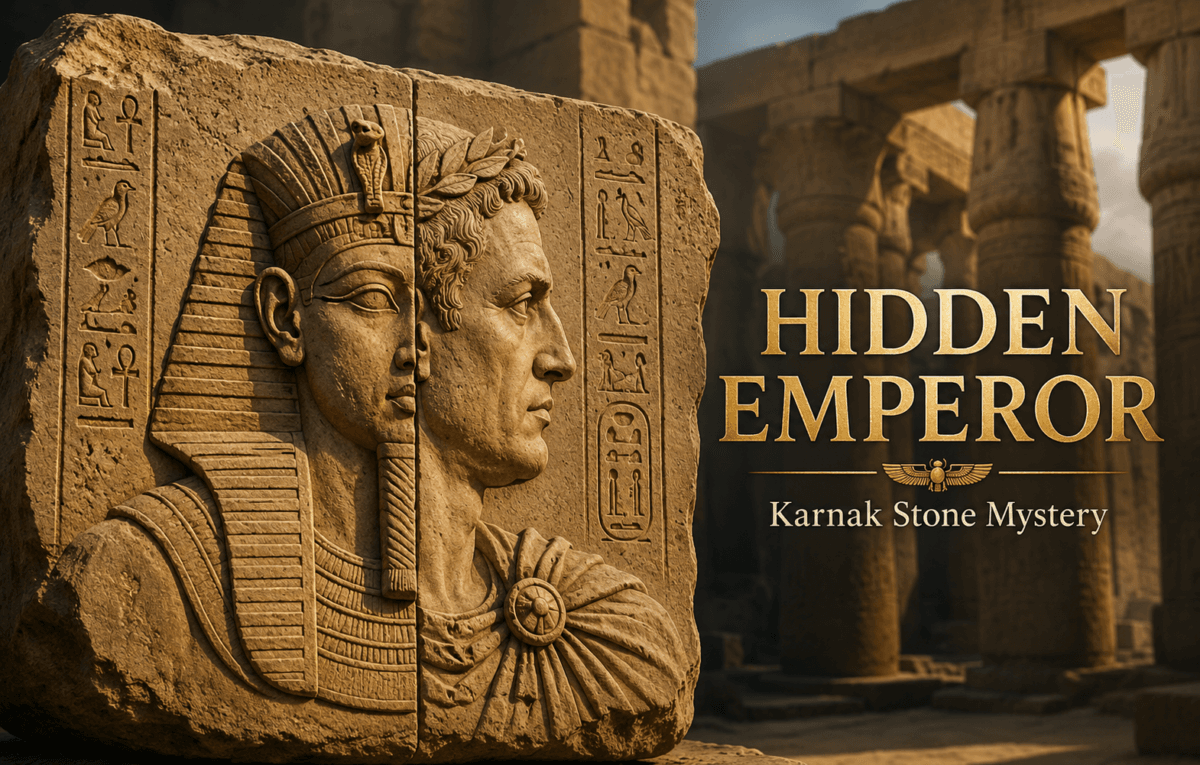
A small stone from Karnak has opened a surprisingly large window into the politics of ancient Egypt under Roman rule. At first glance, the discovery may seem simple: archaeologists found a carved sandstone stela during restoration work at the Karnak temple complex in Luxor. But the image on the stone tells a much deeper story. It shows a Roman emperor presented not as a Roman in toga or armor, but in the traditional role of an Egyptian pharaoh.
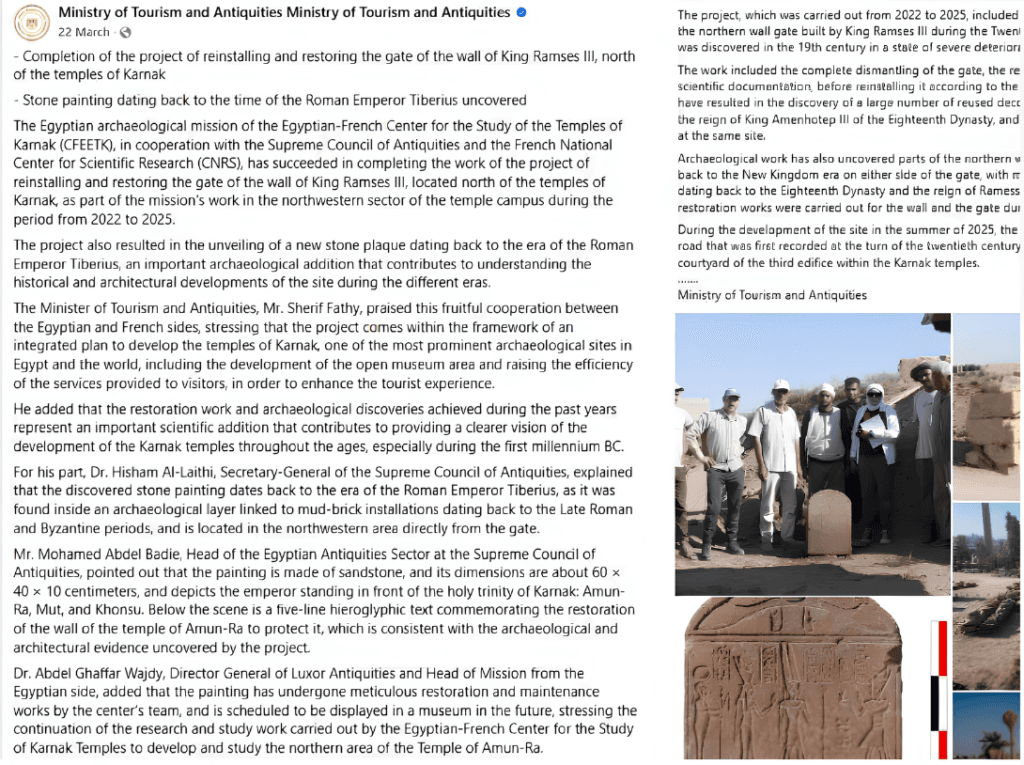
The stela dates to the reign of Emperor Tiberius, who ruled Rome from A.D. 14 to 37. It was discovered during restoration work near a northern gate associated with Ramesses III at Karnak. The stone measures about 60 by 40 centimeters and shows Tiberius before the Theban triad: Amun-Ra, Mut, and Khonsu. Beneath the scene, five lines of hieroglyphic text refer to restoration work on the wall of the Temple of Amun-Ra.
The find is important because it reminds us that ancient power was not only expressed through armies and taxes. It was also expressed through images, rituals, temples, and carefully chosen symbols.
Main Content
What Was Found at Karnak?
A Sandstone Stela From the Roman Period
The object is a stela, which is an upright stone slab carrying carved images or inscriptions. Stelae were often used in ancient Egypt to record religious devotion, royal acts, building projects, or commemorative messages.
This newly reported stela is linked to Tiberius, the second Roman emperor. By the time Tiberius ruled, Egypt had already been under Roman control for more than four decades, following Rome’s takeover after the defeat of Cleopatra VII and Mark Antony. Yet the stela does not present Tiberius in a clearly Roman style. Instead, it places him inside an Egyptian religious setting, standing before the gods of Karnak.
That contrast is what makes the discovery so interesting. Politically, Tiberius was emperor of Rome. Visually and ritually, in this scene, he appears as the type of ruler Egyptian temples had long recognized: a pharaoh who honors the gods and maintains cosmic order.
Found During Restoration, Not a Treasure Hunt
The stela came to light during restoration work near the northern part of Karnak, close to a gate connected with Ramesses III. Egyptian-French archaeological work in this area included documentation, dismantling, cleaning, consolidation, and reassembly of architectural blocks. The project also revealed hidden layers of construction and later occupation.
This matters because archaeology is often imagined as dramatic digging for treasures. In reality, important discoveries frequently appear through patient conservation work. Cleaning a wall, stabilizing a gate, or documenting old stones can reveal evidence that had been overlooked for centuries.
Why Tiberius Appears as an Egyptian Pharaoh
Rome Ruled Egypt, But Egypt Kept Its Sacred Language
When Rome took control of Egypt, it did not simply erase Egyptian religious traditions. Temples continued to function, priests continued rituals, and Egyptian visual culture remained powerful. Roman emperors were often inserted into existing Egyptian temple language because that was how local religious authority was expressed.
In Roman Egypt, the emperor did not need to personally visit every temple to be shown as a pharaoh. The image was not necessarily a portrait of a real event. It was a statement of legitimacy. In Egyptian terms, the ruler’s duty was to support the gods, preserve order, and protect the balance known as ma’at. Egyptologist Abdelghaffar Wagdy explained that the monument expresses what a king should be in Egyptian terms, rather than recording Tiberius’ personal achievements.
This helps modern readers avoid a common mistake. The stela is not simply “Tiberius pretending to be Egyptian.” It is a temple image using Egyptian rules to describe political authority.
The Pharaoh Was a Role, Not Just a Person
In ancient Egypt, “pharaoh” was more than a royal title. The king had a religious function. He was shown making offerings to the gods, defeating chaos, building temples, and maintaining divine order. These images were part of how temples presented the ideal relationship between ruler, gods, and land.
So when Tiberius appears in pharaonic form, the point is not that he became culturally Egyptian in everyday Roman life. The point is that in the sacred space of Karnak, he had to be shown in the language Karnak understood. Rome ruled through administration and military power, but in temples, Rome also wore Egyptian symbols.
Karnak as a Living Historical Archive
A Temple Built Across Many Centuries
Karnak was not built at one moment by one king. It grew over many centuries, with different rulers adding gates, courts, chapels, pylons, inscriptions, and statues. Its main religious focus was Amun-Ra, along with related deities such as Mut and Khonsu. The site became one of the most important sacred complexes in ancient Egypt.
That long history explains why discoveries at Karnak often reveal layers rather than single stories. A New Kingdom gate, a Roman-era stela, late Roman or Byzantine mud-brick structures, and modern restoration work can all meet in one archaeological zone.
Sacred Space Was Reused and Reinterpreted
The Tiberius stela shows that Karnak was not frozen in the age of the great pharaohs. Later rulers continued to use the site’s religious authority. Even after Egypt became part of the Roman Empire, Karnak remained meaningful enough for imperial power to be expressed there in Egyptian form.
This is one of the most valuable lessons of the discovery. Ancient monuments were not always abandoned after one period ended. They could be repaired, reused, reinterpreted, and absorbed into new political worlds.
The Theban Triad: Why These Gods Matter
Amun-Ra, Mut, and Khonsu
The scene shows Tiberius before the Theban triad: Amun-Ra, Mut, and Khonsu. Amun-Ra was the great god closely associated with Thebes and Karnak. Mut was his consort, and Khonsu was their son, often linked with the moon. Together, they formed a central divine family in Theban religion.
By showing Tiberius before these gods, the stela places him in one of Egypt’s most respected religious frameworks. This was not random decoration. It connected Roman imperial authority to the sacred order of one of Egypt’s most important temples.
Offerings as Political Language
In Egyptian temple art, offering scenes carried strong meaning. The king gives to the gods, and the gods support the king’s rule. The image creates a cycle of religious and political legitimacy.
For Tiberius, being shown in this way helped communicate that Roman rule could fit into Egyptian tradition. It reassured temple culture that the old ritual order continued, even under foreign political control.
What the Inscription Adds to the Story
A Record of Restoration
The five lines of hieroglyphic text beneath the scene reportedly refer to restoration of the Temple of Amun-Ra’s enclosure wall. Scholars have suggested that the stela may have acted as an architectural marker, possibly fixed into or near the wall section it commemorated.
This makes the stone more than a religious image. It is also a building record. It tells us that Roman-period authority was connected with temple maintenance. Repairing a sacred wall was not only practical construction; it was an act of royal responsibility.
Small Stone, Big Historical Message
The stela is not large, but its message is powerful. It shows how government, religion, and architecture worked together. A ruler could strengthen his legitimacy by funding or commemorating temple repairs. A temple could preserve its status by placing the ruler inside its traditional visual system. This is why archaeological objects should not be judged only by size. A modest slab can explain how empires negotiated identity.
Why the Discovery Matters Today
It Complicates the Idea of Empire
Modern readers often imagine empire as one culture simply forcing itself onto another. Sometimes that happened. But the Tiberius stela shows a more complicated process. Rome controlled Egypt politically, yet Roman emperors still used Egyptian religious symbols to communicate authority within Egyptian sacred spaces.
This does not make Roman rule gentle or equal. Egypt was a valuable province, and Rome benefited from its wealth, grain, and strategic position. But the stela shows that empire also depended on adaptation. Powerful rulers often had to speak the symbolic language of the people and institutions they ruled.
It Shows the Strength of Egyptian Tradition
The discovery also shows the durability of Egyptian temple culture. Even under Rome, Egyptian artistic and religious forms remained meaningful. The image of the pharaoh was so powerful that a Roman emperor could be represented through it centuries after Egypt had lost native royal rule. That is not cultural weakness. It is cultural endurance.
Practical Tips for Understanding Finds Like This
Look Beyond the Headline
A headline may say that a Roman emperor was “hidden” as a pharaoh, but the deeper story is about legitimacy, temple ritual, and cultural translation. Always ask what the object was used for and where it was found.
Pay Attention to Location
A discovery inside or near Karnak is not the same as a random stone found in the desert. Karnak’s religious importance shapes the meaning of the image.
Separate Portrait From Symbol
Ancient royal images are often symbolic. Tiberius may not have stood personally before these gods in the way the scene shows. The image presents his official role, not necessarily a real visit.
Remember That Cultures Interacted
Roman Egypt was not purely Roman or purely ancient Egyptian. It was a layered world where Greek, Roman, and Egyptian traditions overlapped in administration, religion, art, and daily life.
Key Takeaways
A roughly 2,000-year-old sandstone stela was discovered during restoration work at Karnak in Luxor.
The stone dates to the reign of Roman Emperor Tiberius, who ruled from A.D. 14 to 37.
It shows Tiberius in an Egyptian religious setting before Amun-Ra, Mut, and Khonsu.
The five-line hieroglyphic inscription refers to restoration work on the wall of the Temple of Amun-Ra.
The stela shows how Roman rulers used Egyptian temple imagery to support their legitimacy.
Karnak’s long history makes it a layered archive of Egyptian, later Roman, and modern restoration activity.
The discovery proves that small archaeological objects can reveal major political and cultural ideas.
Conclusion
The Karnak stela of Tiberius is important because it captures a moment where two worlds meet on stone. Rome held political power, but Egypt’s sacred language still shaped how that power had to appear inside a temple. Tiberius was a Roman emperor, yet at Karnak he could be shown in the role of a pharaoh, standing before Egyptian gods and linked to the restoration of a sacred wall.
This is what makes the discovery so valuable. It does not simply add another artifact to a museum collection. It helps explain how ancient empires worked through symbols, how temples preserved authority, and how Egyptian religious tradition remained powerful even under foreign rule.
A stone only 60 by 40 centimeters can seem small beside Karnak’s vast columns and monumental gates. But historically, it speaks loudly. It tells us that power changes its costume depending on where it stands, and in Karnak, even Rome had to speak like Egypt.