
War memorials are not ordinary public objects. They are places where families, veterans, local residents, historians, and visitors pause to remember people who did not return home. That is why the theft of a D-Day memorial in Normandy has caused sadness and anger far beyond the small French community where it stood.
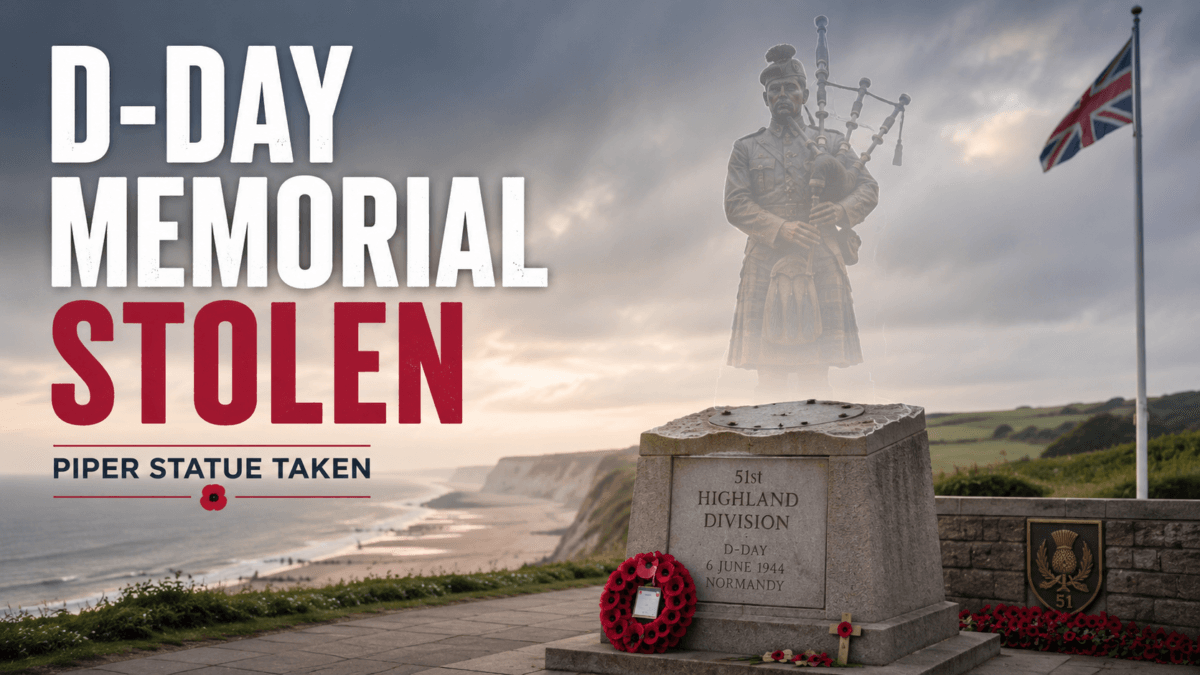
A statue of a piper from the 51st Highland Division was reported stolen from Bréville-les-Monts, a commune north of Caen, just days before D-Day anniversary commemorations. Local officials said the memorial was part of the town’s history and condemned the theft as deeply disrespectful. Reports said the statue was forced from its plinth and likely loaded onto a vehicle, suggesting a planned theft rather than casual vandalism.
The loss matters not only because a bronze statue has disappeared, but because the memorial represented sacrifice during one of the most important military campaigns of the Second World War.
Main Content
What Happened to the Normandy Memorial?
A Statue Disappeared Before D-Day Events
The missing memorial depicted a piper of the 51st Highland Division. It stood in Bréville-les-Monts, near the area where Scottish troops fought in the days after the Normandy landings. According to reports, officials discovered on Friday that the statue had vanished from its base. The timing made the theft especially painful because D-Day commemorations were approaching.
The statue was not a small decorative item. Reports described it as a heavy bronze monument that would have required force, planning, and transport to remove. That has led to concern that the thieves may have targeted it for its metal value.
More Than a Piece of Bronze
To thieves, a bronze statue may look like scrap. To a community, it can represent memory, gratitude, and identity. This memorial stood for soldiers who fought in Normandy when the success of the Allied invasion was still uncertain.
The theft is painful because it removes a visible link between past and present. Visitors may still know what happened at Bréville-les-Monts, but an empty plinth changes the experience. It turns remembrance into absence.
Why the 51st Highland Division Memorial Was Important
The Fighting Around Bréville-les-Monts
The memorial was connected to the fighting around Bois des Monts and Château St Côme. The inscription recorded that on 10 June 1944, the Highland Division attacked from Bois des Monts toward Bréville. It also stated that 110 men were killed in two days during that action and the fighting at Château St Côme.
This was not a symbolic battlefield far removed from danger. The area was heavily contested between German forces and British units, including the 6th Airborne Division and the 51st Highland Division. Europe Remembers notes that the piper memorial honoured the men of the 5th Black Watch and their attack on Bréville from 10 June 1944.
Protecting the Orne Bridgehead
The fighting near Bréville mattered because Allied forces needed to secure their bridgehead after landing in Normandy. The bridgehead around the Orne River and Caen Canal was strategically important. If German forces had broken through in this area, the eastern flank of the Allied landing zone could have been threatened.
The memorial inscription says the Highlanders, though outnumbered and facing fierce counterattacks, helped secure the Orne bridgehead through dedication, courage, and sacrifice.
The Wider Meaning of D-Day
A Turning Point in the War
D-Day, on 6 June 1944, began the Allied invasion of German-occupied Normandy. It was not a single-day story. The beach landings opened the way for a long and brutal campaign across Normandy.
The Commonwealth War Graves Commission estimates that the Allies suffered about 10,250 casualties on D-Day, including around 4,440 killed. The Battle of Normandy continued from June to August 1944, with the Allies suffering more than 226,000 casualties in total.
These numbers are difficult to absorb, which is why memorials matter. A statue, a name on a wall, or a small plaque can make a huge historical event feel personal.
British Sacrifice in Normandy
The British Normandy Memorial records the names of 22,442 individuals who died while serving under British command during D-Day and the Battle of Normandy. Those named include British personnel and people from more than 30 countries serving in British units.
The stolen piper statue belonged to this wider landscape of remembrance. It was one memorial among many, but each one carries a local meaning. Together, these monuments form a map of sacrifice across Normandy.
Why Memorial Theft Feels So Personal
It Damages Trust as Well as Property
When a war memorial is stolen, the damage goes beyond money. A community loses something it cared for. Families of veterans may feel that their relatives’ sacrifice has been insulted. Visitors arriving for commemorations may see not a tribute, but a wound.
This is why such crimes often provoke stronger emotion than ordinary theft. The target is not simply an object. It is shared memory.
The Timing Made the Theft Worse
The theft happened shortly before D-Day commemorations, when Normandy towns prepare to welcome veterans’ families, military representatives, history groups, schoolchildren, and tourists. During this period, memorials become gathering places.
Removing the statue at that moment made the act feel especially cruel. It interrupted remembrance at the exact time when remembrance was most visible.
The Piper as a Symbol
Why a Piper Matters in Highland Military Memory
The image of a piper is strongly connected with Scottish military tradition. In battle, pipers could represent courage, identity, and morale. A piper figure on a memorial is not just a musician. It stands for the Highland regiments’ presence, culture, and sacrifice.
For the 51st Highland Division, the piper symbol carried emotional weight. It linked the soldiers to Scotland while marking the place where many of them died far from home.
A Human Figure Makes History Easier to Feel
Abstract memorials can be powerful, but human figures often connect more immediately with visitors. A statue of a piper gives people something to look at and remember. It suggests a person standing in a dangerous place, carrying tradition into war.
That is why the theft feels like more than the loss of metal. It removed a human-shaped reminder of men who once stood there in real danger.
Challenges in Protecting War Memorials
Bronze Monuments Can Be Targeted
Bronze is durable, beautiful, and historically common in public sculpture. Unfortunately, it also has scrap value. This makes bronze memorials vulnerable, especially if they are in quieter rural areas or open public spaces.
Protecting them can be difficult. Too much security can make a memorial feel like a locked object instead of a public place. Too little protection may leave it exposed.
Rural Memorials Need Special Care
Many important memorials in Normandy are not located in large museums. They stand near fields, roads, villages, farms, woods, and former battlefield positions. These places are historically meaningful because they are close to where events happened.
But that also makes them harder to monitor. Small towns may not have the same security resources as major heritage sites.
Practical Tips for Protecting Local Memorials
Improve Lighting Without Changing the Character of the Site
Good lighting can discourage theft and vandalism, but it should be respectful. Harsh lights can damage the atmosphere of a memorial. Soft, well-placed lighting and motion-sensitive systems may offer a better balance.
Use Discreet Cameras and Community Watch
Security cameras can help, especially in areas where heavy objects could only be removed by vehicle. Local residents, landowners, history groups, and visitors can also play a role by reporting suspicious activity.
Record Memorial Details Carefully
Communities should keep detailed records of memorials, including photographs, measurements, inscriptions, materials, and sculptor information. If a statue is stolen, these records can help police, insurers, heritage groups, and metal dealers identify it.
Work With Scrap Metal Dealers
Authorities can alert scrap yards and metal dealers when bronze memorials are stolen. A one-ton statue or large bronze figure is not easy to hide forever. Quick alerts can increase the chance of recovery.
Teach the Story Behind the Memorial
The more people understand a memorial’s meaning, the more likely they are to protect it. Schools, local guides, museums, veterans’ groups, and tourism boards can help keep these stories alive.
Key Takeaways
A bronze statue of a piper from the 51st Highland Division was reported stolen from Bréville-les-Monts in Normandy.
The theft happened shortly before D-Day anniversary commemorations.
The memorial was connected to the fighting near Bois des Monts and Château St Côme in June 1944.
The memorial inscription recorded that 110 Highlanders were killed in two days during the fighting.
The 51st Highland Division helped secure the Orne bridgehead, an important part of the Allied position in Normandy.
The theft is painful because the statue represented memory, sacrifice, and local history, not just metal.
Protecting war memorials requires security, documentation, community awareness, and respect for their public meaning.
Conclusion
The theft of the Highland piper memorial in Normandy is a reminder that remembrance must be protected. Monuments do not preserve history by themselves. They need communities, visitors, officials, and younger generations to understand why they matter.
The missing statue stood for soldiers who fought in a dangerous and decisive campaign. It honoured men who crossed into battle, held ground under pressure, and helped secure the Allied foothold in Normandy. Its removal leaves an empty space, but not an empty memory.
If the statue is recovered, it will return with even greater meaning. If it must be replaced, the new memorial should carry the same message: sacrifice should not be forgotten, and the people who gave their lives for freedom deserve more than silence.