
Delhi’s air pollution is usually discussed in the language of crisis. For many residents, the city’s winter smog, burning eyes, morning haze, and health warnings have become an uncomfortable part of daily life. That is why any improvement in air quality gets public attention. But it also needs careful interpretation.
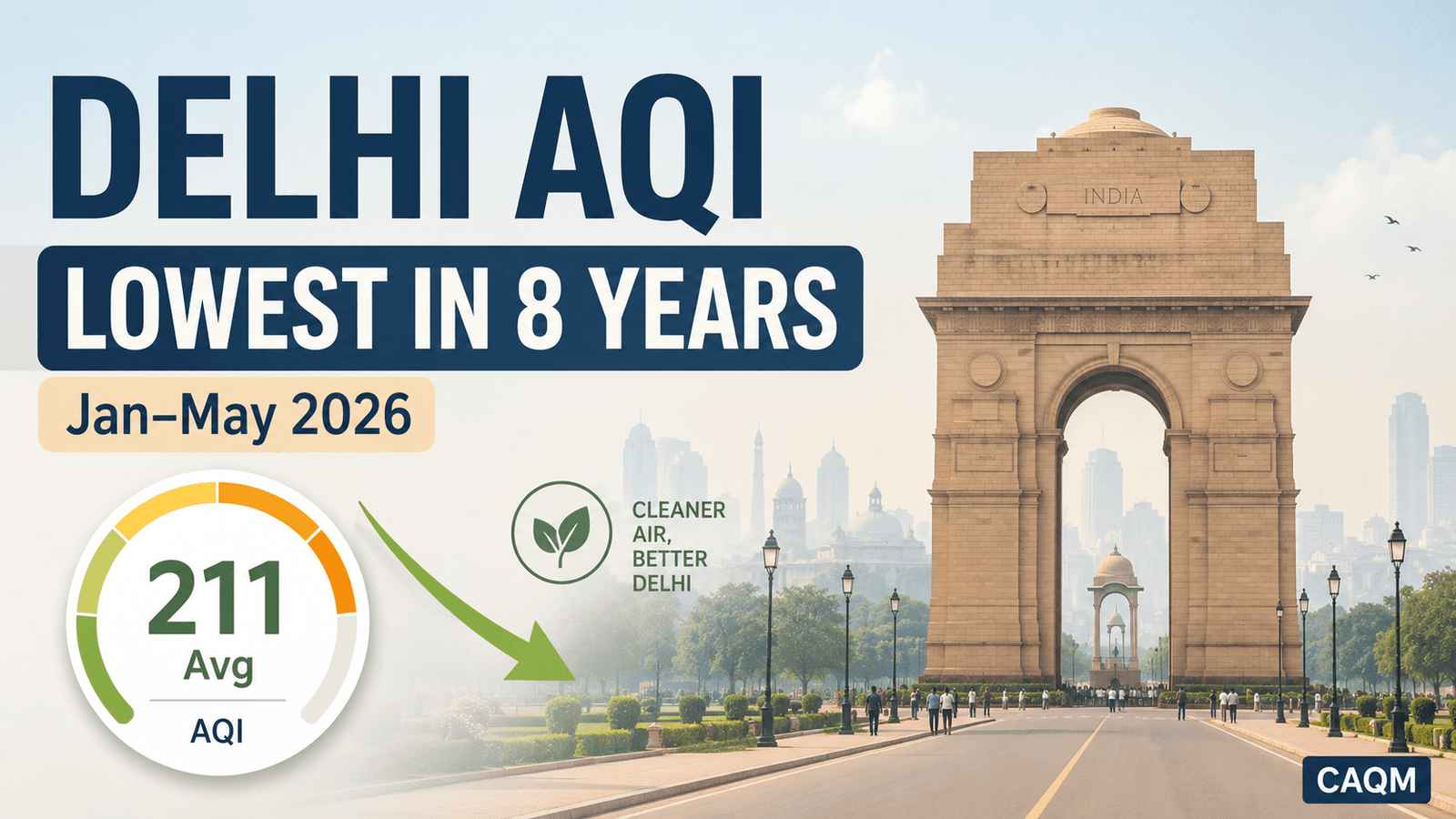
The Commission for Air Quality Management said Delhi’s average Air Quality Index for January to May 2026 was 211, the lowest for this period in eight years, except for 2020, when Covid-related restrictions sharply reduced pollution from traffic and economic activity. The figure was slightly better than 214 in 2025, 231 in 2024, 213 in 2023, 238 in 2022, 235 in 2021, 237 in 2019, and 243 in 2018.
This is positive news, but it does not mean Delhi’s air has become clean. An average AQI of 211 still falls in the “Poor” range under India’s air-quality scale. The real story is more balanced: Delhi has shown measurable improvement, but the city still has a long road ahead before residents can regularly breathe healthy air.
Understanding the AQI Improvement
What AQI Means in Simple Terms
The Air Quality Index, or AQI, is a number used to explain air pollution in a way ordinary people can understand. Instead of showing separate readings for pollutants such as PM2.5, PM10, nitrogen dioxide, sulphur dioxide, carbon monoxide, ozone, ammonia, and lead, AQI converts the air-quality situation into one value and category. CPCB describes AQI as a communication tool that turns complex air-quality data into a single number, colour, and health-based category.
India’s AQI categories are: Good, Satisfactory, Moderately Polluted, Poor, Very Poor, and Severe. This matters because a lower AQI is better, but not every improvement means the air is safe for everyone.
Why 211 Is Better, But Still Not Good
Delhi’s January-May 2026 average AQI of 211 is an improvement compared with several previous years. However, the number still sits just inside the “Poor” category, which usually means people may experience breathing discomfort, especially after prolonged exposure.
This is why the result should be understood as progress, not victory. The city has moved in the right direction, but the air is still not healthy enough to be called clean.
What the CAQM Data Shows
Delhi Had More Better-Air Days
CAQM also said Delhi recorded 75 “Good to Moderate” AQI days during January-May 2026. This was higher than 70 such days in 2025 and much better than 37 in 2022. The same count was 75 in 2024, 74 in 2023, 59 in 2021, 98 in the unusual lockdown year of 2020, 59 in 2019, and 44 in 2018.
This trend is important because residents feel air quality through daily experience, not only through averages. More days in the better categories mean more mornings when children can go outdoors more comfortably, more evenings when walking feels easier, and fewer days when the city feels trapped under thick pollution.
May 2026 Saw Noticeable Relief
May also brought better air compared with Delhi’s usual pollution pattern. Reports noted that Delhi’s average AQI in May 2026 was around 157, which is in the moderate range and among the better May readings of recent years, excluding unusual pandemic-linked periods.
Weather likely played a role too. Rain, wind speed, dust movement, and temperature conditions can strongly affect daily AQI. Earlier in May, CAQM revoked GRAP Stage-I restrictions after Delhi’s AQI improved from 175 on May 3 to 88 on May 4, helped by rain and favourable weather conditions.
Why Delhi’s Air May Be Improving
Better Monitoring and Enforcement
One reason for improvement could be stricter monitoring of pollution sources. Delhi-NCR has seen repeated action against construction dust, industrial emissions, diesel generator use, open burning, and heavily polluting vehicles.
When rules are enforced regularly, even small improvements across many sectors can lower pollution levels. Dust control at construction sites, cleaner fuels in industries, better waste management, and checking old vehicles may not create dramatic change in one day, but they can gradually reduce the pollution load.
Weather Helped, But Policy Still Matters
It is important not to give all credit to policy alone. Weather has a major influence on Delhi’s AQI. Rain can wash pollutants out of the air. Strong winds can disperse pollution. On the other hand, calm winds and temperature inversion can trap pollutants close to the ground.
That means a good AQI period may come from both human action and favourable meteorology. The challenge is to make improvements strong enough that Delhi performs better even when weather conditions are not helpful.
Regional Pollution Control Is Essential
Delhi’s air does not depend only on activities inside Delhi. Pollution travels across borders. NCR towns, industries, highways, construction zones, crop-residue burning, and dust from surrounding regions all influence the capital’s air.
This is why CAQM’s regional role matters. Air pollution cannot be solved by one city government alone. It needs coordination between Delhi, Haryana, Uttar Pradesh, Rajasthan, central agencies, local bodies, industries, and citizens.
What This Means for Delhi Residents
Cleaner Days Can Improve Daily Life
Even moderate improvement can make a real difference. Fewer high-pollution days can reduce irritation in the eyes and throat, make outdoor activity more comfortable, and reduce stress for people with asthma, bronchitis, heart disease, or allergies.
For schools, workplaces, and families, better AQI days also mean fewer disruptions. Children can play outside more often, morning walkers can return to parks, and people may feel less dependent on masks and air purifiers during certain periods.
Sensitive Groups Still Need Protection
Despite the improvement, Delhi’s air remains a health concern. Children, elderly people, pregnant women, outdoor workers, and people with lung or heart conditions should still track daily AQI before planning long outdoor activities.
An average AQI of 211 means many days may still be unhealthy. The improvement is encouraging, but it should not create a false sense of safety.
Challenges Delhi Still Faces
Winter Pollution Remains the Biggest Test
January-May data gives only part of the picture. Delhi’s most difficult air-quality months often come later in the year, especially around October, November, December, and parts of January. During this period, lower temperatures, calm winds, firecracker emissions, farm-fire smoke, traffic, and local pollution can combine to create severe smog.
A better start to 2026 is encouraging, but the real test will be whether Delhi can maintain progress during the winter pollution season.
“Poor” Air Cannot Become the New Normal
One danger with air-quality discussions is that people may start accepting “poor but better than before” as success. That would be a mistake. A city should not treat poor air as normal simply because earlier years were worse.
The goal should be to move Delhi toward more “Satisfactory” and “Good” days, not only fewer “Very Poor” and “Severe” days.
Practical Tips for Residents
Check AQI Before Outdoor Activity
Before jogging, cycling, sending children outdoors, or planning sports activities, check the day’s AQI. If the air is poor or worse, reduce intense outdoor exercise, especially near traffic-heavy roads.
Reduce Indoor Pollution
Outdoor air gets attention, but indoor air also matters. Avoid burning incense or mosquito coils in closed rooms for long periods. Keep kitchens ventilated while cooking. Clean dust regularly, especially in homes near roads or construction sites.
Use Masks During Bad-Air Days
A good-quality mask can help reduce exposure during high-pollution days, especially for people who travel by bike, work outdoors, or spend time in traffic.
Support Cleaner Local Habits
Do not burn waste. Report open garbage burning or visible dust violations where possible. Use public transport, carpooling, or cleaner mobility options when practical. Small actions cannot solve Delhi’s pollution alone, but they support wider change.
Key Takeaways
Delhi’s average AQI for January-May 2026 was 211, the lowest for this period in eight years, except for the Covid-lockdown year 2020.
The improvement is real, but AQI 211 still falls in the “Poor” category.
Delhi recorded 75 “Good to Moderate” AQI days during January-May 2026, better than 2025 and many previous years.
Weather conditions, pollution-control actions, and regional coordination all likely contributed to the improvement.
The biggest challenge will be maintaining progress during the winter pollution season.
Residents should continue checking daily AQI and taking health precautions during poor-air days.
Conclusion
Delhi’s improved January-May 2026 AQI is a welcome sign. It shows that the city’s air quality can move in the right direction when pollution-control measures, monitoring, and favourable weather come together. For residents tired of smog and health warnings, even a modest improvement brings some hope.
But hope should not turn into complacency. Delhi’s average AQI of 211 is still poor, and the city remains far from consistently safe air. The latest CAQM data should be treated as a step forward, not a finish line.
The real success will come when Delhi can reduce pollution across seasons, not just during relatively favourable months. Cleaner transport, dust control, industrial compliance, better waste management, regional cooperation, and public awareness must continue. Delhi has shown improvement in early 2026. Now the challenge is to turn that improvement into a lasting change that people can feel with every breath.