
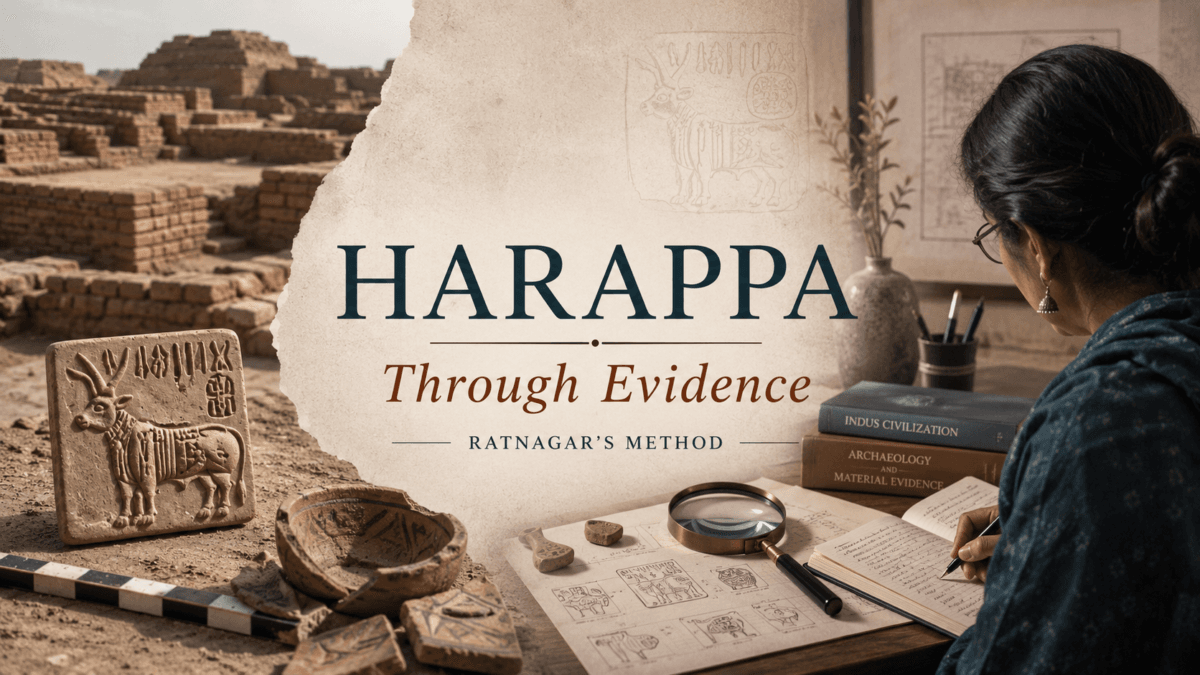
Harappa is often introduced as a mystery: an ancient civilization with planned cities, seals, weights, drains, craft workshops, and an undeciphered script. Because the script remains unread, people sometimes rush to fill the silence with imagination. They call a figurine a goddess, a small statue a priest-king, or a seal a direct link to later religion. Shereen Ratnagar’s way of interpreting Harappa was different. She asked readers to slow down, look carefully at the evidence, and separate what archaeology can show from what we only wish to believe.
Ratnagar, one of India’s leading scholars of the Harappan civilization, died in Mumbai in May 2026 at the age of 82. Her major works included Encounters: The Westerly Trade of the Harappan Civilisation, Harappan Archaeology: Early State Perspectives, and The End of the Great Harappan Tradition. She taught at Jawaharlal Nehru University and later continued as an independent researcher.
Understanding the Shereen Ratnagar Approach
Evidence Comes Before Emotion
The most important part of Ratnagar’s method was her loyalty to evidence. She did not treat Harappa as a place for national pride, fantasy, or easy claims. For her, archaeology was not about making the past sound grand. It was about asking what the material remains actually allow us to say.
This matters because the Harappan civilization attracts many strong claims. Some people want it to prove a modern identity. Some want it to show an ideal peaceful society. Others want to connect every object with later religious traditions. Ratnagar’s method resisted such shortcuts. She showed that good history is not weakened by caution. In fact, it becomes stronger.
Harappa as a Social World, Not Just a Set of Ruins
Looking Beyond Bricks and Seals
Many introductions to Harappa focus on famous objects: the “Dancing Girl,” the so-called “Priest-King,” seals, beads, and the Great Bath. Ratnagar did not ignore these objects, but she wanted readers to ask social questions about them. Who made them? Who used them? What kind of labour, authority, trade, and planning made them possible?
Harappan settlements show signs of complex organization. NCERT’s discussion of Harappan society notes the uniformity of pottery, seals, weights, and bricks, as well as the mobilization of labour for bricks, walls, and platforms. These are not small matters. They suggest planning, coordination, and authority, even if the exact political structure remains debated.
The “Human Angle” in Archaeology
Ratnagar’s work is especially valuable because she treated Harappan society as a world of people, not simply a collection of museum objects. A review of her Harappan Archaeology: Early State Perspectives notes that she foregrounded the agency of inhabitants and explored the “human angle” behind house blocks, chert blade distribution, water access, and political organization.
This approach makes Harappa easier to understand. Instead of asking only, “What is this object?” we ask, “What kind of society needed this object?” A seal may point to trade, ownership, administration, or identity. A bead workshop may reveal skill, labour, and demand. A drain may show not only engineering, but also shared rules about urban life.
Questioning Popular Labels
The Problem With the “Priest-King”
One of Ratnagar’s strengths was her willingness to question names that sound familiar but rest on weak evidence. The famous small male sculpture from Mohenjo-daro is widely called the “Priest-King.” But this label says more about early archaeologists’ assumptions than about proven Harappan reality.
NCERT explains that the statue was labelled in this way partly because archaeologists were familiar with Mesopotamian “priest-kings,” even though Harappan ritual practices are not well understood and there is no firm way to know whether ritual specialists held political power.
Ratnagar’s method teaches a simple lesson: names can become traps. Once an object is called a “priest-king,” readers may imagine a monarchy, priesthood, palace, and temple system. But the object itself does not prove all of that. A careful historian must ask whether the label is supported by evidence or merely repeated by habit.
Mother Goddess, Proto-Shiva, and Other Easy Answers
Harappan religion is another area where caution is necessary. Early interpretations often described female terracotta figurines as “mother goddesses” and some seal images as “proto-Shiva.” These ideas became popular because they seem to create a clear bridge between Harappa and later Indian religious traditions.
But archaeology does not work by desire. NCERT notes that reconstructions of Harappan religion often depend on later traditions, and while such comparison may be plausible for everyday objects like querns and pots, it becomes much more speculative when applied to religious symbols.
Ratnagar’s way was not to deny all religious meaning. Rather, she asked for better reasoning. A figurine may have been used in a household ritual, a healing practice, a social ceremony, a toy-like context, or something else entirely. Without clear evidence, the honest answer may be: we do not yet know.
Trade, Comparison, and the Wider Bronze Age World
Harappa Was Not Isolated
Ratnagar’s training in Mesopotamian studies shaped her reading of Harappa. She studied archaeology at Deccan College and later specialized in Mesopotamian studies at the Institute of Archaeology in London. Her doctoral work explored possible exchanges between communities of West and South Asia in the third millennium BCE.
This background helped her place Harappa in a wider Bronze Age world. She did not treat the civilization as sealed off from outside influence. Trade, movement, and comparison mattered. That does not mean Harappa was dependent on Mesopotamia. It means ancient societies, like modern ones, often learned, exchanged, adapted, and responded to one another.
Comparison Without Cultural Insecurity
Ratnagar’s comparative approach is useful because it avoids two extremes. One extreme says everything important came from outside. The other says outside influence is insulting and must be rejected. Ratnagar rejected both. In a Harappa.com interview, she argued that influence from elsewhere should not be seen as demeaning; it can show openness and broad-mindedness.
This is a mature way to understand civilization. Cultures do not become smaller because they interact. They often become richer, more flexible, and more creative.
Rethinking the Scale of Harappa
Vast Does Not Mean Simple
Harappa covered an enormous region, but Ratnagar warned against using scale carelessly. In a Sahapedia interview, she explained that the civilization stretched across a wide zone from Balochistan and the Indus region toward Kutch, Gujarat, and Saurashtra. At the same time, she pointed out that the actual number and size of clearly Harappan settlements should be defined carefully, rather than inflated by including every related or neighbouring site.
This is another example of her careful method. She did not reduce Harappa’s importance. She made that importance more precise. A civilization does not need exaggerated numbers to be impressive. Its real achievements are strong enough when described honestly.
The End of the Harappan Tradition
Decline as Transformation
The end of Harappan urban life is often described dramatically, as though a great civilization suddenly collapsed. Ratnagar’s work encouraged more thoughtful explanations. Instead of searching for one simple cause, she paid attention to trade changes, social organization, settlement shifts, and the weakening of urban systems.
NCERT notes that by around 1800 BCE many Mature Harappan sites in some regions had been abandoned, while population expanded into areas such as Gujarat, Haryana, and western Uttar Pradesh. It also notes the disappearance of distinctive features such as weights, seals, special beads, writing, long-distance trade, and craft specialization after 1900 BCE in many continuing settlements.
This suggests not a single instant disaster, but a long transformation. The cities changed, networks weakened, and older forms of urban life no longer continued in the same way.
Practical Tips for Students Reading Harappa
Ask What the Evidence Actually Shows
Before accepting any claim, ask: what object, site, layer, or pattern supports it? A strong interpretation should connect clearly to material evidence.
Be Careful With Famous Labels
Words like “priest-king,” “mother goddess,” and “proto-Shiva” are easy to remember, but they may carry assumptions. Use them with caution.
Compare, But Do Not Copy-Paste
Comparing Harappa with Mesopotamia, Egypt, or other early civilizations can be useful. But comparison should clarify evidence, not force one civilization into another’s model.
Accept Uncertainty
A good historical answer does not always sound dramatic. Sometimes the most honest answer is that the evidence is incomplete. Ratnagar’s scholarship shows that uncertainty is not failure. It is part of responsible thinking.
Key Takeaways
Shereen Ratnagar interpreted Harappa through evidence, social context, and careful comparison.
Her work challenged simple labels and unsupported claims about Harappan religion and politics.
She treated Harappa as a living social world shaped by labour, trade, authority, craft, and everyday people.
Her approach reminds readers that ancient history should not be used for modern pride without proof.
Her method remains valuable for students, writers, and anyone interested in understanding the Indus civilization responsibly.
Conclusion
Shereen Ratnagar’s way of interpreting Harappa was clear, disciplined, and deeply humane. She did not make the civilization smaller by questioning myths around it. She made it more real. Her Harappa was not a fantasy land of perfect peace, mysterious gods, and convenient modern connections. It was a complex Bronze Age society with cities, workers, traders, rulers or administrators, craftspeople, households, symbols, and unanswered questions.
That is why her work continues to matter. In a time when the past is often simplified for emotion or politics, Ratnagar’s method offers a better path. Look closely. Ask hard questions. Respect the evidence. Admit uncertainty. And above all, remember that archaeology is not about forcing the past to speak our language. It is about listening carefully to what the past can still say.