
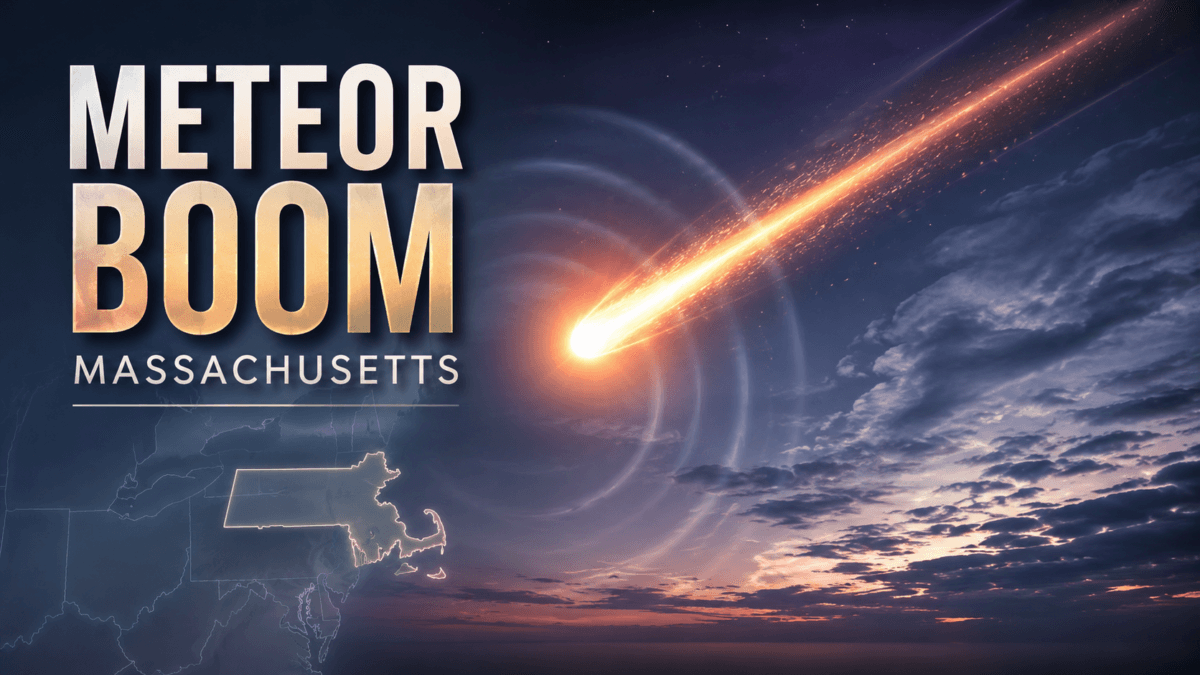
A quiet Saturday afternoon turned startling for many people in Massachusetts when a sudden boom rolled through parts of New England. For a few seconds, residents wondered whether they had felt an earthquake, heard an explosion, or witnessed something even more unusual. Reports quickly spread from people who heard loud blasts, felt buildings shake, or saw a bright streak in the daytime sky.
The cause was later identified as a meteor that entered Earth’s atmosphere and exploded high above the region. The event happened around 2:06 p.m. EDT on May 30, 2026, over northeastern Massachusetts and southeastern New Hampshire. NASA estimated that the meteor was traveling about 75,000 miles per hour and broke apart roughly 40 miles above the ground, releasing energy equal to about 300 tons of TNT.
What Happened Over Massachusetts?
A Meteor Entered the Atmosphere at High Speed
The object was a small space rock, roughly three feet wide, according to reports citing NASA and the American Meteor Society. It entered the atmosphere near the Massachusetts-New Hampshire border and created a bright fireball before breaking apart.
Although three feet may sound small, speed changes everything. A rock moving at tens of thousands of miles per hour carries enormous energy. When it hits Earth’s atmosphere, air pressure and heat build quickly around it. The object can glow brightly, fragment, and sometimes explode before reaching the ground.
That is what appears to have happened in this case. The meteor did not simply pass quietly through the sky. It broke apart with enough force to produce loud sonic booms heard across parts of the region.
Why the Boom Was So Loud
The loud sound was not caused by a ground explosion. It was a sonic boom produced when the meteor traveled faster than the speed of sound and then fragmented high in the atmosphere.
People often associate sonic booms with jets, but fast-moving natural objects can create them too. A meteor moving at extreme speed compresses the air in front of it. When that pressure wave reaches the ground, people may hear a sharp boom, a rumble, or even a double blast.
NASA said the energy released during the breakup explains why the sound was so strong. Some residents reported shaking, which led many to first suspect an earthquake. The U.S. Geological Survey later indicated that the shaking was not from an earthquake but from a widely felt sonic boom linked to a suspected bolide.
Understanding the Science Behind the Event
Meteor, Meteoroid, or Meteorite?
Space events can be confusing because similar words are used for different stages of the same object.
A meteoroid is a small rocky or metallic object while it is still in space. When it enters Earth’s atmosphere and burns brightly, it becomes a meteor. If any part survives the journey and lands on the ground, it is called a meteorite. NASA explains this difference clearly in its educational material on meteors and meteorites.
In the Massachusetts event, the object was called a meteor or fireball because it became visible as it entered the atmosphere. If any surviving pieces reached the surface, those pieces would be meteorites. However, early reports suggested that much of the material likely burned up or may have fallen into the ocean.
What Is a Fireball or Bolide?
A fireball is an unusually bright meteor. NASA’s Center for Near Earth Object Studies describes fireballs as bright meteor events caused by objects entering Earth’s atmosphere at high velocity.
A bolide is often used to describe a bright meteor that explodes in the atmosphere. That term fits this event because the object fragmented and produced a powerful boom. For people on the ground, the experience can feel sudden and alarming, especially when the sky appears normal moments before.
Why People Mistook It for an Earthquake or Explosion
The Sound Reached the Ground Before Many People Understood What They Saw
Most people do not expect a meteor explosion in the middle of the day. At night, a bright streak in the sky is easier to notice. During daylight, many people may hear the boom without seeing the fireball.
That creates confusion. If a house shakes or windows rattle, the first thoughts are usually local: construction, thunder, a gas explosion, military aircraft, or an earthquake. In this case, the sound was regional, and reports came from many communities. That wide pattern helped experts identify it as an atmospheric event rather than a local emergency.
The Event Was Detected by More Than Eyewitnesses
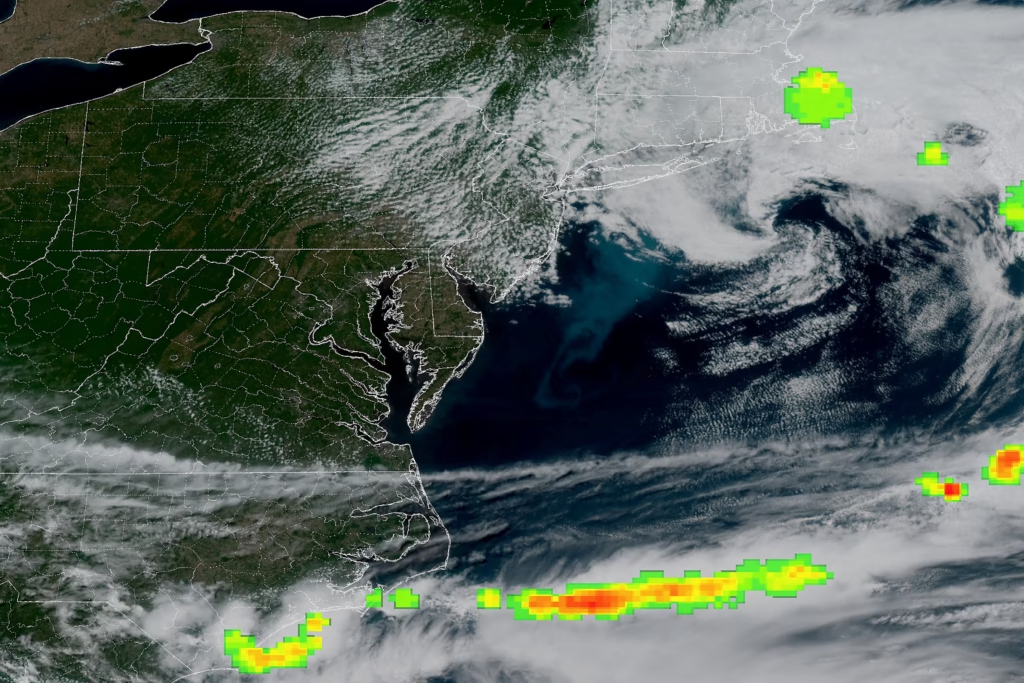
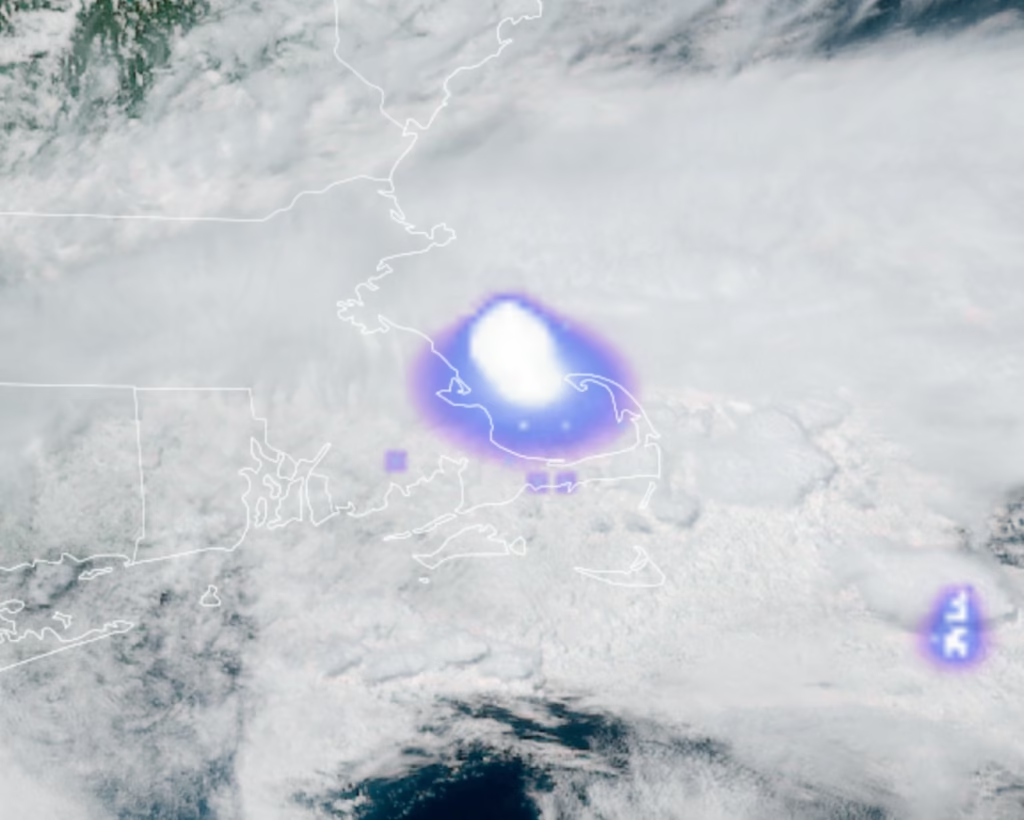
The meteor was not confirmed only through social media posts. It was also detected by observers and NOAA’s GOES-19 satellite, which helped confirm that a bright fireball had occurred.
This matters because modern meteor detection often combines several sources: eyewitness reports, satellite data, seismic sensors, acoustic signals, and camera footage. Together, these tools help scientists estimate speed, altitude, direction, and possible breakup location.
Was the Massachusetts Meteor Dangerous?
The Risk to People Was Low
Based on available reports, the meteor exploded high above the ground. A breakup altitude of about 40 miles means the event happened far above airplanes, buildings, and people. That height greatly reduced the chance of direct damage.
There were no immediate reports of major damage connected to the event. Reports also suggested that if any fragments survived, they may have landed in the ocean or disintegrated before reaching the ground.
Small Meteors Usually Burn Up
Earth is constantly encountering dust, pebbles, and small rocks from space. Most burn up harmlessly in the atmosphere. Only a small number survive long enough to become meteorites.
The Massachusetts meteor was unusual because it was bright, loud, and widely noticed in daylight. But the basic process is natural. NASA said this fireball was not linked to an active meteor shower and was not space debris or a satellite re-entry.
That detail is important because many people worry about falling satellites or human-made debris when they hear about objects streaking across the sky. In this case, experts identified it as a natural object.
Why This Event Matters
It Shows How Active Earth’s Atmosphere Is
The atmosphere does more than provide air and weather. It also acts as a protective shield. Small objects from space often burn, break, or explode high above the surface before they can cause harm.
The Massachusetts event is a clear example of that protection. A fast-moving rock entered at high speed, released a large amount of energy, and still did not become a major disaster because the atmosphere absorbed and scattered much of the impact.
It Helps Scientists Study Space Rocks
Events like this give scientists useful data. A meteor that is seen by witnesses, captured by satellite, and detected by instruments can help researchers better understand how small space rocks behave.
Scientists can study how the object broke apart, how much energy it released, and whether any fragments survived. These details are useful for planetary defense research, meteorite studies, and public safety planning.
Even a small meteor can teach important lessons when it is well observed.
Practical Tips: What to Do If You Hear a Loud Boom or See a Fireball
Stay Calm and Check for Immediate Danger
If you hear a sudden boom, first check your surroundings. Look for broken glass, smoke, fire, or signs of local danger. If there is damage or a safety risk, contact emergency services.
If there is no visible danger, avoid spreading unconfirmed claims. Loud booms can come from many sources, and early rumors often create unnecessary panic.
Note the Time and Direction
If you saw a bright streak, write down the exact time, direction, color, brightness, and how long it lasted. These details can help meteor organizations and scientists reconstruct the event.
For example, a report that says “I saw a bright green-white streak moving from west to east at 2:06 p.m.” is more useful than simply saying “I saw something in the sky.”
Check Trusted Sources
Look for updates from official agencies, local emergency management offices, weather services, NASA, the U.S. Geological Survey, or respected news outlets. During fast-moving events, reliable information may take time to appear.
Report a Fireball Sighting
If you clearly saw the meteor, consider reporting it to a recognized meteor tracking organization. Public reports help scientists map the path of the object and estimate whether fragments may have reached the ground.
Common Questions About the Massachusetts Meteor
Did It Hit the Ground?
There was no confirmed major ground impact in early reports. Experts suggested that most of the object likely burned up, and any surviving fragments may have fallen into the ocean.
Was It Part of a Meteor Shower?
No. NASA said the fireball was not associated with any currently active meteor shower. It was described as a natural object, not a satellite or re-entering space debris.
Why Was It Seen During the Day?
Very bright meteors can be visible in daylight, although they are less common for casual observers to notice. A daytime fireball needs to be bright enough to stand out against sunlight. That is one reason this event attracted attention.
Could This Happen Again?
Yes. Meteors enter Earth’s atmosphere every day, but most are too small or too faint to notice. Loud, daylight fireballs are less common, but they are natural events and can happen anywhere.
Key Takeaways
The loud booms heard across parts of Massachusetts and New England were caused by a meteor exploding high in the atmosphere.
The event happened around 2:06 p.m. EDT on May 30, 2026.
NASA estimated the meteor was traveling about 75,000 miles per hour and broke apart about 40 miles above the ground.
The energy released during the breakup was estimated at about 300 tons of TNT.
The event was not an earthquake, satellite re-entry, or known meteor shower.
No major damage was immediately confirmed, and any surviving fragments likely burned up or fell into the ocean.
The event shows how Earth’s atmosphere protects the surface from many small space objects.
Conclusion
The meteor that exploded over Massachusetts was sudden, loud, and unsettling, but it was also a powerful reminder of the natural activity happening above us every day. A small rock from space entered the atmosphere at incredible speed, turned into a bright fireball, and broke apart high above the ground. For people below, it arrived as a mysterious boom. For scientists, it became a useful event to study.
The most important lesson is that not every loud boom is an earthquake or man-made explosion. Sometimes, the cause comes from far beyond Earth. Thanks to satellites, sensors, eyewitness reports, and scientific analysis, experts were able to explain what happened and reduce confusion.
For residents who heard the sound, the moment may be remembered as a strange afternoon shock. For the wider public, it is a chance to better understand meteors, the atmosphere, and the quiet protection our planet receives every day.