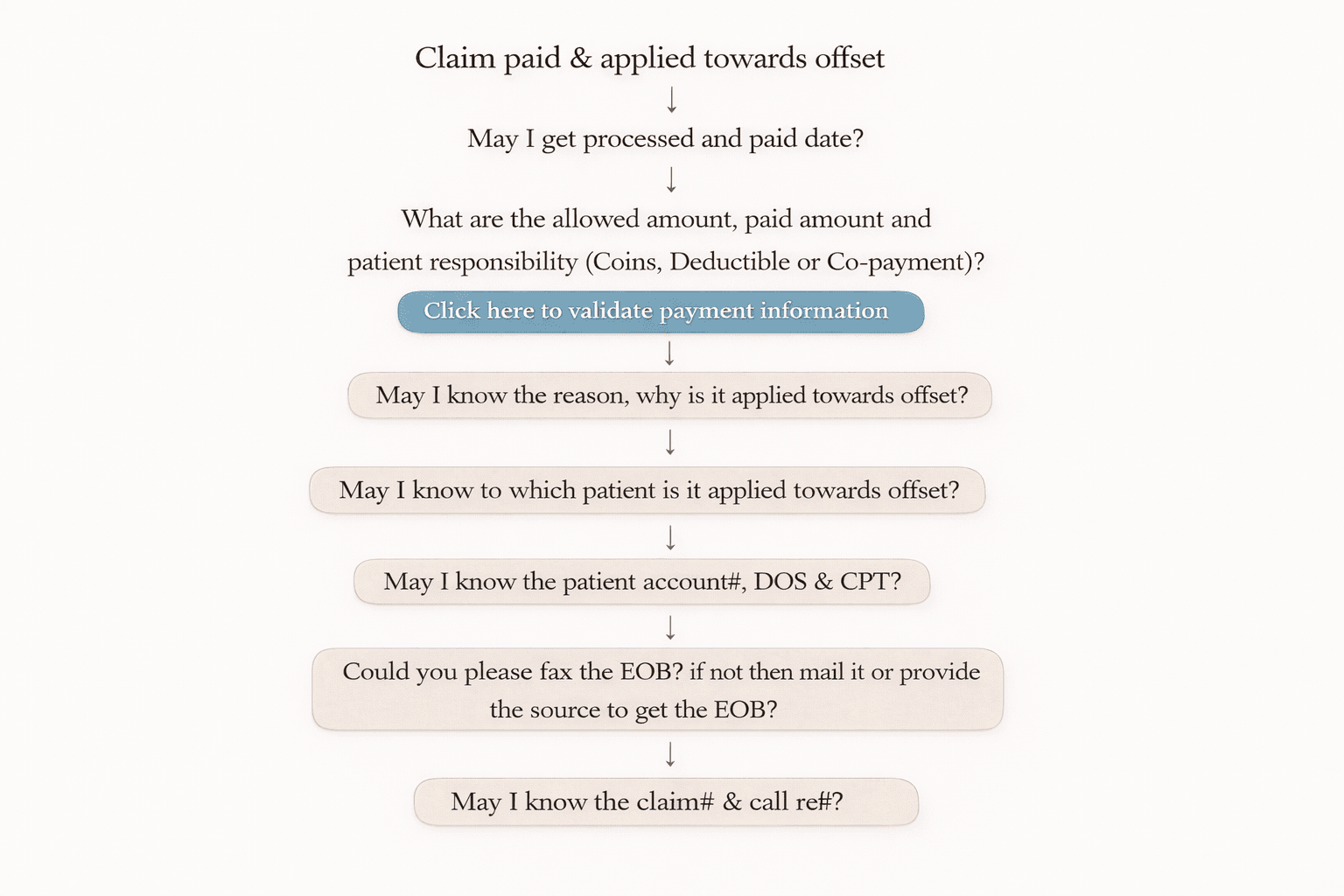
Claim Paid and Applied Towards Offset – Simple Explanation (With Call Guide)
In medical billing, sometimes we see a claim status that says:
“Claim paid and applied towards offset.”
At first glance, this can look confusing because it feels like the insurance has paid the claim — but no payment is received. Let’s understand what this actually means and how to handle it correctly.
What Does “Paid and Applied Towards Offset” Mean?
This scenario happens when:
- The insurance company had already paid extra money to the provider in the past (overpayment).
- Now, instead of sending payment for the current claim, insurance uses this new claim amount to recover (adjust) the previous overpayment.
- So the claim shows as processed and paid, but the payment is not released, because it is adjusted against the previous extra amount.
In short:
Insurance is not paying now because they are deducting this amount from the extra money they paid earlier.
On-Call Scenario: What to Ask Insurance
When you call the insurance payer, follow this sequence to gather correct information:
1) Confirm Processed and Paid Date
Start by asking:
“May I get the processed and paid date?”
This confirms when the claim was officially completed.
2) Confirm Payment Details
Then ask for financial breakdown:
“What are the allowed amount, paid amount, and patient responsibility?”
Patient responsibility can include:
- Coinsurance
- Deductible
- Co-payment
This helps you understand the claim adjudication properly.
3) Ask Why It Was Applied to Offset
Now address the main issue:
“May I know the reason why it is applied towards offset?”
This gives you the explanation from payer side (previous over-payment, recoupment, recovery).
4) Identify Which Patient the Offset Was Applied To
Important step:
“May I know to which patient it is applied towards offset?”
Because sometimes offset is linked to a different patient/account, not the current claim.
5) Ask for Patient Account Details (Old Offset Claim)
Ask insurance to provide:
- Patient Account Number
- DOS (Date of Service)
- CPT code
“May I know the patient account#, DOS, and CPT?”
This is needed for reconciliation and posting.
6) Request EOB (Most Important)
EOB is mandatory for documentation and posting.
Ask:
“Could you please fax the EOB? If not, then mail it or provide the source to obtain the EOB?”
Without EOB, the offset posting is difficult to justify internally.
7) Capture Claim # and Call Reference
Finally, collect identifiers for follow-up:
“May I know the claim number and call reference number?”
Always note these in the account notes.
Important Notes & Actions
Based on process, take appropriate action:
If You Receive the EOB:
- Note the related patient account
- Send EOB for posting
- Offset can be properly applied in the billing system
If You Don’t Receive the EOB:
- Note the account
- Mention “EOB not received”
- Follow-up as per internal workflow
Conclusion
“Paid and applied towards offset” does not mean new payment is issued.
It means:
Insurance adjusted the current claim payment against a previous overpayment.
If handled properly — especially by collecting EOB and offset patient details — this scenario can be cleared smoothly without revenue loss.